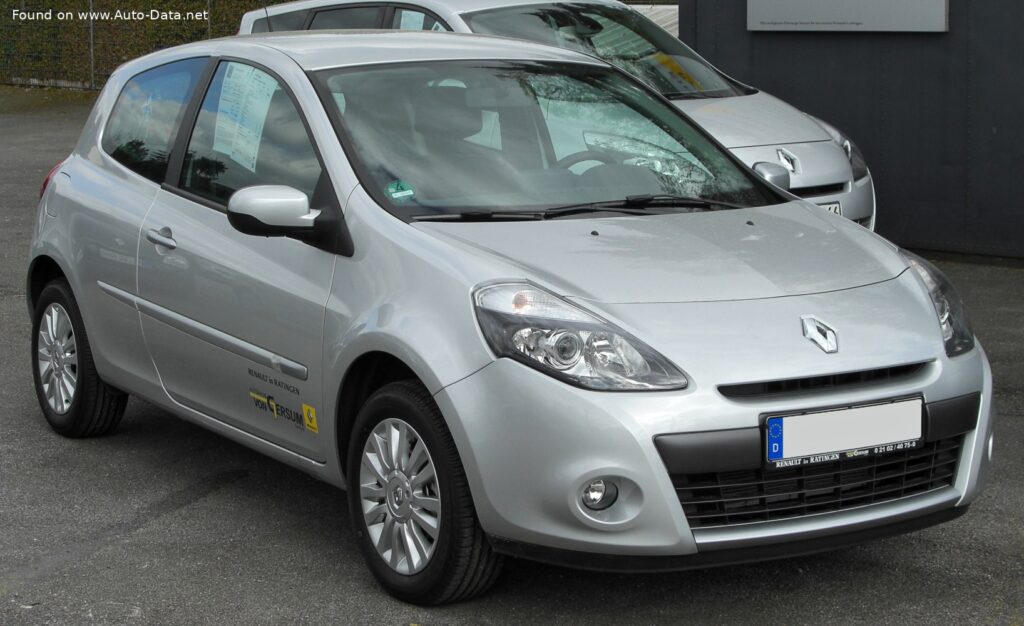
The Renault Clio III (Phase II, 2009) 3-door 1.5 dCi (86 Hp) Quickshift represents a significant iteration of one of Europe’s most enduring and popular subcompact vehicles, known in many markets as a “supermini.” Introduced in May 2009 as part of the Clio III’s mid-cycle refresh (Phase II), this particular variant combined a highly efficient diesel powertrain with an automated manual transmission, aiming to deliver an economical and practical driving experience for the bustling urban and suburban landscapes of its primary European markets. As a model not directly sold in the United States, understanding the Clio III requires an appreciation for its role within the highly competitive European B-segment, where it consistently vied for top sales positions against rivals like the Volkswagen Polo and Ford Fiesta.
The Clio III Phase II: Positioning and Overview
The Clio III, launched initially in 2005, built upon the immense success of its predecessors, evolving the design language and significantly enhancing safety and comfort features for its class. The Phase II facelift, produced from 2009 to 2010, brought subtle exterior revisions, updated interior materials, and refined powertrain options to keep the model fresh against a new wave of competitors. This 3-door hatchback configuration, with its compact dimensions and agile handling, was specifically tailored for the narrow streets and dense traffic often found in European cities, while still offering enough versatility for longer journeys. The 1.5 dCi 86 Hp Quickshift trim occupied a mid-range position within the Phase II lineup, offering a balance between affordability and convenience. It sat below the more powerful diesel variants (like the 90 hp manual) and above the base petrol engines in terms of price and performance.
Powertrain & Engine Architecture
At the heart of this particular Renault Clio III (Phase II, 2009) 3-door 1.5 dCi (86 Hp) Quickshift model was Renault’s ubiquitous K9K 766 1.5-liter dCi (direct Commonrail injection) diesel engine. This four-cylinder inline powerplant, renowned for its efficiency and robust nature, featured a single overhead camshaft (SOHC) controlling two valves per cylinder. Bolstered by a turbocharger and intercooler, it produced a respectable 86 horsepower at 3750 rpm. More critically for a diesel of its size, it generated a robust 147.51 lb.-ft. (200 Nm) of torque from a low 1900 rpm, providing ample low-end grunt for city driving and effortless cruising. The engine utilized a Delphi Common Rail direct injection system, delivering precise fuel metering for optimal combustion and reduced emissions.
Power was delivered to the front wheels via Renault’s “Quickshift” automated manual transmission, a 5-speed unit that offered the convenience of an automatic without the traditional torque converter, often resulting in better fuel economy than a conventional automatic of the era. This transmission operates using actuators to shift gears, controlled by the vehicle’s computer. While automated manuals typically require a slight adjustment period for drivers due to their characteristic shift feel, the Quickshift aimed to bridge the gap between manual engagement and automatic ease, particularly in stop-and-go traffic. The Quickshift transmission featured a creep function, mimicking the behavior of a traditional automatic in slow-moving situations.
Driving Characteristics
In real-world conditions, the Clio III 1.5 dCi Quickshift offered a comfortable and economical driving experience. The low-end torque of the 1.5 dCi engine made it particularly well-suited to urban environments, providing brisk acceleration from low speeds without the need for frequent gear changes. The Quickshift transmission, while not as refined as a modern dual-clutch gearbox, provided smooth enough shifts for everyday driving. Compared to the manual transmission versions of the same engine, the Quickshift offered increased convenience, especially in congested traffic. However, it did result in a slight performance deficit, with the 0-60 mph time being approximately 14 seconds, and a top speed of 108.12 mph (174 km/h). The gear ratios were optimized for fuel efficiency, with taller gearing in higher gears to reduce engine speed at cruising speeds. Compared to the higher-output 1.5 dCi variants, this 86 hp version felt less eager to rev, prioritizing fuel economy over outright performance.
Equipment & Trim Levels
The Clio III Phase II 1.5 dCi 86 Hp Quickshift typically came equipped with a reasonable level of standard features. These included power steering, central locking, electric front windows, an air conditioning system, and an audio system with CD player. Safety features included ABS, front airbags, and seatbelt pretensioners. Interior upholstery was typically cloth, with a dark color scheme. Optional extras available for this trim included alloy wheels, rear electric windows, a trip computer, and upgraded audio systems. Higher trim levels, such as the “Dynamique” or “Privilege” variants, added features like automatic headlights and rain-sensing wipers, as well as more luxurious interior trim.
Chassis & Braking
The Clio III featured a well-engineered chassis for its class. It employed an independent McPherson strut front suspension with coil springs and an anti-roll bar, providing responsive handling and a comfortable ride. The rear utilized a torsion beam setup with coil springs, a common and cost-effective solution for compact front-wheel-drive vehicles that balances ride comfort with cargo capacity. Braking performance was handled by 10.24 x 0.87-inch (260×22 mm) ventilated discs at the front and 9.45 x 0.31-inch (240×8 mm) solid discs at the rear, complemented by an Anti-lock Braking System (ABS) for enhanced safety during emergency stops. The suspension was tuned to provide a comfortable ride without sacrificing handling, making it suitable for both city driving and longer journeys. Stabilizer bar thickness was relatively modest, prioritizing ride comfort over ultimate cornering performance.
Market Reception & Comparison
Critics generally viewed the Clio III 1.5 dCi Quickshift favorably, praising its fuel efficiency, practicality, and comfortable ride. The Quickshift transmission was seen as a convenient option for drivers who preferred not to operate a manual gearbox, although some reviewers noted its slightly jerky shifts compared to traditional automatics. Fuel economy was a major selling point, with the Clio III 1.5 dCi consistently achieving impressive figures in independent tests. Compared to the manual transmission versions of the same engine, the Quickshift offered slightly lower fuel economy due to the transmission’s inherent inefficiencies. In terms of reliability, the K9K engine proved to be robust and durable, although the Quickshift transmission was known to be more prone to issues than the manual gearbox. Against rivals like the Ford Fiesta and Volkswagen Polo, the Clio III offered a compelling combination of style, practicality, and value for money.
Technical Specifications
| Category | Specification |
| Brand | Renault |
| Model | Clio III (Phase II, 2009) 3-door |
| Type (Engine) | 1.5 dCi (86 Hp) Quickshift |
| Production Start | May, 2009 |
| Production End | October, 2010 |
| Body Type | Hatchback |
| Doors | 3 |
| Seats | 5 |
| Fuel Type | Diesel |
| Engine Model/Code | K9K 766 |
| Engine Layout | Front, Transverse |
| Engine Configuration | Inline 4-cylinder |
| Engine Displacement | 1461 cm3 (89.16 cu. in.) |
| Power | 86 Hp @ 3750 rpm |
| Power per Litre | 58.9 Hp/l |
| Torque | 200 Nm (147.51 lb.-ft.) @ 1900 rpm |
| Compression Ratio | 17.9:1 |
| Valves per Cylinder | 2 |
| Fuel Injection System | Diesel Commonrail |
| Engine Aspiration | Turbocharger, Intercooler |
| Valvetrain | SOHC |
| Acceleration 0-60 mph | 14 seconds |
| Maximum Speed | 108.12 mph (174 km/h) |
| Fuel Economy – Urban (NEDC) | 45.2 US mpg (5.2 l/100 km) |
| Fuel Economy – Extra Urban (NEDC) | 58.8 US mpg (4.0 l/100 km) |
| Fuel Economy – Combined (NEDC) | 53.5 US mpg (4.4 l/100 km) |
| CO2 Emissions (NEDC) | 118 g/km |
| Emission Standard | Euro 4 |
| Drivetrain Architecture | Front-wheel drive |
| Gearbox Type | 5-speed automatic transmission Quickshift |
| Front Suspension | Independent, McPherson with coil spring and anti-roll bar |
| Rear Suspension | Coil spring, Torsion beam |
| Front Brakes | Ventilated discs, 10.24 x 0.87 in (260×22 mm) |
| Rear Brakes | Disc, 9.45 x 0.31 in (240×8 mm) |
| Assisting Systems | ABS (Anti-lock braking system) |
| Steering Type | Rack and pinion, Electric Power Steering |
| Tires Size | 185/60 R15; 195/50 R16 |
| Wheel Rims Size | 6J x 15; 6.5J x 16 |
| Length | 158.74 in (4032 mm) |
| Width | 67.72 in (1720 mm) |
| Width (incl. mirrors) | 79.72 in (2025 mm) |
| Height | 58.94 in (1497 mm) |
| Wheelbase | 101.38 in (2575 mm) |
| Front Track | 57.4 – 57.95 in (1458-1472 mm) |
| Rear Track | 57.09 – 57.91 in (1450-1471 mm) |
| Ground Clearance | 4.72 in (120 mm) |
| Kerb Weight | 2590.43 lbs (1175 kg) |
| Max. Weight | 3670.7 lbs (1665 kg) |
| Max Load | 1080.27 lbs (490 kg) |
| Weight-to-Power Ratio | 13.7 kg/Hp (73.2 Hp/tonne) |
| Weight-to-Torque Ratio | 5.9 kg/Nm (170.2 Nm/tonne) |
| Trunk Space (min) | 10.17 cu. ft. (288 l) |
| Trunk Space (max) | 36.66 cu. ft. (1038 l) |
| Fuel Tank Capacity | 14.53 US gal (55 l) |
| Engine Oil Capacity | 4.76 US qt (4.5 l) |
| Coolant Capacity | 6.87 US qt (6.5 l) |
Legacy
The Renault Clio III, and specifically its Phase II iteration, left an indelible mark on the European automotive landscape. Building on the Clio’s reputation for style, practicality, and affordability, the third generation elevated the model’s perceived quality and safety. The 1.5 dCi engine, in its various power outputs including the 86 HP variant, was a cornerstone of the Clio’s appeal. It represented the ideal balance for European consumers prioritizing low running costs, excellent fuel economy, and sufficient performance for both urban commutes and intercity travel. The Quickshift transmission, while perhaps not as smooth as a continuously variable transmission (CVT) or a dual-clutch automatic, offered a compelling option for those seeking convenience without sacrificing the diesel’s inherent efficiency advantages. In the used car market today, the Clio III 1.5 dCi Quickshift remains a popular choice, particularly for budget-conscious buyers seeking a reliable and economical runabout. While age and mileage may necessitate some maintenance, the K9K engine is generally considered durable, and parts availability remains good. The Clio III’s success underscored Renault’s expertise in producing small, capable cars that resonated with European tastes.