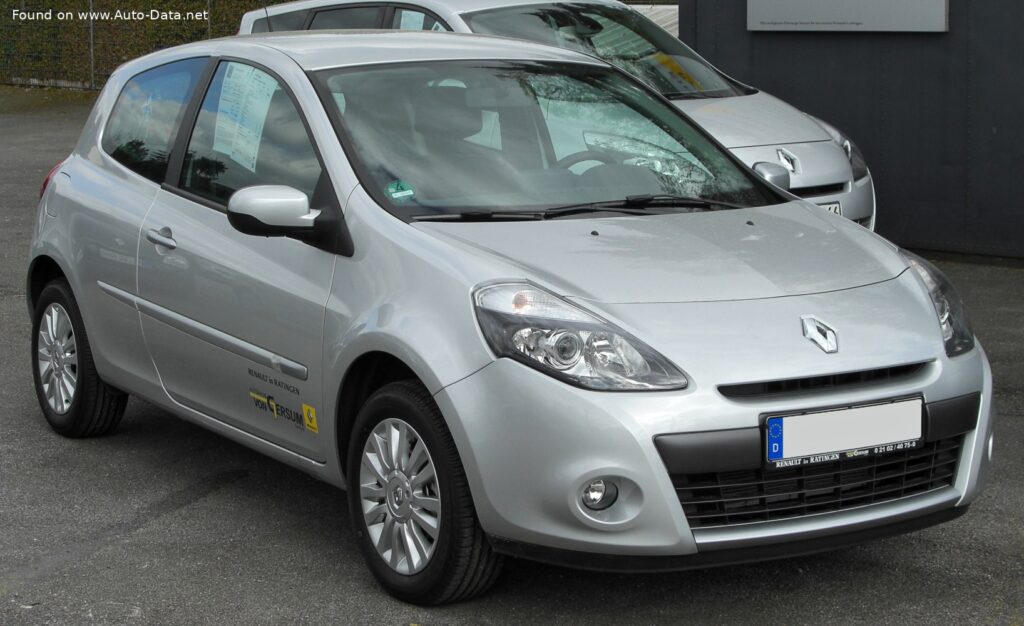
The Renault Clio III (Phase II, 2009) 3-door 1.6 16V (110 Hp) represents a significant chapter in the long-running history of Renault’s popular supermini lineup. Launched in 2009 as a refreshed iteration of the third-generation Clio, this particular variant, with its 1.6-liter 16-valve engine, solidified its position as a highly competitive and well-regarded offering in the fiercely contested European B-segment. While never officially imported to the United States, the Clio has been a cornerstone of Renault’s global strategy, particularly in its home market of France and across the European continent, where it consistently ranks among the best-selling vehicles. This Phase II model, produced until 2012, brought subtle but important updates to design, technology, and efficiency, ensuring the Clio III remained a compelling choice for urban commuters and small families seeking a blend of practicality, style, and economical performance.
The Clio III Phase II: Positioning and Overview
The Clio III, first introduced in 2005, garnered critical acclaim, including the prestigious European Car of the Year award in 2006. The Phase II refresh aimed to build upon this success by refining its aesthetics and powertrain options. The 3-door hatchback configuration, a classic staple of the segment, emphasized a sportier, more dynamic profile compared to its 5-door sibling, appealing to a younger demographic or those prioritizing style over absolute rear-door convenience. This 1.6 16V variant occupied a mid-range position within the Clio III lineup. It sat above the base 1.2-liter engine options, offering a noticeable performance increase, but remained below the more potent 1.6 16V Sport Tourer and the diesel-powered variants like the 1.5 dCi. It was aimed at buyers who wanted a balance of fuel efficiency and respectable power for both city and highway driving.
Powertrain & Engine Architecture
At the core of the Renault Clio III (Phase II, 2009) 3-door 1.6 16V (110 Hp) lies Renault’s well-proven K4M 800 engine. This naturally aspirated, 1.6-liter (1598 cm³ or 97.52 cu. in.) inline four-cylinder powerplant was renowned for its balance of lively performance and respectable fuel economy. Featuring a Double Overhead Camshaft (DOHC) valvetrain with four valves per cylinder, the engine was designed for efficient combustion and smooth power delivery. Fuel was delivered via a multi-port manifold injection system, a standard and reliable technology for the era, ensuring precise fuel metering. The K4M engine family is known for its robustness and relatively simple design, contributing to its longevity and ease of maintenance.
The K4M 800 engine produced a healthy 110 horsepower (Hp) at 6000 rpm, a commendable output for a non-turbocharged engine of its displacement in the supermini class. Torque output stood at 111.37 lb.-ft. (151 Nm) available at 4250 rpm, providing a broad powerband suitable for both city driving and highway cruising. This combination allowed the Clio III Phase II to accelerate from 0 to 60 mph in a reasonable 11.6 seconds, with a top speed of 115.58 mph (186 km/h). Power was sent to the front wheels via a five-speed manual transmission, a common and reliable setup for the segment. While an automated manual transmission (Quickshift) was available on some Clio III models, the 1.6 16V was primarily offered with the standard five-speed manual. From an efficiency standpoint, the Clio III Phase II 1.6 16V delivered competitive fuel consumption figures for its time. It achieved an urban economy of 22.2 US mpg (10.6 l/100 km), an extra-urban economy of 38.6 US mpg (6.1 l/100 km), and a combined rating of 30.2 US mpg (7.8 l/100 km). Furthermore, it met the stringent Euro 5 emission standard, reflecting Renault’s commitment to environmental responsibility in the European market.
Driving Characteristics
The 1.6 16V engine in the Clio III Phase II provided a noticeably more engaging driving experience compared to the smaller 1.2-liter engines. While not a performance-oriented model, the 110 hp output offered sufficient power for confident overtaking and merging onto highways. The five-speed manual transmission was well-matched to the engine’s characteristics, with gear ratios designed to maximize fuel efficiency while still providing adequate acceleration. Compared to the 1.5 dCi diesel variant, the 1.6 16V offered a more responsive and linear power delivery, albeit with slightly lower fuel economy. The diesel engine excelled in low-end torque, making it ideal for city driving and carrying loads, while the 1.6 16V favored higher-revving performance. The Clio’s steering was light and precise, making it easy to maneuver in urban environments. The suspension provided a comfortable ride, absorbing bumps and imperfections in the road surface effectively, although it wasn’t particularly sporty in its handling.
Equipment & Trim Levels
The Renault Clio III (Phase II, 2009) 3-door 1.6 16V typically came equipped with a reasonable level of standard features. These included power steering, central locking, electric front windows, an air conditioning system, and an audio system with CD player. Safety features such as ABS, front airbags, and seatbelt pretensioners were also standard. Interior upholstery was typically cloth, with a dark color scheme. Higher trim levels, such as the “Dynamique” and “Privilege” variants, added features like alloy wheels, rear electric windows, automatic headlights and rain sensors, a trip computer, and upgraded audio systems. Optional extras included a panoramic sunroof, leather upholstery, and a navigation system. The dashboard layout was functional and user-friendly, with clearly labeled controls and a relatively simple design.
Chassis & Braking
Underneath its stylish skin, the Clio III featured a robust chassis designed for comfort and confident handling. The front suspension utilized a tried-and-true MacPherson Strut system, while the rear employed a Torsion Beam setup, providing a compliant ride suitable for varying road conditions. Braking performance was handled by ventilated disc brakes at the front and solid disc brakes at the rear, augmented by an Anti-lock Braking System (ABS) for enhanced safety during emergency stops. The steering system was a rack and pinion type, complemented by electric power steering, which offered light and precise control, particularly beneficial for navigating tight urban environments and parking maneuvers. The vehicle rode on 185/60 R15 tires mounted on 6J x 15-inch wheel rims, a common specification for balancing grip, comfort, and cost in the segment. Its minimum turning circle of 35.1 feet (10.7 meters) further underscored its agility in crowded cityscapes.
Market Reception & Comparison
Critics generally viewed the Renault Clio III (Phase II) 1.6 16V as a competent and well-rounded supermini. It was praised for its comfortable ride, refined engine, and attractive styling. However, some reviewers noted that its interior plastics felt somewhat low-rent compared to some of its rivals, such as the Volkswagen Polo. Fuel economy was considered competitive, but not class-leading, particularly when compared to the diesel-powered options. In terms of reliability, the Clio III generally enjoyed a good reputation, although some owners reported minor electrical issues. Compared to the 1.5 dCi, the 1.6 16V offered a more enjoyable driving experience for those who preferred a petrol engine, but at the cost of slightly higher fuel consumption. Against the Ford Fiesta, the Clio III offered a more comfortable ride, while the Fiesta was generally considered to be more engaging to drive.
Technical Specifications
| Category | Specification |
| General Information | |
| Brand | Renault |
| Model | Clio |
| Generation | Clio III (Phase II, 2009) 3-door |
| Type (Engine) | 1.6 16V (110 Hp) |
| Start of Production | 2009 year |
| End of Production | 2012 year |
| Powertrain Architecture | Internal Combustion engine |
| Body type | Hatchback |
| Seats | 5 |
| Doors | 3 |
| Performance Specs | |
| Fuel consumption (economy) – urban | 10.6 l/100 km (22.2 US mpg) |
| Fuel consumption (economy) – extra urban | 6.1 l/100 km (38.6 US mpg) |
| Fuel consumption (economy) – combined | 7.8 l/100 km (30.2 US mpg) |
| Fuel Type | Petrol (Gasoline) |
| Acceleration 0 – 60 mph | 11.6 sec |
| Maximum speed | 186 km/h (115.58 mph) |
| Emission standard | Euro 5 |
| Engine Specs | |
| Power | 110 Hp @ 6000 rpm |
| Power per liter | 68.8 Hp/l |
| Torque | 151 Nm @ 4250 rpm (111.37 lb.-ft. @ 4250 rpm) |
| Engine layout | Front, Transverse |
| Engine Model/Code | K4M 800 |
| Engine displacement | 1598 cm³ (97.52 cu. in.) |
| Number of cylinders | 4 |
| Engine configuration | Inline |
| Cylinder Bore | 79.5 mm (3.13 in.) |
| Piston Stroke | 80.5 mm (3.17 in.) |
| Compression ratio | 10:1 |
| Number of valves per cylinder | 4 |
| Fuel injection system | Multi-port manifold injection |
| Engine aspiration | Naturally aspirated engine |
| Valvetrain | DOHC |
| Engine oil capacity | 5 l (5.28 US qt) |
| Coolant | 6.5 l (6.87 US qt) |
| Space, Volume and Weights | |
| Trunk (boot) space – minimum | 288 l (10.17 cu. ft.) |
| Trunk (boot) space – maximum | 1038 l (36.66 cu. ft.) |
| Fuel tank capacity | 55 l (14.53 US gal) |
| Dimensions | |
| Length | 4032 mm (158.74 in.) |
| Width | 1720 mm (67.72 in.) |
| Width including mirrors | 2025 mm (79.72 in.) |
| Height | 1497 mm (58.94 in.) |
| Wheelbase | 2575 mm (101.38 in.) |
| Front track | 1472 mm (57.95 in.) |
| Rear track | 1470 mm (57.87 in.) |
| Front overhang | 830 mm (32.68 in.) |
| Rear overhang | 626 mm (24.65 in.) |
| Minimum turning circle (turning diameter) | 10.7 m (35.1 ft.) |
| Drivetrain, Brakes and Suspension Specs | |
| Drivetrain Architecture | Front-wheel drive, Internal Combustion Engine (ICE) |
| Drive wheel | Front wheel drive |
| Number of gears and type of gearbox | 5 gears, manual transmission |
| Front suspension | Spring Strut |
| Rear suspension | Torsion Beam |
| Front brakes | Ventilated discs |
| Rear brakes | Disc |
| Assisting systems | ABS (Anti-lock braking system) |
| Steering type | Steering rack and pinion |
| Power steering | Electric Steering |
| Tires size | 185/60 R15 |
| Wheel rims size | 6J x 15 |
Legacy
The Renault Clio III (Phase II, 2009) 3-door 1.6 16V (110 Hp) remains a relatively common sight on European roads today, a testament to its durability and reliability. The K4M engine is known for its longevity, and with proper maintenance, can easily exceed 150,000 miles. In the used car market, these Clios are generally affordable and represent a good value for money, particularly for first-time buyers or those seeking a practical and economical city car. While not a particularly sought-after model by enthusiasts, its simplicity and reliability make it a sensible choice for everyday transportation. The Clio III, in general, helped solidify Renault’s reputation for building well-engineered and dependable small cars, paving the way for the continued success of subsequent Clio generations.