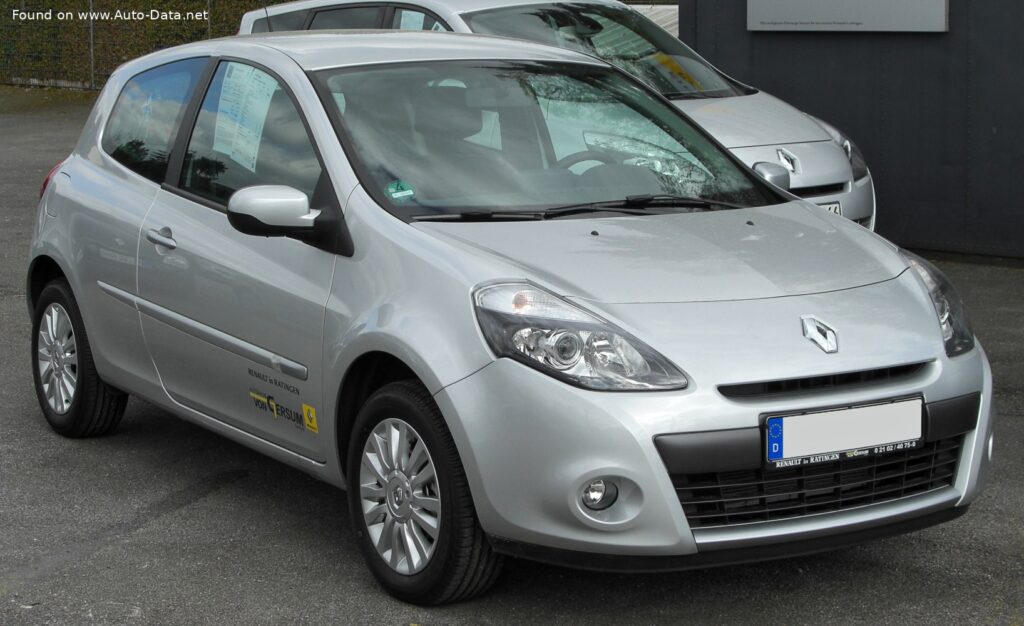
The Renault Clio III (Phase II, 2009) 3-door 1.6 16V (112 Hp) Automatic represents a significant iteration of Renault’s highly successful Clio supermini, a staple in the European automotive landscape since its inception in 1990. This particular model, part of the third generation’s mid-cycle refresh (Phase II), was produced from May 2009 to October 2010. Positioned in the highly competitive B-segment, the Clio III was lauded for its maturity, sophisticated ride quality, and robust safety features, elevating it beyond the typical small car expectations of its time. While never officially sold in the United States, the Clio series has consistently been one of Europe’s best-selling vehicles, embodying French design flair and practical engineering for urban and suburban environments. This 3-door hatchback variant, equipped with the 1.6-liter 16-valve engine and an automatic transmission, offered a blend of zesty performance and ease of driving, making it a popular choice for a wide range of consumers across the continent.
Powertrain & Engine Architecture
At the heart of this particular Renault Clio III (Phase II) model lies the venerable K4M 801 engine, a naturally aspirated 1.6-liter (1598 cm3 or 97.52 cubic inches) inline-four cylinder unit. This powerplant, known for its reliability and widespread use across various Renault and Dacia models, features a DOHC (Double Overhead Camshaft) valvetrain with 4 valves per cylinder, totaling 16 valves. Fuel delivery is managed by a multi-port manifold injection system, ensuring efficient combustion. The engine’s design prioritized durability and ease of maintenance, contributing to its longevity in service.
The engine generates a respectable 112 horsepower at 6000 rpm, translating to a power-per-liter output of 70.1 HP/l, which was quite competitive for its segment in 2009. Peak torque is 151 Nm (111.37 lb.-ft.) delivered at 4250 rpm, providing adequate pulling power for city driving and highway cruising. Power is sent to the front wheels via a 4-speed automatic transmission, a common configuration for convenience-oriented small cars of that era. This transmission, while not offering the efficiency of modern multi-gear automatics, provided smooth shifts and reduced driver fatigue in congested European traffic. The automatic transmission was a DP0 (also known as AL4) unit, a Renault-developed transmission known for its compact size and relatively smooth operation. It featured electronic control for shift points and adaptive learning to optimize performance based on driving style.
Driving Characteristics
The Clio III 1.6 16V Automatic offered a comfortable and predictable driving experience. Compared to the manual transmission versions, the automatic sacrificed some responsiveness and driver engagement. Acceleration from 0 to 60 mph took approximately 11.6 seconds (0-100 km/h in 12.2 seconds), and a maximum speed of 115.58 mph (186 km/h) was achievable. While these figures weren’t particularly sporty, they were sufficient for everyday driving needs. The 4-speed automatic transmission’s gear ratios were optimized for fuel efficiency and smooth cruising rather than outright performance. The lower gears provided adequate acceleration from a standstill, while the higher gears allowed for relaxed highway driving. Compared to the higher-output 1.6 16V manual, the automatic version felt noticeably less eager to rev, and overtaking maneuvers required more planning. However, the convenience of the automatic transmission appealed to a broader range of drivers, particularly those who frequently encountered stop-and-go traffic.
Equipment & Trim Levels
The Renault Clio III (Phase II) 3-door 1.6 16V Automatic typically came equipped with a reasonable level of standard features. These included power steering, central locking, electric front windows, and an audio system with CD player. Safety features such as ABS (Anti-lock Braking System) and multiple airbags (driver, passenger, and side airbags) were also standard. Interior upholstery was typically cloth, with a dark color scheme. The dashboard featured a straightforward layout with easy-to-read instrumentation. Optional extras available for this trim included air conditioning, alloy wheels, a trip computer, and a more advanced audio system with steering wheel-mounted controls. Higher trim levels, such as the “Dynamique” or “Privilege” variants, offered additional features like automatic headlights and rain-sensing wipers. The 3-door configuration generally targeted a younger, more style-conscious audience compared to the more practical 5-door model.
Chassis & Braking
The Clio III’s chassis was designed to provide a comfortable yet composed ride. The front suspension featured an independent MacPherson strut setup with coil springs and an anti-roll bar, offering good handling and stability. The rear suspension utilized a torsion beam configuration with coil springs, which was a cost-effective solution that provided adequate ride comfort for most driving conditions. Braking was handled by ventilated discs at the front (260×22 mm) and solid discs at the rear (240×8 mm). The braking system was generally considered effective for a car of this size and weight. Electric power steering, a rack and pinion system, offered light and responsive handling, ideal for urban driving. The car typically rode on 185/60 R15 or 195/50 R16 tires, depending on the trim level, mounted on 15 or 16-inch wheel rims. The suspension tuning was geared towards comfort rather than sporty handling, prioritizing a smooth ride over sharp cornering.
Market Reception & Comparison
Critics generally viewed the Renault Clio III 1.6 16V Automatic favorably, praising its comfortable ride, refined interior, and robust safety features. However, the 4-speed automatic transmission was often criticized for being somewhat dated compared to the more advanced transmissions offered by competitors. Fuel economy, rated at a combined 31.4 US mpg (7.5 l/100 km) according to the NEDC cycle, was competitive for its class. Reliability was generally good, although some owners reported minor issues with the electronic components of the automatic transmission. Compared to the 1.6 16V manual version, the automatic offered slightly lower fuel economy and reduced performance. The 1.5 dCi diesel variants offered superior fuel economy but came with a higher purchase price and potentially higher maintenance costs. The Clio III’s main rivals included the Ford Fiesta, Volkswagen Polo, Peugeot 207, and Opel/Vauxhall Corsa, all of which offered similar levels of practicality and refinement.
Technical Specifications
| Category | Specification |
| General Information | |
| Brand | Renault |
| Model | Clio |
| Generation | Clio III (Phase II, 2009) 3-door |
| Type (Engine) | 1.6 16V (112 Hp) Automatic |
| Start of Production | May, 2009 |
| End of Production | October, 2010 |
| Powertrain Architecture | Internal Combustion Engine |
| Body Type | Hatchback |
| Seats | 5 |
| Doors | 3 |
| Performance Specs | |
| Fuel Consumption (Urban, NEDC) | 23.5 US mpg (10 l/100 km) |
| Fuel Consumption (Extra Urban, NEDC) | 38.6 US mpg (6.1 l/100 km) |
| Fuel Consumption (Combined, NEDC) | 31.4 US mpg (7.5 l/100 km) |
| CO2 Emissions (NEDC) | 179 g/km |
| Fuel Type | Petrol (Gasoline) |
| Acceleration 0 – 60 mph (Calculated) | 11.6 sec |
| Acceleration 0 – 100 km/h | 12.2 sec |
| Maximum Speed | 115.58 mph (186 km/h) |
| Emission Standard | Euro 4 |
| Weight-to-Power Ratio | 10.3 kg/Hp, 97 Hp/tonne |
| Weight-to-Torque Ratio | 7.6 kg/Nm, 130.7 Nm/tonne |
| Engine Specs | |
| Power | 112 Hp @ 6000 rpm |
| Power per Liter | 70.1 Hp/l |
| Torque | 111.37 lb.-ft. @ 4250 rpm (151 Nm) |
| Engine Layout | Front, Transverse |
| Engine Model/Code | K4M 801 |
| Engine Displacement | 1.6 Liters (1598 cm3 / 97.52 cu. in.) |
| Number of Cylinders | 4 |
| Engine Configuration | Inline |
| Cylinder Bore | 3.13 in. (79.5 mm) |
| Piston Stroke | 3.17 in. (80.5 mm) |
| Compression Ratio | 9.8:1 |
| Number of Valves per Cylinder | 4 |
| Fuel Injection System | Multi-port manifold injection |
| Engine Aspiration | Naturally aspirated |
| Valvetrain | DOHC |
| Engine Oil Capacity | 5.28 US qt (5 l) |
| Coolant Capacity | 6.87 US qt (6.5 l) |
| Space, Volume and Weights | |
| Kerb Weight | 2546.34 – 2601.45 lbs. (1155-1180 kg) |
| Max. Weight (GVWR) | 3670.7 lbs. (1665 kg) |
| Max Load | 1069.24 – 1124.36 lbs. (485-510 kg) |
| Trunk (Boot) Space – Minimum | 10.17 cu. ft. (288 l) |
| Trunk (Boot) Space – Maximum | 36.66 cu. ft. (1038 l) |
| Fuel Tank Capacity | 14.53 US gal (55 l) |
| Max. Roof Load | 176.37 lbs. (80 kg) |
| Permitted Trailer Load with Brakes (12%) | 2645.55 lbs. (1200 kg) |
| Permitted Trailer Load without Brakes | 1179.47 lbs. (535 kg) |
| Permitted Towbar Download | 165.35 lbs. (75 kg) |
| Dimensions | |
| Length | 158.74 in. (4032 mm) |
| Width | 67.72 in. (1720 mm) |
| Width Including Mirrors | 79.72 in. (2025 mm) |
| Height | 58.94 in. (1497 mm) |
| Wheelbase | 101.38 in. (2575 mm) |
| Front Track | 57.4 – 57.95 in. (1458-1472 mm) |
| Rear (Back) Track | 57.09 – 57.91 in. (1450-1471 mm) |
| Front Overhang | 32.68 in. (830 mm) |
| Rear Overhang | 24.65 in. (626 mm) |
| Ride Height (Ground Clearance) | 4.72 in. (120 mm) |
| Minimum Turning Circle (Turning Diameter) | 35.1 – 37.07 ft. (10.7-11.3 m) |
Legacy
The Renault Clio series, and specifically the third generation, holds a significant place in the European automotive market. It consistently ranked among the best-selling cars in its segment, challenging strong rivals like the Ford Fiesta, Volkswagen Polo, Peugeot 207, and Opel/Vauxhall Corsa. The Clio III was particularly praised for its elevated sense of quality and refinement, a considerable step up from its predecessors. It garnered the prestigious European Car of the Year award in 2006, a testament to its well-rounded package. The K4M engine, in particular, proved to be a durable and reliable unit when properly maintained. On the used car market today, the Clio III 1.6 16V Automatic represents a relatively affordable and practical option for buyers seeking a small, comfortable, and well-equipped hatchback. While its age means that maintenance may be required, its robust engineering and readily available parts ensure that it can remain a viable transportation option for years to come. The automatic transmission, while not the most modern, is generally reliable if serviced according to Renault’s recommendations.