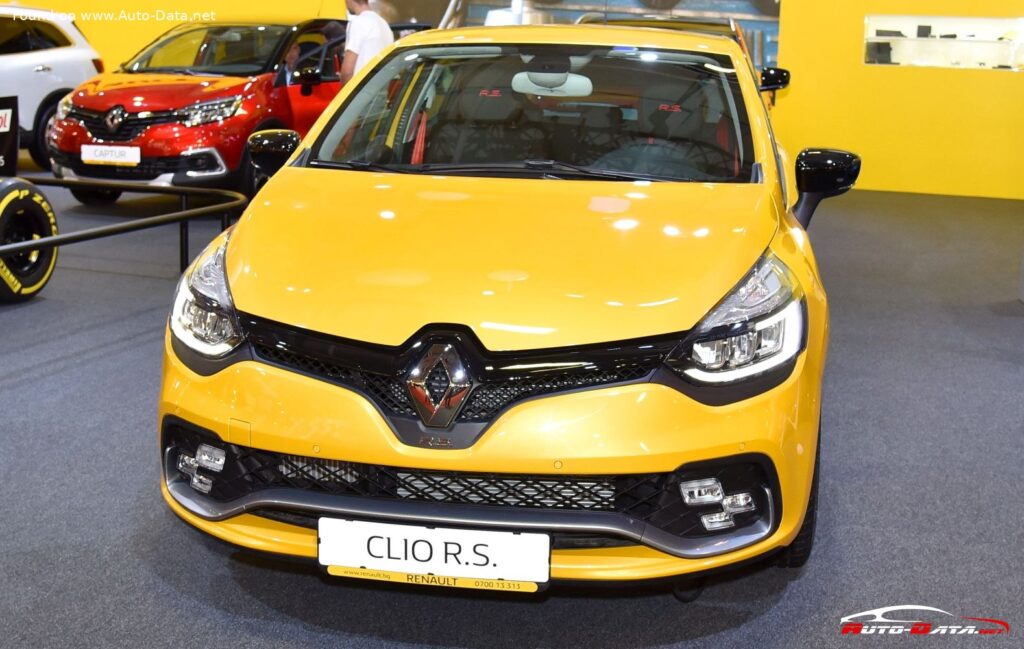
The Renault Clio IV (Phase II, 2016) represents a significant refresh of the fourth generation of Renault’s highly successful supermini, a segment of compact cars particularly popular in Europe. Launched in 2012, the Clio IV quickly established itself as a design-led contender in its class, and the Phase II update for the 2016 model year brought subtle yet impactful enhancements to keep it competitive. This particular variant, the 1.5 Energy dCi (90 Hp) EDC S&S, epitomizes the European market’s preference for fuel-efficient diesel powertrains combined with modern automatic transmissions, making it a cornerstone of Renault’s sales strategy across the continent. While the Renault Clio is not sold in the United States, its influence and success in international markets highlight global automotive trends and engineering priorities.
The Renault Clio IV (Phase II) 1.5 dCi 90 EDC S&S: Positioning and Overview
As a five-door hatchback, the Clio IV (Phase II) offered a blend of practicality, style, and advanced technology for its segment. This 1.5 dCi 90 EDC S&S variant occupied a mid-range position within the Clio IV lineup. It sat above the base-level petrol engine options (typically the 1.2 TCe) and below the more powerful diesel variants (like the 1.5 dCi 110 Hp). This positioning targeted buyers seeking a balance between affordability, fuel economy, and the convenience of an automatic transmission. It was aimed at urban commuters, small families, and drivers prioritizing low running costs over outright performance. The “Energy” designation in its name signifies Renault’s commitment to efficiency, incorporating features like a Start & Stop system to reduce fuel consumption and emissions. This model year, running from 2016 to 2019, solidified the Clio’s reputation as a segment leader, frequently appearing at the top of sales charts in numerous European countries.
Powertrain & Engine Architecture
At the heart of the Renault Clio IV (Phase II, 2016) 1.5 Energy dCi (90 Hp) EDC S&S lies Renault’s venerable K9K diesel engine, a 1.5-liter (1461 cm³) inline four-cylinder unit renowned for its robust nature and exceptional fuel economy. This particular iteration, code K9K 628, delivers 90 horsepower at 4000 rpm and a substantial 162.26 lb.-ft. (220 Nm) of torque, available from a low 1750 rpm. The power output of 61.6 horsepower per liter is impressive for a diesel engine of its size, balancing performance with efficiency.
The engine’s design incorporates a common rail direct fuel injection system and a turbocharger with an intercooler, optimizing combustion and power delivery across the rev range. The common rail system, operating at very high pressures, allows for precise control of fuel injection timing and quantity, maximizing efficiency and minimizing emissions. With only two valves per cylinder, the focus is clearly on torque and fuel efficiency rather than high-revving power. A key feature of this powertrain is the inclusion of a Start & Stop (S&S) system, which automatically shuts off the engine when the vehicle is stationary and restarts it silently when the driver intends to move, significantly reducing fuel consumption and emissions in city driving conditions. Furthermore, a diesel particulate filter (DPF) ensures compliance with stringent Euro 6b emission standards, a critical requirement for European markets. The DPF traps soot particles produced during combustion, periodically undergoing a regeneration cycle to burn off the accumulated soot.
Power is delivered to the front wheels via a 6-speed Efficient Dual Clutch (EDC) automatic transmission. This type of gearbox offers the convenience of an automatic with the efficiency and direct feel of a manual transmission, making it a popular choice for modern compact cars. The EDC transmission utilizes two separate clutches – one for odd-numbered gears and one for even-numbered gears – allowing for seamless and rapid gear changes. This minimizes power interruption during shifts, resulting in a smoother and more responsive driving experience. The combination of the torquey diesel engine and the smooth EDC transmission provides a refined driving experience, particularly suited for stop-and-go traffic and longer highway cruises.
Driving Characteristics
The 1.8L 90 hp / Automatic setup delivers a driving experience geared towards practicality and fuel efficiency rather than sporty performance. Acceleration from 0 to 60 mph is achieved in a respectable 12.3 seconds, with a top speed of 109.36 mph (176 km/h). However, its true strength lies in its fuel economy, boasting a combined rating of 67.2 US mpg (3.5 l/100 km), with extra-urban driving achieving an outstanding 71.3 US mpg (3.3 l/100 km). The EDC transmission is programmed to prioritize fuel economy, often upshifting quickly to maintain low engine speeds. Compared to a manual transmission version of the same engine, the EDC offers greater convenience, especially in urban environments. However, the manual version might feel slightly more responsive and engaging for drivers who enjoy a more direct connection to the drivetrain. Compared to the more powerful 1.5 dCi 110 Hp variant, the 90 Hp version offers less outright acceleration, but it provides a more relaxed and economical driving experience, particularly on longer journeys.
The gear ratios in the EDC transmission are optimized for fuel efficiency and smooth cruising. First gear is relatively short for quick acceleration from a standstill, while higher gears are spaced to keep engine speeds low at highway speeds. The torque available from 1750 rpm means that the engine doesn’t need to be revved excessively to maintain speed, contributing to its excellent fuel economy. The steering is light and precise, making it easy to maneuver in tight spaces. The suspension is tuned for comfort, providing a reasonably smooth ride over most road surfaces.
Equipment & Trim Levels
The Clio IV (Phase II) 1.5 Energy dCi (90 Hp) EDC S&S typically came equipped with a respectable level of standard features. These included air conditioning, power windows, power door locks, a basic infotainment system with Bluetooth connectivity, and a height-adjustable driver’s seat. Safety features such as ABS, Electronic Stability Control (ESC), and multiple airbags were also standard. Interior upholstery was typically cloth, with options for upgraded materials and designs available on higher trim levels. The dashboard configuration was modern and functional, with a focus on driver ergonomics.
Optional extras available for this trim included a touchscreen infotainment system with navigation, rear parking sensors, automatic headlights and wipers, cruise control, and alloy wheels. Higher trim levels, such as the “Iconic” or “Dynamique” variants, often included these features as standard. Renault also offered various personalization options, allowing buyers to customize the exterior and interior of their Clio to suit their individual preferences.
Chassis & Braking
The Clio IV (Phase II) utilized a MacPherson strut front suspension and a torsion beam rear suspension. This configuration provides a good balance between ride comfort and handling. The torsion beam rear suspension is a cost-effective and space-efficient solution commonly used in supermini cars. The steering utilized a rack and pinion system, offering responsive and predictable handling. The braking system consisted of ventilated discs at the front and drum brakes at the rear. While the rear drums were a cost-saving measure, they provided adequate stopping power for the vehicle’s weight and performance. The Anti-lock Braking System (ABS) and Electronic Brakeforce Distribution (EBD) were standard features, enhancing braking safety and stability. Stabilizer bars were fitted to both the front and rear axles to reduce body roll during cornering.
Market Reception & Comparison
Critics generally viewed the Renault Clio IV (Phase II) 1.5 Energy dCi (90 Hp) EDC S&S favorably, praising its fuel economy, comfortable ride, and smooth-shifting EDC transmission. The car was often commended for its stylish design and well-equipped interior. However, some reviewers noted that the engine could feel slightly underpowered when fully loaded or when tackling steep hills. Compared to other trims in the same lineup, the 1.5 dCi 90 EDC S&S offered a compelling balance between performance and efficiency. It was more economical than the petrol-powered versions and provided a smoother and more refined driving experience than the lower-powered diesel variants. In terms of reliability, the K9K diesel engine has a generally good reputation, although owners should be aware of the potential for DPF issues if the car is primarily used for short journeys.
Technical Specifications
| Category | Specification |
| Brand | Renault |
| Model | Clio |
| Generation | Clio IV (Phase II, 2016) |
| Type (Engine) | 1.5 Energy dCi (90 Hp) EDC S&S |
| Production Start | 2016 |
| Production End | 2019 |
| Powertrain Architecture | Internal Combustion Engine |
| Body Type | Hatchback |
| Seats | 5 |
| Doors | 5 |
| Fuel Consumption (Urban) | 3.9 l/100 km (60.3 US mpg) |
| Fuel Consumption (Extra Urban) | 3.3 l/100 km (71.3 US mpg) |
| Fuel Consumption (Combined) | 3.5 l/100 km (67.2 US mpg) |
| CO2 Emissions | 92 g/km |
| Fuel Type | Diesel |
| Acceleration 0-60 mph | 12.3 sec |
| Acceleration 0-100 km/h | 12.9 sec |
| Maximum Speed | 109.36 mph (176 km/h) |
| Emission Standard | Euro 6 b |
| Power | 90 Hp @ 4000 rpm |
| Power per liter | 61.6 Hp/l |
| Torque | 162.26 lb.-ft. (220 Nm) @ 1750 rpm |
| Engine Layout | Front, Transverse |
| Engine Model/Code | K9K 628 |
| Engine Displacement | 1.5 liters (1461 cm³ / 89.16 cu. in.) |
| Number of Cylinders | 4 |
| Engine Configuration | Inline |
| Valves per Cylinder | 2 |
| Fuel Injection System | Diesel Commonrail |
| Engine Aspiration | Turbocharger, Intercooler |
| Engine Oil Capacity | 4.76 US qt (4.5 l) |
| Coolant Capacity | 5.28 US qt (5 l) |
| Engine Systems | Start & Stop System, Particulate Filter |
| Kerb Weight | 2623.5 – 2656.57 lbs. (1190-1205 kg) |
| Max. Weight | 3809.59 – 3825.02 lbs. (1728-1735 kg) |
| Max. Load | 1153.02 – 1201.52 lbs. (523-545 kg) |
| Length | 159.92 in. (4062 mm) |
| Width | 68.15 in. (1731 mm) |
| Width (incl. mirrors) | 76.57 in. (1945 mm) |
| Height | 57.01 in. (1448 mm) |
| Wheelbase | 101.93 in. (2589 mm) |
| Front Track | 59.29 in. (1506 mm) |
| Rear Track | 59.29 in. (1506 mm) |
| Front Overhang | 33.5 in. (851 mm) |
| Rear Overhang | 24.49 in. (622 mm) |
| Ground Clearance | 4.72 in. (120 mm) |
| Drivetrain Architecture | Front-wheel drive, Internal Combustion Engine |
| Drive Wheel | Front Wheel Drive |
| Gearbox Type | 6 gears, automatic transmission (EDC) |
| Front Brakes | Ventilated Discs |
| Rear Brakes | Drum |
| Assisting Systems | ABS (Anti-lock Braking System) |
| Steering Type | Steering rack and pinion |
| Tire Size | 195/55 R16; 205/45 R17 |
| Wheel Rim Size | 16; 17 |
Legacy
The Renault Clio series has long been a pillar of the European automotive landscape, consistently ranking among the best-selling cars for decades. The Clio IV, and particularly its Phase II iteration from 2016-2019, continued this impressive legacy, solidifying Renault’s position in the highly competitive B-segment (supermini class). This segment is crucial in Europe, representing a significant portion of new car sales and serving as a gateway for many first-time buyers or as a practical second family car.
The 1.5 Energy dCi (90 Hp) EDC S&S variant played a pivotal role in the Clio IV’s success. Its combination of a highly efficient diesel engine, smooth automatic transmission, and low CO2 emissions (92 g/km) made it exceptionally attractive in markets with high fuel prices and stringent emissions regulations. For many European consumers, a diesel supermini offered an unbeatable blend of low running costs, decent performance for highway cruising, and urban maneuverability. This model was a direct competitor to other European best-sellers such as the Ford Fiesta, Volkswagen Polo, Peugeot 208, and Opel Corsa, often outperforming them in specific markets due to its distinctive styling and competitive pricing.
The Clio IV Phase II was praised for its improved interior quality, advanced infotainment options, and continued emphasis on safety, contributing to its strong reputation for reliability and value. Its “Energy” branding and features like the Start & Stop system highlighted Renault’s commitment to eco-friendly motoring and technological innovation within the mass-market segment. While not a performance powerhouse, its balanced attributes made it a highly practical and enjoyable car for millions of drivers across Europe. The legacy of the Clio IV Phase II is that of a modern, well-rounded supermini that successfully adapted to evolving consumer demands for efficiency, technology, and style, ensuring the Clio nameplate remained synonymous with accessible and desirable compact motoring.