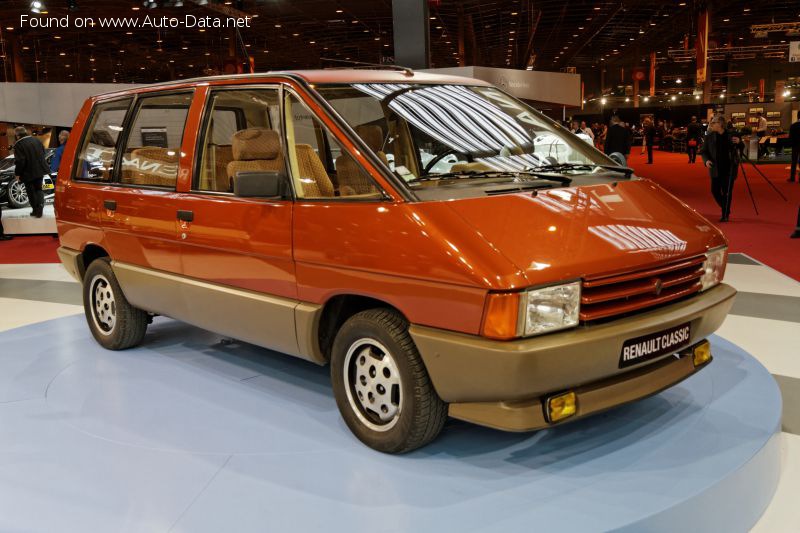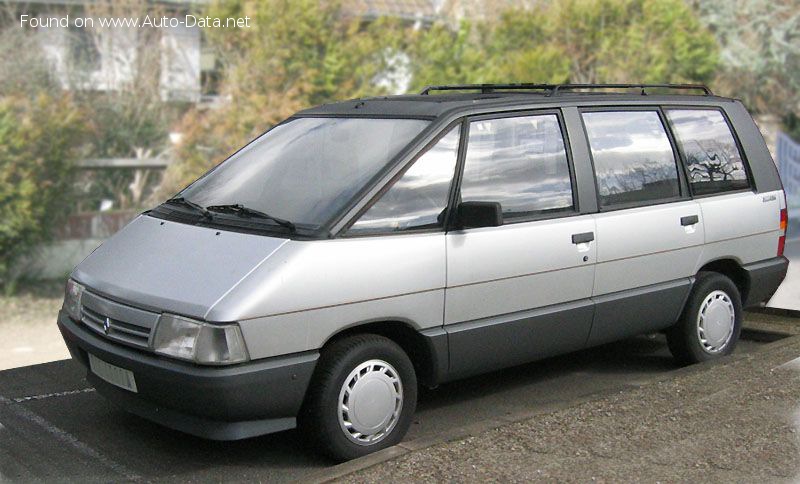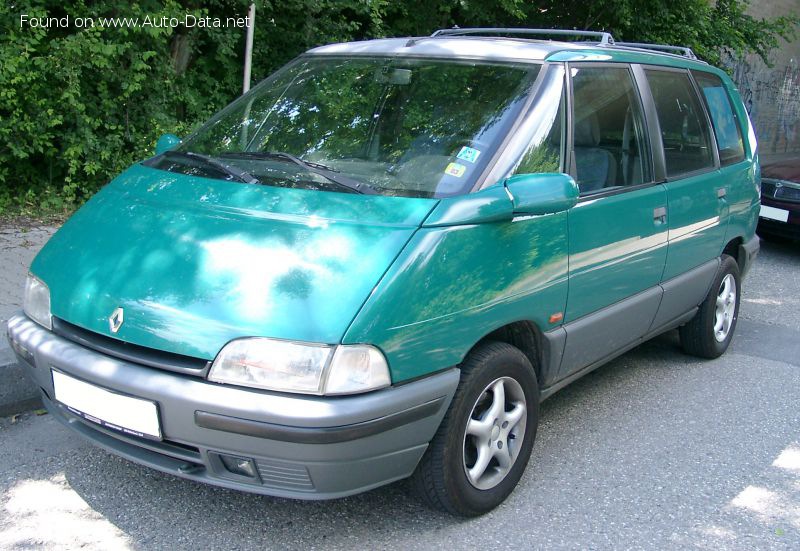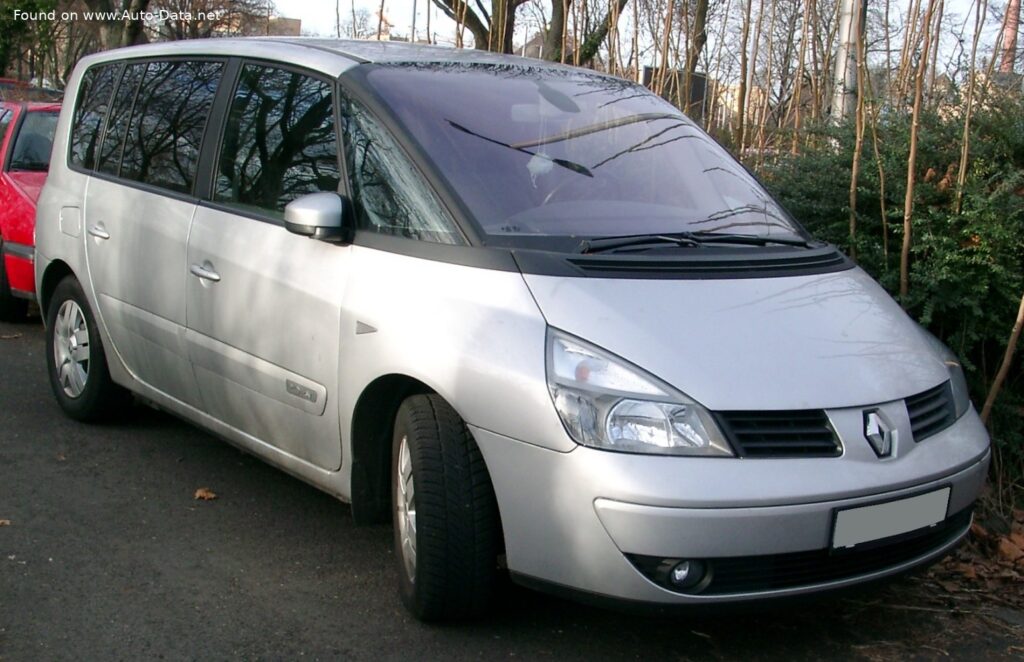
The Renault Espace IV 2.0i 16V, introduced in 2002, represents the fourth generation of Renault’s groundbreaking minivan (Multi-Purpose Vehicle or MPV) series. This specific variant, the 2.0i 16V producing 136 horsepower, was a key component of the Espace IV lineup from 2002 to 2006. Primarily designed for the European market, the Espace IV was never officially sold in the United States. However, its influence on family transportation and innovative interior design resonated internationally. It continued the Espace’s tradition of providing exceptional passenger comfort, versatility, and a distinctive, futuristic design that differentiated it from competitors in the European family car segment.
Renault Espace IV 2.0i 16V: A European Minivan Icon
Moving away from the more angular styling of previous models, the Espace IV adopted a smoother, more aerodynamic aesthetic, often described as a “monospace” design. It was built on the Renault-Nissan D platform, shared with other large Renault and Nissan vehicles, emphasizing improvements in ride quality, handling, and safety. The 2.0i 16V was positioned as a practical and efficient option within the Espace range, offering a balance of performance and fuel economy for families and individuals prioritizing space and utility.
Engine & Performance
The Renault Espace IV 2.0i 16V is powered by Renault’s respected F4R engine, a naturally aspirated inline-four gasoline (petrol) unit. This powerplant has a displacement of 1998 cm³ (121.93 cu. in.) and features a Double Overhead Camshaft (DOHC) valvetrain with 16 valves (four per cylinder). This configuration, advanced for its time, ensured efficient air intake and exhaust. The engine generates 136 horsepower at 5500 rpm, providing adequate power for a vehicle of its size and purpose. Torque output is 191 Nm (140.87 lb.-ft.) delivered at 3750 rpm, offering sufficient pulling power for both city driving and highway cruising, even when fully loaded with passengers and cargo.
Power is transferred to the front wheels through a 6-speed manual transmission, highlighting Renault’s focus on driver engagement and fuel efficiency. This transmission allows for optimal gear selection in various driving conditions, contributing to a combined fuel economy of 9.4 liters per 100 kilometers, or approximately 25 US miles per gallon. While not a performance-oriented vehicle, the Espace IV 2.0i 16V can accelerate from 0 to 60 mph in 11.9 seconds, reaching a top speed of 114.95 mph. These figures were competitive for a large family minivan in the early 2000s, prioritizing comfortable and stable cruising over outright speed. The multi-port manifold injection system ensures precise fuel delivery, optimizing combustion and contributing to the engine’s reliability and relatively low emissions for its era.
Design & Features
The design of the Renault Espace IV marked a significant evolution for the model. Its “monospace” silhouette is characterized by a steeply raked windshield that seamlessly integrates into the hood, creating a single, flowing form. The body style is a traditional 5-door minivan, designed to maximize interior space and flexibility for up to seven passengers. Its dimensions are substantial, measuring 183.5 inches in length, 73.23 inches in width (82.83 inches including mirrors), and ranging from 68.03 to 70.16 inches in height, depending on the specification. The 110.35-inch wheelbase contributes to a stable ride and a spacious cabin.
The Espace IV excels in modularity and comfort. The seven individual seats can be easily removed, folded, or slid, allowing for numerous configurations to prioritize passenger space or cargo capacity. With all rear seats removed, the Espace offers a cavernous maximum trunk volume of 2860 liters (101 cu. ft.), making it exceptionally practical for transporting large items. Even with all seven seats in place, a respectable 291 liters (10.28 cu. ft.) of cargo space remains available. The interior features a centrally mounted digital instrument cluster, a signature Renault design element of the period, aiming for a clean and uncluttered driver’s view.
In terms of safety and driving dynamics, the Espace IV was well-equipped for its time. It included an Anti-lock Braking System (ABS) as standard, enhancing control during emergency braking. The steering system utilizes a hydraulic power-assisted rack and pinion setup, providing predictable handling. Suspension consists of an independent McPherson strut system at the front and a trailing arm setup at the rear, tuned for comfort and stability. Braking is provided by ventilated discs at the front and solid discs at the rear, ensuring confident stopping power for the vehicle’s 3670.7 lbs. (1665 kg) curb weight. The vehicle rides on 225/60 R16 tires mounted on 6.5J x 16 wheel rims.
Technical Specifications
| Category | Specification |
| General Information | |
| Brand | Renault |
| Model | Espace |
| Generation | Espace IV |
| Type (Engine) | 2.0i 16V (136 Hp) |
| Production Start | 2002 |
| Production End | 2006 |
| Powertrain Architecture | Internal Combustion engine |
| Body type | Minivan, MPV |
| Seats | 7 |
| Doors | 5 |
| Performance Specs | |
| Fuel consumption (urban) | 12.6 l/100 km (18.7 US mpg) |
| Fuel consumption (extra urban) | 7.6 l/100 km (30.9 US mpg) |
| Fuel consumption (combined) | 9.4 l/100 km (25 US mpg) |
| Fuel Type | Petrol (Gasoline) |
| Acceleration 0 – 60 mph | 11.9 sec |
| Acceleration 0 – 62 mph (100 km/h) | 12.5 sec |
| Maximum speed | 185 km/h (114.95 mph) |
| Weight-to-power ratio | 12.2 kg/Hp (81.7 Hp/tonne) |
| Weight-to-torque ratio | 8.7 kg/Nm (114.7 Nm/tonne) |
| Engine Specs | |
| Power | 136 Hp @ 5500 rpm |
| Power per liter | 68.1 Hp/l |
| Torque | 191 Nm @ 3750 rpm (140.87 lb.-ft. @ 3750 rpm) |
| Engine layout | Front, Transverse |
| Engine Model/Code | F4R |
| Engine displacement | 1998 cm³ (121.93 cu. in.) |
| Number of cylinders | 4 |
| Engine configuration | Inline |
| Cylinder Bore | 82.7 mm (3.26 in.) |
| Piston Stroke | 93 mm (3.66 in.) |
| Compression ratio | 9.8:1 |
| Number of valves per cylinder | 4 |
| Fuel injection system | Multi-port manifold injection |
| Engine aspiration | Naturally aspirated engine |
| Valvetrain | DOHC |
| Engine oil capacity | 5.4 l (5.71 US qt) |
| Coolant capacity | 8.8 l (9.3 US qt) |
| Space, Volume and Weights | |
| Kerb Weight | 1665 kg (3670.7 lbs.) |
| Max. weight (GVWR) | 2435 kg (5368.26 lbs.) |
| Max load | 770 kg (1697.56 lbs.) |
| Trunk (boot) space – minimum | 291 l (10.28 cu. ft.) |
| Trunk (boot) space – maximum | 2860 l (101 cu. ft.) |
| Fuel tank capacity | 83 l (21.93 US gal) |
| Max. roof load | 80 kg (176.37 lbs.) |
| Permitted trailer load with brakes (12%) | 2000 kg (4409.25 lbs.) |
| Permitted trailer load without brakes | 750 kg (1653.47 lbs.) |
| Permitted towbar download | 85 kg (187.39 lbs.) |
| Dimensions | |
| Length | 4661 mm (183.5 in.) |
| Width | 1860 mm (73.23 in.) |
| Width including mirrors | 2104 mm (82.83 in.) |
| Height | 1728-1782 mm (68.03 – 70.16 in.) |
| Wheelbase | 2803 mm (110.35 in.) |
| Front track | 1574 mm (61.97 in.) |
| Rear (Back) track | 1556 mm (61.26 in.) |
| Front overhang | 1026 mm (40.39 in.) |
| Rear overhang | 832 mm (32.76 in.) |
| Ride height (ground clearance) | 175 mm (6.89 in.) |
| Drag coefficient (Cd) | 0.35 |
| Minimum turning circle (turning diameter) | 11.3 m (37.07 ft.) |
| Drivetrain, Brakes and Suspension Specs | |
| Drivetrain Architecture | Front-wheel drive, Internal Combustion engine |
| Drive wheel | Front wheel drive |
| Number of gears and type of gearbox | 6 gears, manual transmission |
| Front suspension | Independent type McPherson |
| Rear suspension | Trailing arm |
| Front brakes | Ventilated discs |
| Rear brakes | Disc |
| Assisting systems | ABS (Anti-lock braking system) |
| Steering type | Steering rack and pinion |
| Power steering | Hydraulic Steering |
| Tires size | 225/60 R16 |
| Wheel rims size | 6.5J x 16 |
The Renault Espace series, and particularly the Espace IV, holds a significant place in European automotive history as a pioneer and benchmark for the minivan segment. The first Espace, launched in 1984, essentially invented the modern European MPV, offering a new approach to family transportation. The fourth generation, the Renault Espace IV 2.0i 16V, continued this legacy by refining the formula with contemporary styling, enhanced safety, and greater interior flexibility.
In its primary European market, the Espace IV competed with rivals like the Ford Galaxy/Volkswagen Sharan, the Chrysler Voyager, and domestic offerings such as the Peugeot 807/Citroën C8 and the Opel Zafira. The Espace distinguished itself through its consistent commitment to innovative design and interior modularity. Its unique “monospace” aesthetic and adaptable seating arrangements made it popular among large families and those needing versatile cargo solutions.
The Espace IV’s reputation was built on its comfortable ride, spacious interior, and practical features. It was praised for its ability to accommodate seven adults or carry substantial luggage, demonstrating efficient packaging. The 2.0i 16V variant, with its balanced performance and reasonable fuel economy, was a sensible choice for many buyers. While some French cars of the era faced reliability concerns, the Espace IV generally maintained a strong image for comfort and innovation.
Historically, the Espace IV solidified Renault’s leadership in the MPV segment, even as the market shifted towards SUVs. It demonstrated how a family vehicle could be both functional and stylistically progressive. Though never sold in the United States, the Espace IV’s design philosophy and emphasis on interior space influenced vehicle design globally, showcasing European innovation in family-focused automotive engineering. Its impact is still felt in today’s versatile family vehicles, making it a true icon in its category.