
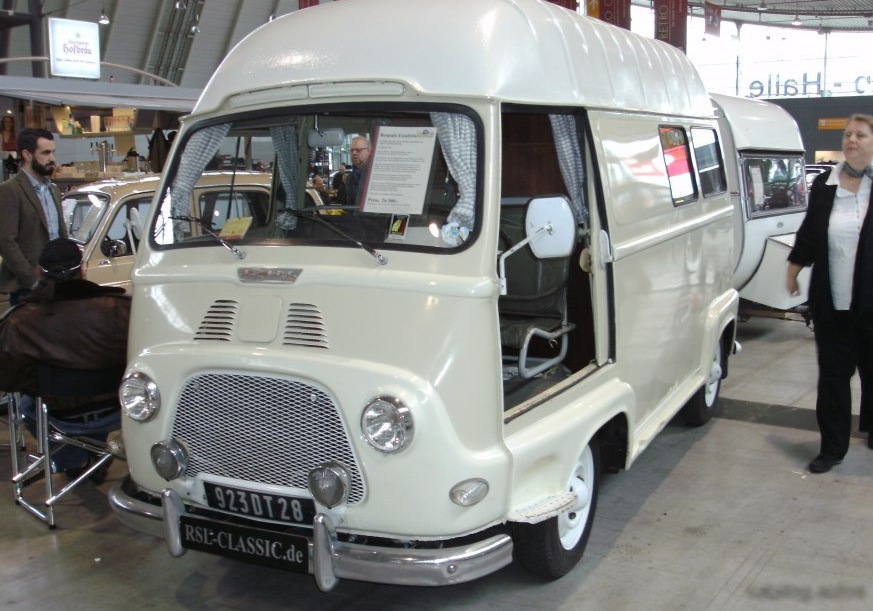
The Renault Estafette 1.1, produced from 1962 to 1981, represents a significant chapter in French commercial vehicle history. This variant, powered by a modest 1.1-liter engine producing 39 horsepower, served as the entry-level workhorse within the Estafette range. Designed as a direct replacement for the Renault Dauphinoise van, the Estafette aimed to provide a practical and affordable transportation solution for small businesses, tradespeople, and families. Its distinctive, utilitarian design and robust construction contributed to its longevity and widespread use throughout France and beyond. The Estafette, built on a rear-wheel-drive platform, was notable for its front-wheel drive predecessor, the 4CV, and offered a substantial increase in cargo capacity and overall utility.
Technical Specifications
| Brand | Renault |
| Model | Estafette |
| Generation | Estafette |
| Type (Engine) | 1.1 (39 Hp) |
| Start of Production | 1962 |
| End of Production | 1981 |
| Powertrain Architecture | Internal Combustion Engine |
| Body Type | Minivan |
| Seats | 9 |
| Doors | 4 |
| Fuel Type | Petrol (Gasoline) |
| Power | 39 Hp |
| Engine Model/Code | 688.01 |
| Engine Aspiration | Naturally Aspirated |
Powertrain & Engine Architecture
The heart of the Estafette 1.1 is the Renault 688.01 engine, a 1,108 cc (67.6 cubic inches) inline-four cylinder petrol engine. This engine, derived from the Renault 4’s powerplant, is characterized by its simplicity and durability. It features a single overhead valve (OHV) valvetrain, operating with two valves per cylinder. Fuel delivery is managed by a single Solex carburetor, a common setup for vehicles of this era. The engine’s modest output of 39 horsepower at 4,500 rpm and 57 lb-ft of torque at 3,000 rpm is achieved through a relatively low compression ratio of 8.5:1. The engine is paired with a four-speed manual transmission, which was the standard offering for this variant. While an automatic transmission was not available for the 1.1-liter Estafette, the manual gearbox was known for its robust construction and relatively easy operation. The engine’s design prioritized reliability and ease of maintenance over outright performance.
Driving Characteristics
The driving experience in an Estafette 1.1 is decidedly utilitarian. With only 39 horsepower propelling a relatively heavy vehicle, acceleration is slow and deliberate. The four-speed manual transmission requires frequent shifting, particularly when navigating hills or carrying a full load. The gear ratios are optimized for low-end torque, allowing the Estafette to manage moderate inclines and maintain a reasonable cruising speed on flat roads. However, overtaking maneuvers require careful planning and ample space. The suspension, consisting of independent front suspension with trailing arms and a rigid rear axle with leaf springs, provides a comfortable, if somewhat bouncy, ride. Steering is relatively direct, but requires a fair amount of effort, especially at low speeds. Compared to the later, more powerful Estafette variants (such as those equipped with the 1.3-liter or 1.6-liter engines), the 1.1-liter model feels significantly underpowered, making it best suited for short-distance deliveries and light-duty tasks.
Equipment & Trim Levels
The Estafette 1.1 was typically offered in a very basic trim level, reflecting its role as a commercial vehicle. Standard features included a simple dashboard with basic instrumentation (speedometer, fuel gauge, and temperature gauge), vinyl upholstery, and rubber floor mats. The interior was designed for practicality and ease of cleaning. Windows were large and provided good visibility, essential for commercial use. Options were limited, but could include a basic radio, upgraded seating, and additional cargo securing points. The exterior was typically finished in a single color, often white or a pastel shade. Chrome trim was minimal, further emphasizing the Estafette’s utilitarian character. The focus was on providing a functional and affordable vehicle, rather than luxury or comfort.
Chassis & Braking
The Estafette 1.1 utilizes a body-on-frame construction, providing a robust and durable chassis. The rear-wheel-drive layout contributes to its load-carrying capacity and relatively simple mechanical design. The suspension system, as mentioned previously, consists of independent front suspension with trailing arms and a rigid rear axle with leaf springs. Braking is handled by hydraulic drum brakes on all four wheels. While adequate for the vehicle’s weight and performance, the drum brakes lack the stopping power and fade resistance of disc brakes. Steering is a recirculating ball system, providing a direct but somewhat heavy feel. The Estafette’s chassis and braking system were designed to withstand the rigors of commercial use, prioritizing durability and reliability over sporty handling or high-performance braking.
Market Reception & Comparison
The Renault Estafette 1.1 was generally well-received in its target market. Its affordability, practicality, and robust construction made it a popular choice for small businesses and tradespeople. Critics praised its load-carrying capacity and ease of maintenance, but noted its lack of performance and basic interior. Compared to its competitors, such as the Citroën HY and the Volkswagen Transporter, the Estafette 1.1 offered a more affordable entry point, but lacked the sophistication and refinement of some of its rivals. The 1.3-liter and 1.6-liter Estafette variants offered significantly improved performance and were favored by those who required more power and carrying capacity. However, the 1.1-liter model remained a popular choice for those on a tight budget or who primarily used the vehicle for light-duty tasks. Fuel economy, while not exceptional by modern standards, was reasonable for a vehicle of its size and era.
Legacy
The Renault Estafette, particularly the 1.1-liter variant, has achieved a cult following among classic vehicle enthusiasts. Its simple mechanical design and readily available parts make it relatively easy to maintain and restore. While not known for its blistering performance, the Estafette 1.1 offers a unique and charming driving experience. Today, well-maintained examples are sought after by collectors and those looking for a distinctive and practical classic vehicle. The Estafette’s legacy lies in its contribution to French commercial vehicle history and its enduring appeal as a symbol of a bygone era. The 688.01 engine, while modest in its output, proved to be remarkably durable and reliable, ensuring the Estafette’s longevity on the road. The Estafette 1.1 remains a testament to the principles of functional design and robust engineering.
