
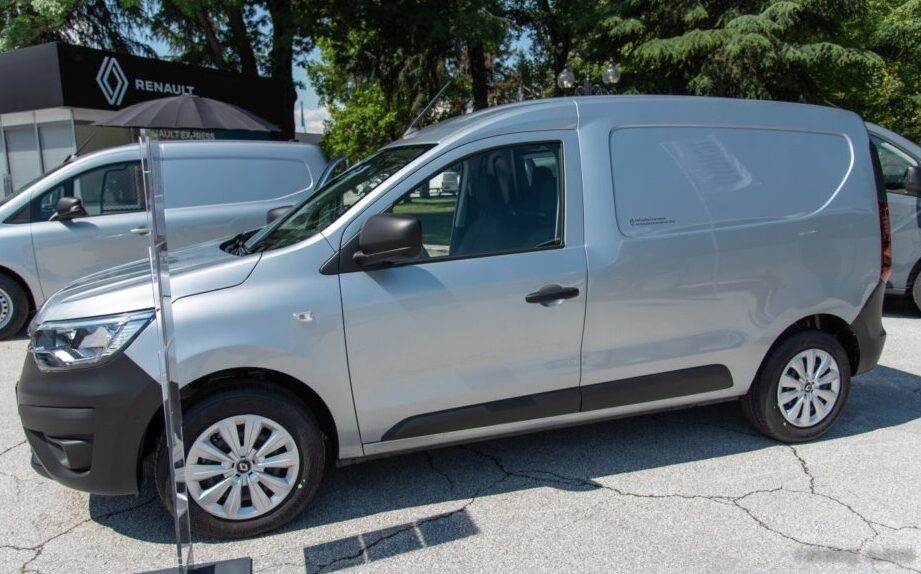
The Renault Express II Van 1.3 TCe (100 hp) FAP is a commercial vehicle produced by Renault since 2021. Representing the second generation of the Express van, it’s positioned as a compact and practical solution for small businesses and tradespeople. This particular variant, equipped with the 1.3-liter turbocharged gasoline engine and a six-speed manual transmission, serves as a core offering within the Express II lineup, balancing affordability with reasonable performance and efficiency. It’s primarily marketed in Europe, where compact vans are a popular choice due to urban density and logistical needs.
Technical Specifications
| Brand | Renault |
| Model | Express |
| Generation | Express II Van |
| Type (Engine) | 1.3 TCe (100 Hp) FAP |
| Start of production | 2021 |
| Powertrain Architecture | Internal Combustion engine |
| Body type | Minivan |
| Seats | 2 |
| Doors | 4 |
| Combined fuel consumption (WLTP) | 6.8-7.1 l/100 km (34.6 – 33.1 US mpg, 41.5 – 39.8 UK mpg, 14.7 – 14.1 km/l) |
| CO2 emissions (WLTP) | 153-160 g/km |
| Fuel Type | Petrol (Gasoline) |
| Acceleration 0 – 100 km/h | 11.9 sec |
| Acceleration 0 – 62 mph | 11.9 sec |
| Acceleration 0 – 60 mph | 11.3 sec |
| Maximum speed | 167 km/h (103.77 mph) |
| Emission standard | Euro 6D-Temp |
| Power | 100 Hp @ 4500 rpm |
| Power per litre | 75 Hp/l |
| Torque | 200 Nm @ 1500 rpm (147.51 lb.-ft. @ 1500 rpm) |
| Engine layout | Front, Transverse |
| Engine Model/Code | H5H 470 |
| Engine displacement | 1333 cm3 (81.34 cu. in.) |
| Number of cylinders | 4 |
| Engine configuration | Inline |
| Number of valves per cylinder | 4 |
| Fuel injection system | Direct injection |
| Engine aspiration | Turbocharger, Intercooler |
| Trunk (boot) space – minimum | 3300 l (116.54 cu. ft.) |
| Trunk (boot) space – maximum | 3700 l (130.66 cu. ft.) |
| Fuel tank capacity | 50 l (13.21 US gal | 11 UK gal) |
| Length | 4393 mm (172.95 in.) |
| Width | 1775 mm (69.88 in.) |
| Width including mirrors | 2079 mm (81.85 in.) |
| Height | 1811-1893 mm (71.3 – 74.53 in.) |
| Wheelbase | 2812 mm (110.71 in.) |
| Front track | 1488 mm (58.58 in.) |
| Rear (Back) track | 1478 mm (58.19 in.) |
| Front overhang | 851 mm (33.5 in.) |
| Rear overhang | 730 mm (28.74 in.) |
| Ride height (ground clearance) | 160 mm (6.3 in.) |
| Minimum turning circle (turning diameter) | 11.1 m (36.42 ft.) |
| Drivetrain Architecture | The Internal combustion engine (ICE) drives the front wheels of the vehicle. |
| Drive wheel | Front wheel drive |
| Number of gears and type of gearbox | 6 gears, manual transmission |
| Front suspension | Independent, type McPherson with coil spring and anti-roll bar |
| Rear suspension | Torsion |
| Front brakes | Ventilated discs, 280×24 mm |
| Rear brakes | Drum, 229 mm |
| Assisting systems | ABS (Anti-lock braking system) |
| Steering type | Steering rack and pinion |
| Power steering | Electric Steering |
| Tires size | 185/65 R15 |
| Wheel rims size | 15 |
Powertrain & Engine Architecture
The Renault Express II Van 1.3 TCe utilizes the H5H 470 engine, a 1.3-liter inline-four cylinder gasoline engine. This engine is part of the Alliance’s (Renault-Nissan-Mitsubishi) modular engine family. It features direct fuel injection and is turbocharged, allowing for a good balance of power and fuel efficiency. The turbocharger and intercooler help to increase air density entering the engine, boosting performance. The engine produces 100 horsepower at 4500 rpm and 200 Nm (147.51 lb-ft) of torque at 1500 rpm. The six-speed manual transmission is standard on this variant, providing a relatively wide range of gear ratios for both city driving and highway cruising. The inclusion of a particulate filter (FAP) helps to reduce emissions, meeting Euro 6D-Temp standards.
Driving Characteristics
The 1.3 TCe engine, paired with the six-speed manual transmission, provides adequate performance for typical commercial van duties. Acceleration is not its strong suit, with a 0-60 mph time of around 11.3 seconds, but it’s sufficient for navigating urban environments and carrying moderate loads. The torque curve is relatively flat, offering usable power across a broad rev range, making it easy to drive in various conditions. The manual transmission allows for greater driver control and engagement compared to an automatic, and the gear ratios are well-suited to maximizing fuel efficiency. Compared to higher-powered versions of the Express, this variant prioritizes economy over outright speed.
Equipment & Trim Levels
The 1.3 TCe variant of the Renault Express II Van typically comes with a functional, no-frills interior focused on practicality. Standard equipment generally includes a driver’s airbag, ABS brakes, a basic audio system with USB connectivity, and power steering. The cabin is designed for durability and ease of cleaning. Trim levels are relatively simple, with options often limited to upgrades like air conditioning, rear parking sensors, and a more advanced infotainment system. Upholstery is typically hard-wearing fabric. The focus is on providing a cost-effective and reliable work vehicle.
Chassis & Braking
The Renault Express II Van utilizes a front-wheel-drive layout. The front suspension consists of an independent McPherson strut setup with coil springs and an anti-roll bar, providing a reasonable level of ride comfort and handling. The rear suspension employs a torsion beam axle, which is a cost-effective and space-saving solution. The braking system features ventilated discs on the front wheels and drum brakes on the rear. ABS (Anti-lock Braking System) is standard. The chassis is designed to prioritize load-carrying capacity and durability over sporty handling.
Market Reception & Comparison
The Renault Express II Van 1.3 TCe (100 hp) has been generally well-received as a practical and affordable commercial vehicle. Critics have praised its fuel efficiency and maneuverability, particularly in urban settings. Compared to diesel-powered alternatives, the 1.3 TCe offers lower emissions, although it may not match the diesel’s low-end torque. Against competitors like the Citroën Berlingo, Peugeot Partner, and Volkswagen Caddy, the Express II offers a competitive price point and a reasonable level of equipment. Fuel economy is comparable to similar gasoline-powered vans in its class.
Legacy
The Renault Express II Van 1.3 TCe represents a shift towards more efficient gasoline engines in the light commercial vehicle segment. While diesel engines have traditionally dominated this market, the increasing focus on emissions regulations and the development of advanced gasoline technologies like turbocharging and direct injection have made gasoline-powered vans a more viable option. The H5H engine family has proven to be relatively reliable, and the 1.3 TCe variant is expected to maintain a reasonable level of dependability in the used car market. Its simplicity and relatively low maintenance costs should contribute to its long-term appeal.
