
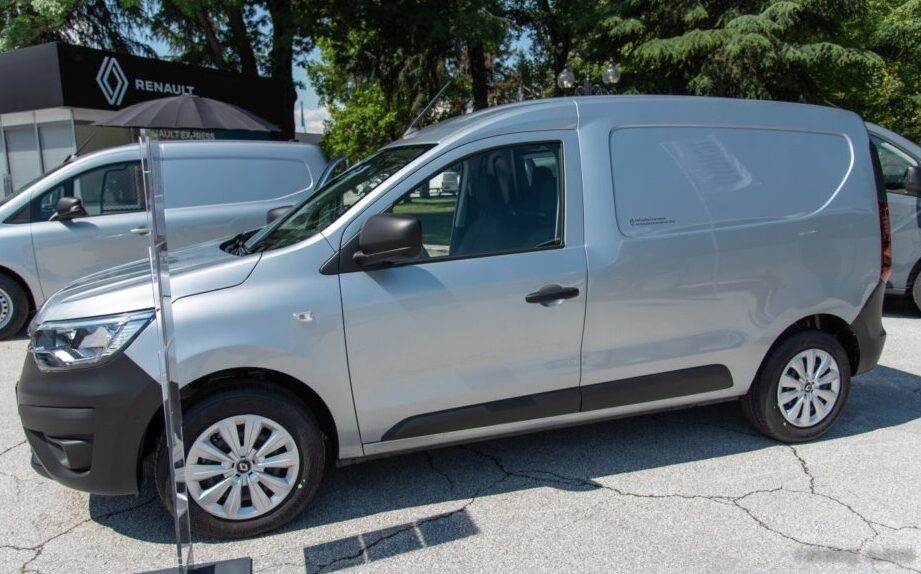
The Renault Express II Van 1.5 Blue dCi (95 hp) is a commercial vehicle produced by Renault since 2021. Representing a key variant within the second generation of the Express, this model serves as an entry-level offering focused on practicality and fuel efficiency for businesses and tradespeople. It’s positioned below higher-powered diesel options and is primarily sold in European and international markets where compact vans are popular. This specific configuration, with the 1.5 Blue dCi engine and a six-speed manual transmission, aims to balance affordability with acceptable performance for urban delivery and light commercial tasks.
Technical Specifications
| Brand | Renault |
| Model | Express |
| Generation | Express II Van |
| Type (Engine) | 1.5 Blue dCi (95 Hp) |
| Start of production | 2021 |
| Powertrain Architecture | Internal Combustion engine |
| Body type | Minivan |
| Seats | 2 |
| Doors | 4 |
| Combined fuel consumption (WLTP) | 5.1-5.3 l/100 km (46.1 – 44.4 US mpg, 55.4 – 53.3 UK mpg, 19.6 – 18.9 km/l) |
| CO2 emissions (WLTP) | 134-140 g/km |
| Fuel Type | Diesel |
| Acceleration 0 – 100 km/h | 13 sec |
| Acceleration 0 – 62 mph | 13 sec |
| Acceleration 0 – 60 mph | 12.4 sec |
| Maximum speed | 169 km/h (105.01 mph) |
| Emission standard | Euro 6D-Temp |
| Power | 95 Hp @ 3000-3750 rpm |
| Power per litre | 65 Hp/l |
| Torque | 240 Nm @ 1750-2000 rpm (177.01 lb.-ft. @ 1750-2000 rpm) |
| Engine layout | Front, Transverse |
| Engine Model/Code | K9K 872 |
| Engine displacement | 1461 cm3 (89.16 cu. in.) |
| Number of cylinders | 4 |
| Engine configuration | Inline |
| Number of valves per cylinder | 2 |
| Fuel injection system | Diesel Commonrail |
| Engine aspiration | Turbocharger, Intercooler |
| Trunk (boot) space – minimum | 3300 l (116.54 cu. ft.) |
| Trunk (boot) space – maximum | 3700 l (130.66 cu. ft.) |
| Fuel tank capacity | 50 l (13.21 US gal | 11 UK gal) |
| AdBlue tank | 17 l (4.49 US gal | 3.74 UK gal) |
| Length | 4393 mm (172.95 in.) |
| Width | 1775 mm (69.88 in.) |
| Width including mirrors | 2079 mm (81.85 in.) |
| Height | 1811-1893 mm (71.3 – 74.53 in.) |
| Wheelbase | 2812 mm (110.71 in.) |
| Front track | 1488 mm (58.58 in.) |
| Rear (Back) track | 1478 mm (58.19 in.) |
| Front overhang | 851 mm (33.5 in.) |
| Rear overhang | 730 mm (28.74 in.) |
| Ride height (ground clearance) | 160 mm (6.3 in.) |
| Minimum turning circle | 11.1 m (36.42 ft.) |
| Drivetrain Architecture | The Internal combustion engine (ICE) drives the front wheels of the vehicle. |
| Drive wheel | Front wheel drive |
| Number of gears and type of gearbox | 6 gears, manual transmission |
| Front suspension | Independent, type McPherson with coil spring and anti-roll bar |
| Rear suspension | Torsion |
| Front brakes | Ventilated discs, 280×24 mm |
| Rear brakes | Drum, 229 mm |
| Assisting systems | ABS (Anti-lock braking system) |
| Steering type | Steering rack and pinion |
| Power steering | Electric Steering |
| Tires size | 185/65 R15 |
| Wheel rims size | 15 |
Introduction
The Renault Express II Van, launched in 2021, represents the latest iteration of Renault’s long-standing commercial vehicle line. Built upon the shared platform with the Nissan Townstar and the Mercedes-Benz Citan, the Express II aims to provide a practical and efficient solution for small businesses and delivery services. The 1.5 Blue dCi 95 hp variant is a core model within the range, designed to offer a balance between running costs and usability. It’s a direct successor to the previous generation Express, inheriting its focus on compact dimensions and cargo capacity, but with updated technology and improved fuel efficiency.
Powertrain & Engine Architecture
The heart of this Express variant is the Renault K9K 872 1.5-liter four-cylinder diesel engine. This engine is a member of the Blue dCi family, known for its focus on reducing emissions and improving fuel economy. It utilizes a common rail direct injection system, delivering fuel at high pressure for optimized combustion. The engine features a turbocharger with an intercooler, boosting power output and torque. The 95 horsepower is achieved at 3000-3750 rpm, while peak torque of 240 Nm (177 lb-ft) is available from 1750-2000 rpm. This configuration is paired with a six-speed manual transmission, chosen for its efficiency and driver control. The engine also incorporates a Start & Stop system and a particulate filter to meet stringent Euro 6D-Temp emission standards.
Driving Characteristics
The 1.5 Blue dCi 95 hp engine provides adequate, though not exhilarating, performance for typical van duties. Acceleration from 0-100 km/h (0-62 mph) takes around 13 seconds. The engine’s torque delivery is relatively flat, making it suitable for carrying loads and navigating urban environments. Compared to higher-powered versions of the Express, this variant feels less responsive, particularly when fully loaded or climbing hills. The six-speed manual transmission allows for efficient cruising on highways, while the gear ratios are optimized for maximizing fuel economy. The driving experience is generally comfortable, with a focus on practicality rather than sporty handling.
Equipment & Trim Levels
The Renault Express II Van 1.5 Blue dCi (95 hp) typically comes with a functional, no-frills interior. Standard equipment generally includes a driver’s airbag, ABS brakes, a basic audio system with USB connectivity, and power steering. The cabin is designed for durability and ease of cleaning. Trim levels are often limited on base models, with options such as air conditioning, a passenger airbag, and upgraded audio systems available as extras. Interior upholstery is typically hard-wearing fabric. The focus is on providing a practical workspace for drivers, with ample storage compartments and a functional dashboard layout.
Chassis & Braking
The Express II Van utilizes a front-wheel-drive layout. The front suspension consists of an independent McPherson strut setup with a coil spring and anti-roll bar, providing a reasonable level of ride comfort and handling. The rear suspension employs a torsion beam axle, which is a cost-effective and space-saving solution. The braking system features ventilated discs on the front wheels (280x24mm) and drum brakes on the rear wheels (229mm). ABS (Anti-lock Braking System) is standard, enhancing safety during emergency braking situations. The vehicle’s relatively light weight contributes to its manageable braking performance.
Market Reception & Comparison
The Renault Express II Van 1.5 Blue dCi (95 hp) has been generally well-received as a practical and affordable commercial vehicle. Critics have praised its fuel efficiency and compact dimensions, making it ideal for urban deliveries. Compared to higher-powered diesel variants, this model offers lower running costs but sacrifices some performance. Against competitors like the Citroën Berlingo, Peugeot Partner, and Volkswagen Caddy, the Express II offers a competitive package in terms of price and cargo capacity. Its fuel economy of 5.1-5.3 l/100 km is comparable to other diesel vans in its class.
Legacy
The Renault K9K engine family has a long history of reliability and has been used in numerous Renault and Nissan vehicles. While long-term reliability data for the Express II is still emerging, the K9K engine has generally proven to be durable and relatively easy to maintain. The 1.5 Blue dCi variant is expected to hold its value reasonably well in the used car market, particularly among businesses seeking a cost-effective and reliable van. The focus on fuel efficiency and low emissions will likely make it an attractive option for environmentally conscious buyers. The simplicity of the powertrain, combined with readily available parts, should contribute to lower maintenance costs over the vehicle’s lifespan.
