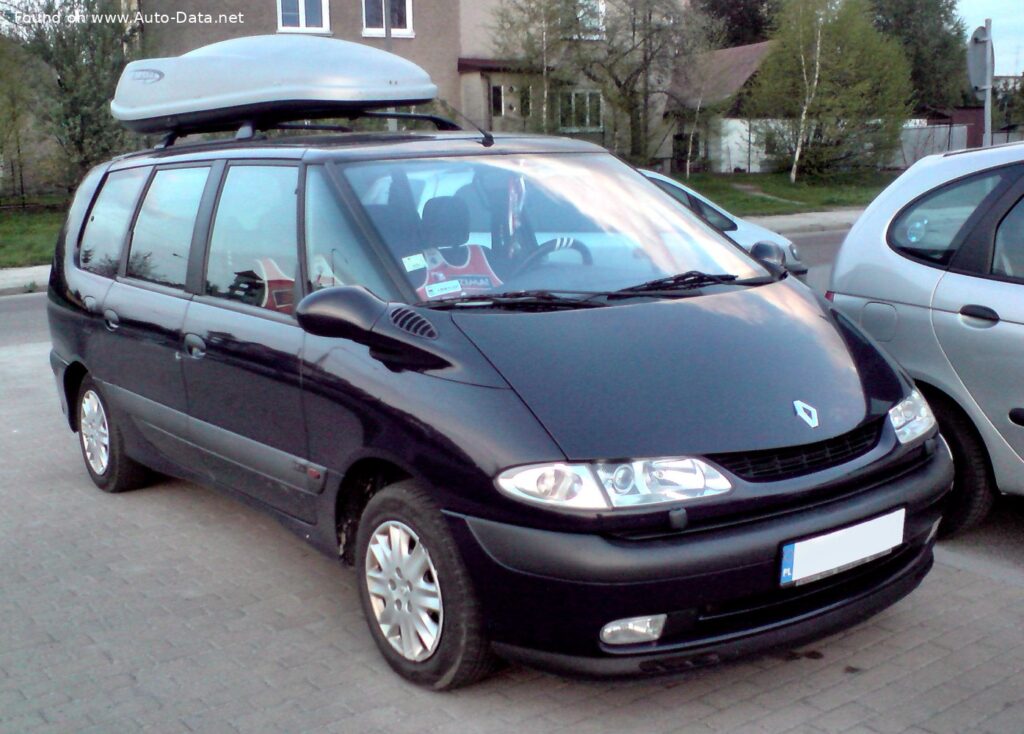
The Renault Grand Espace III, specifically the Phase II model produced from 2000 to 2002, represents a significant iteration in the Espace lineage. As a large, seven-seat minivan (or Multi-Purpose Vehicle – MPV as it’s known in Europe), the Grand Espace III was primarily marketed in Europe as a spacious and versatile family vehicle. While not officially sold in the United States, it exemplifies the European approach to people-carrying, prioritizing practicality, comfort, and innovative design. The 2.0i 16V variant, equipped with a 2.0-liter gasoline engine producing 140 horsepower, was a popular choice for buyers seeking a balance between performance and fuel economy.
Renault Grand Espace III (JE, Phase II, 2000) 2.0i 16V: An Overview
The Espace model has a long and storied history, originating in 1984 as a collaborative effort between Renault and Matra. It pioneered the minivan segment in Europe, offering a unique blend of space, comfort, and driving dynamics. The third-generation Espace (JE) introduced in 1996, and subsequently updated with the Phase II revisions in 2000, continued this tradition. The Phase II updates included cosmetic refinements, improved interior materials, and enhancements to the engine range. The Grand Espace designation signifies the longer wheelbase version, providing increased interior space and seating capacity compared to the standard Espace.
Engine & Performance
The heart of the Grand Espace III 2.0i 16V is Renault’s F4R engine, a 1.998-liter (121.93 cubic inches) inline-four cylinder gasoline engine. This naturally aspirated engine utilizes multi-port fuel injection and a double overhead camshaft (DOHC) valvetrain with four valves per cylinder. It produces a maximum power output of 140 horsepower at 5500 rpm, and a torque figure of 188 Nm (138.66 lb-ft) at 3750 rpm. While not a performance-oriented engine, it provides adequate power for comfortable cruising and family transportation. The engine’s power-to-weight ratio is 11.5 kg/Hp, and the torque-to-weight ratio is 8.5 kg/Nm. The engine is transversely mounted at the front of the vehicle, driving the front wheels through a five-speed manual transmission. Acceleration from 0 to 100 km/h (0-62 mph) takes 11.6 seconds, with a top speed of 187 km/h (116.2 mph). Fuel consumption is rated at 8.9 l/100 km (26.4 US mpg) combined, with 11.9 l/100 km (19.8 US mpg) in urban conditions and 7.2 l/100 km (32.7 US mpg) on the extra-urban cycle. CO2 emissions are rated at 211 g/km, meeting Euro 3 emission standards.
Design & Features
The Renault Grand Espace III is a five-door minivan designed to accommodate up to seven passengers. Its body style prioritizes interior space and practicality. The Phase II model features a streamlined exterior design with rounded edges and a relatively low roofline for a vehicle of its size. Key features include a spacious and configurable interior, with flexible seating arrangements allowing for various cargo and passenger configurations. The rear seats can be folded flat or even removed entirely to maximize cargo space, which ranges from a minimum of 520 liters (18.36 cubic feet) to a maximum of 3075 liters (108.59 cubic feet) with all rear seats folded. Safety features for the time included ABS (Anti-lock Braking System) and ventilated disc brakes on the front wheels, with disc brakes on the rear. The vehicle utilizes a hydraulic power steering system and McPherson strut front suspension with a coil spring and anti-roll bar, paired with a semi-independent coil spring rear suspension. The Grand Espace III offered a comfortable ride and predictable handling, making it well-suited for long-distance family journeys.
Technical Specifications
| Brand | Renault |
| Model | Espace |
| Generation | Grand Espace III (JE, Phase II, 2000) |
| Type (Engine) | 2.0i 16V (140 Hp) |
| Start of production | 2000 |
| End of production | 2002 |
| Powertrain Architecture | Internal Combustion engine |
| Body type | Minivan, MPV |
| Seats | 7 |
| Doors | 5 |
| Fuel consumption (urban) | 11.9 l/100 km (19.8 US mpg) |
| Fuel consumption (extra urban) | 7.2 l/100 km (32.7 US mpg) |
| Fuel consumption (combined) | 8.9 l/100 km (26.4 US mpg) |
| CO2 emissions | 211 g/km |
| Fuel Type | Petrol (Gasoline) |
| Acceleration 0 – 100 km/h | 11.6 sec |
| Acceleration 0 – 62 mph | 11.6 sec |
| Acceleration 0 – 60 mph | 11 sec |
| Maximum speed | 187 km/h (116.2 mph) |
| Emission standard | Euro 3 |
| Weight-to-power ratio | 11.5 kg/Hp |
| Weight-to-torque ratio | 8.5 kg/Nm |
| Power | 140 Hp @ 5500 rpm |
| Torque | 188 Nm @ 3750 rpm (138.66 lb.-ft. @ 3750 rpm) |
| Engine layout | Front, Transverse |
| Engine Model/Code | F4R |
| Engine displacement | 1998 cm3 (121.93 cu. in.) |
| Number of cylinders | 4 |
| Engine configuration | Inline |
| Cylinder Bore | 82.7 mm (3.26 in.) |
| Piston Stroke | 93 mm (3.66 in.) |
| Compression ratio | 9.8:1 |
| Number of valves per cylinder | 4 |
| Fuel injection system | Multi-port manifold injection |
| Engine aspiration | Naturally aspirated engine |
| Valvetrain | DOHC |
| Engine oil capacity | 5.3 l (5.6 US qt | 4.66 UK qt) |
| Coolant | 8.8 l (9.3 US qt | 7.74 UK qt) |
| Kerb Weight | 1605 kg (3538.42 lbs.) |
| Max. weight | 2300 kg (5070.63 lbs.) |
| Max load | 695 kg (1532.21 lbs.) |
| Trunk (boot) space – minimum | 520 l (18.36 cu. ft.) |
| Trunk (boot) space – maximum | 3075 l (108.59 cu. ft.) |
| Fuel tank capacity | 78 l (20.61 US gal | 17.16 UK gal) |
| Max. roof load | 80 kg (176.37 lbs.) |
| Permitted trailer load with brakes (12%) | 1580 kg (3483.3 lbs.) |
| Permitted trailer load without brakes | 750 kg (1653.47 lbs.) |
| Length | 4787 mm (188.46 in.) |
| Width | 1810 mm (71.26 in.) |
| Width including mirrors | 2070 mm (81.5 in.) |
| Height | 1775 mm (69.88 in.) |
| Wheelbase | 2874 mm (113.15 in.) |
| Front track | 1534 mm (60.39 in.) |
| Rear (Back) track | 1540 mm (60.63 in.) |
| Front overhang | 929 mm (36.57 in.) |
| Rear overhang | 984 mm (38.74 in.) |
| Ride height (ground clearance) | 110 mm (4.33 in.) |
| Minimum turning circle (turning diameter) | 11.5 m (37.73 ft.) |
| Drive wheel | Front wheel drive |
| Number of gears and type of gearbox | 5 gears, manual transmission |
| Front suspension | Independent, type McPherson with coil spring and anti-roll bar |
| Rear suspension | Semi-independent, coil spring |
| Front brakes | Ventilated discs |
| Rear brakes | Disc |
| Assisting systems | ABS (Anti-lock braking system) |
| Steering type | Steering rack and pinion |
| Power steering | Hydraulic Steering |
| Tires size | 205/65 R15 |
| Wheel rims size | 15 |