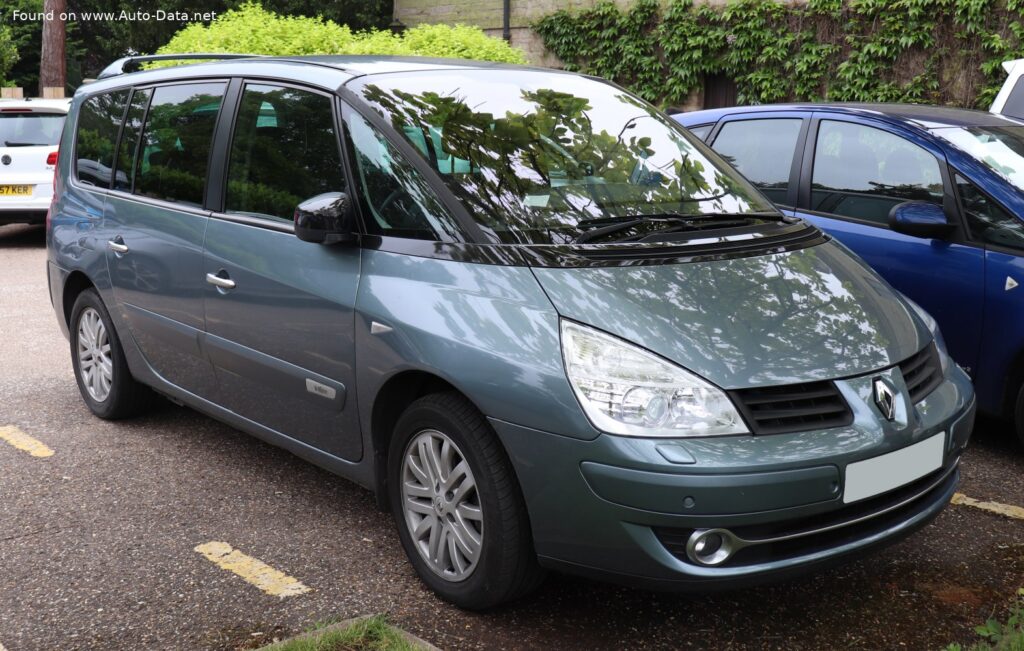
The Renault Grand Espace IV (Phase III), produced from 2010 to 2012, represents a significant iteration of Renault’s long-running Espace line. This model, powered by a 2.0 dCi diesel engine producing 150 horsepower, continued the Espace’s role as a large, comfortable, and technologically advanced minivan, primarily aimed at the European market. While not officially sold in the United States, the Espace series, and particularly the Grand Espace IV, offered a compelling alternative to larger SUVs and was popular among families needing substantial passenger and cargo space. The Phase III updates brought refinements to the styling, interior, and engine options, enhancing its appeal in a competitive segment.
Renault Grand Espace IV (Phase III): An Overview
The Grand Espace IV, in its Phase III guise, is a seven-seat minivan (MPV – Multi-Purpose Vehicle) designed to maximize interior space and versatility. It builds upon the foundation laid by previous Espace generations, known for their innovative designs and focus on passenger comfort. The Phase III model received styling tweaks, improved fuel efficiency, and updated technology to remain competitive. Its primary market was Europe, where large MPVs were a popular choice for families. The vehicle’s design prioritized practicality and a comfortable driving experience over sporty handling, making it a strong contender in the family transport category.
Engine & Performance
The 2010 Renault Grand Espace IV Phase III 2.0 dCi is equipped with a 1995 cc (121.74 cu. in.) inline-four cylinder diesel engine. This engine, designated M9R, produces 150 horsepower at 4000 rpm and 340 Nm (250.77 lb.-ft.) of torque at 2000 rpm. The engine utilizes a turbocharger with an intercooler and a diesel commonrail fuel injection system to optimize performance and fuel efficiency. Power is delivered to the front wheels via a six-speed automatic transmission. Acceleration from 0 to 100 km/h (0-62 mph) takes 12.4 seconds, while 0 to 60 mph is achieved in approximately 11.8 seconds. The vehicle has a maximum speed of 188 km/h (116.82 mph). The engine’s 16:1 compression ratio contributes to its efficiency, and it meets Euro 5 emission standards. The weight-to-power ratio is 13.6 kg/Hp, and the weight-to-torque ratio is 6 kg/Nm.
Design & Features
The Renault Grand Espace IV Phase III maintains the distinctive silhouette of the Espace line, characterized by its spacious interior and large windows. The body style is a five-door minivan, offering easy access to all seven seats. The Phase III updates included minor cosmetic changes to the front and rear fascias, as well as interior trim enhancements. A key feature of the Grand Espace is its flexible seating arrangement, allowing for various configurations to accommodate passengers and cargo. The trunk space is remarkably versatile, ranging from a minimum of 456 liters (16.1 cu. ft.) with all seats in use to a maximum of 3050 liters (107.71 cu. ft.) with the rear seats folded down. Safety features include ABS (Anti-lock Braking System) and a robust body structure. The vehicle’s dimensions are substantial, with a length of 4861 mm (191.38 in.), a width of 1894 mm (74.57 in) including mirrors, and a height of 1801 mm (70.91 in). Ride height (ground clearance) is 175 mm (6.89 in).
Technical Specifications
| Brand | Renault |
| Model | Espace |
| Generation | Grand Espace IV (Phase III, 2010) |
| Type (Engine) | 2.0 dCi (150 Hp) Automatic |
| Start of production | 2010 |
| End of production | 2012 |
| Powertrain Architecture | Internal Combustion engine |
| Body type | Minivan, MPV |
| Seats | 7 |
| Doors | 5 |
| Fuel consumption (urban) | 9.3 l/100 km (25.3 US mpg, 30.4 UK mpg, 10.8 km/l) |
| Fuel consumption (extra urban) | 6.1 l/100 km (38.6 US mpg, 46.3 UK mpg, 16.4 km/l) |
| Fuel consumption (combined) | 7.2 l/100 km (32.7 US mpg, 39.2 UK mpg, 13.9 km/l) |
| CO2 emissions | 189 g/km |
| Fuel Type | Diesel |
| Acceleration 0 – 100 km/h | 12.4 sec |
| Acceleration 0 – 62 mph | 12.4 sec |
| Acceleration 0 – 60 mph | 11.8 sec |
| Maximum speed | 188 km/h (116.82 mph) |
| Emission standard | Euro 5 |
| Weight-to-power ratio | 13.6 kg/Hp |
| Weight-to-torque ratio | 6 kg/Nm |
| Power | 150 Hp @ 4000 rpm |
| Torque | 340 Nm @ 2000 rpm (250.77 lb.-ft. @ 2000 rpm) |
| Engine layout | Front, Transverse |
| Engine Model/Code | M9R |
| Engine displacement | 1995 cm3 (121.74 cu. in.) |
| Number of cylinders | 4 |
| Engine configuration | Inline |
| Cylinder Bore | 84 mm (3.31 in.) |
| Piston Stroke | 90 mm (3.54 in.) |
| Compression ratio | 16:1 |
| Number of valves per cylinder | 4 |
| Fuel injection system | Diesel Commonrail |
| Engine aspiration | Turbocharger, Intercooler |
| Valvetrain | DOHC |
| Engine oil capacity | 8.2 l (8.66 US qt | 7.21 UK qt) |
| Kerb Weight | 2038 kg (4493.02 lbs.) |
| Max. weight | 2665 kg (5875.32 lbs.) |
| Max load | 627 kg (1382.3 lbs.) |
| Trunk (boot) space – minimum | 456 l (16.1 cu. ft.) |
| Trunk (boot) space – maximum | 3050 l (107.71 cu. ft.) |
| Fuel tank capacity | 83 l (21.93 US gal | 18.26 UK gal) |
| Max. roof load | 80 kg (176.37 lbs.) |
| Permitted trailer load with brakes (12%) | 2000 kg (4409.25 lbs.) |
| Permitted trailer load without brakes | 750 kg (1653.47 lbs.) |
| Permitted towbar download | 80 kg (176.37 lbs.) |
| Length | 4861 mm (191.38 in.) |
| Width including mirrors | 1894 mm (74.57 in.) |
| Height | 1801 mm (70.91 in.) |
| Wheelbase | 2868 mm (112.91 in.) |
| Front track | 1574 mm (61.97 in.) |
| Rear (Back) track | 1556 mm (61.26 in.) |
| Front overhang | 1026 mm (40.39 in.) |
| Rear overhang | 967 mm (38.07 in.) |
| Ride height (ground clearance) | 175 mm (6.89 in.) |
| Minimum turning circle (turning diameter) | 11.4 m (37.4 ft.) |
| Drivetrain Architecture | Front wheel drive |
| Number of gears and type of gearbox | 6 gears, automatic transmission |
| Front suspension | Independent, type McPherson with coil spring and anti-roll bar |
| Rear suspension | Semi-independent, coil spring |
| Front brakes | Ventilated discs |
| Rear brakes | Disc |
| Assisting systems | ABS (Anti-lock braking system) |
| Steering type | Steering rack and pinion |
| Tires size | 225/55 R17 |
| Wheel rims size | 17 |
The Renault Grand Espace IV Phase III 2.0 dCi Automatic offered a compelling package for families seeking a spacious, comfortable, and relatively efficient minivan. While not available in the US market, it represented a popular and well-regarded vehicle in Europe.