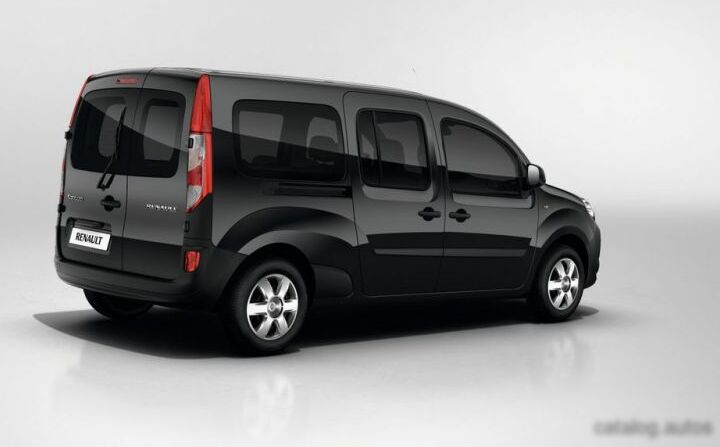
The Renault Grand Kangoo II, specifically the 1.5 dCi variant producing 110 horsepower, was a popular choice in the European market from 2013 to 2018. Positioned as a mid-range offering within the Grand Kangoo II lineup, this version balanced fuel efficiency, practicality, and a reasonable level of performance for family and commercial use. The Grand Kangoo II, a facelift of the original Kangoo II, built upon the success of its predecessor, offering increased space, improved comfort, and updated styling. This particular engine and transmission combination aimed to provide a versatile option for buyers needing a spacious vehicle for both passengers and cargo.
Technical Specifications
| Brand | Renault |
| Model | Kangoo |
| Generation | Grand Kangoo II (facelift 2013) |
| Type (Engine) | 1.5 dCi (110 Hp) |
| Start of production | 2013 |
| End of production | 2018 |
| Powertrain Architecture | Internal Combustion engine |
| Body type | Minivan |
| Seats | 7 |
| Doors | 5 |
| Fuel consumption (urban) | 5.3 l/100 km (44.4 US mpg, 53.3 UK mpg, 18.9 km/l) |
| Fuel consumption (extra urban) | 4.3 l/100 km (54.7 US mpg, 65.7 UK mpg, 23.3 km/l) |
| Fuel consumption (combined) | 4.7 l/100 km (50 US mpg, 60.1 UK mpg, 21.3 km/l) |
| CO2 emissions | 123 g/km |
| Fuel Type | Diesel |
| Acceleration 0 – 100 km/h | 12.3 sec |
| Acceleration 0 – 62 mph | 12.3 sec |
| Acceleration 0 – 60 mph | 11.7 sec |
| Maximum speed | 170 km/h (105.63 mph) |
| Emission standard | Euro 5 |
| Weight-to-power ratio | 13 kg/Hp, 76.9 Hp/tonne |
| Weight-to-torque ratio | 6 kg/Nm, 167.8 Nm/tonne |
| Power | 110 Hp @ 4000 rpm |
| Power per litre | 75.3 Hp/l |
| Torque | 240 Nm @ 1750 rpm (177.01 lb.-ft. @ 1750 rpm) |
| Engine layout | Front, Transverse |
| Engine Model/Code | K9K |
| Engine displacement | 1461 cm3 (89.16 cu. in.) |
| Number of cylinders | 4 |
| Engine configuration | Inline |
| Number of valves per cylinder | 2 |
| Fuel injection system | Diesel Commonrail |
| Engine aspiration | Turbocharger, Intercooler |
| Engine oil capacity | 4.5 l (4.76 US qt | 3.96 UK qt) |
| Coolant capacity | 7.2 l (7.61 US qt | 6.34 UK qt) |
| Kerb Weight | 1430-1625 kg (3152.61 – 3582.51 lbs.) |
| Max. weight | 2200 kg (4850.17 lbs.) |
| Max load | 575-770 kg (1267.66 – 1697.56 lbs.) |
| Trunk (boot) space – minimum | 300 l (10.59 cu. ft.) |
| Trunk (boot) space – maximum | 930 l (32.84 cu. ft.) |
| Fuel tank capacity | 60 l (15.85 US gal | 13.2 UK gal) |
| Permitted trailer load with brakes (12%) | 1050 kg (2314.85 lbs.) |
| Permitted trailer load without brakes | 715 kg (1576.31 lbs.) |
| Length | 4666 mm (183.7 in.) |
| Width | 1829 mm (72.01 in.) |
| Width including mirrors | 2133 mm (83.98 in.) |
| Height | 1802 mm (70.94 in.) |
| Wheelbase | 3081 mm (121.3 in.) |
| Front track | 1521 mm (59.88 in.) |
| Rear track | 1533 mm (60.35 in.) |
| Front overhang | 875 mm (34.45 in.) |
| Rear overhang | 710 mm (27.95 in.) |
| Ride height (ground clearance) | 177-142 mm (6.97 – 5.59 in.) |
| Minimum turning circle | 11.9 m (39.04 ft.) |
| Drivetrain | Front wheel drive |
| Number of gears and type of gearbox | 6 gears, manual transmission |
| Front suspension | Independent type McPherson |
| Rear suspension | Torsion |
| Front brakes | Ventilated discs |
| Rear brakes | Disc |
| Assisting systems | ABS (Anti-lock braking system) |
| Steering type | Steering rack and pinion |
| Power steering | Electric Steering |
| Tires size | 195/65 R15 |
| Wheel rims size | 15 |
INTRODUCTION
The Renault Grand Kangoo II (facelift 2013) 1.5 dCi 110 Hp is a five-door minivan designed to offer a practical and versatile solution for families and businesses. Introduced as part of the Kangoo II’s mid-life refresh, this variant combined the updated styling and improved interior of the facelift with Renault’s proven 1.5 dCi diesel engine. The Grand Kangoo II, built on the X0/B0 platform, was a key model for Renault in Europe, competing with vehicles like the Citroën Berlingo and Peugeot Partner. The “Grand” designation indicates the longer wheelbase version, offering seven-seat capability and increased cargo volume. This 110 horsepower version aimed to strike a balance between fuel economy and usable performance, making it a popular choice for those who didn’t require the higher output of the more powerful dCi options.
Powertrain & Engine Architecture
The heart of this Grand Kangoo is the K9K 1.5 dCi engine, a common rail direct injection diesel engine. This engine is a four-cylinder, inline configuration with two valves per cylinder. The 110 horsepower output is achieved through a turbocharger with an intercooler, optimizing air intake for increased power and efficiency. The engine utilizes a common rail diesel injection system, delivering fuel at extremely high pressure for finer atomization and more complete combustion. This contributes to both improved fuel economy and reduced emissions. The engine’s oil capacity is 4.5 liters, and it requires a specific oil specification (detailed in the vehicle’s manual). The engine is transversely mounted at the front of the vehicle. The 6-speed manual transmission was the standard offering for this variant, providing a good balance of fuel efficiency and driver control. The gear ratios are tuned for maximizing fuel economy while still providing adequate acceleration for everyday driving.
Driving Characteristics
The 1.5 dCi 110 Hp Grand Kangoo offers a comfortable and practical driving experience. While not particularly sporty, the engine provides sufficient power for typical driving situations, including highway cruising and carrying a full load of passengers or cargo. Acceleration from 0-60 mph takes around 11.7 seconds, and the top speed is approximately 105.63 mph. The turbocharger provides a noticeable boost in power at lower engine speeds, improving responsiveness. The 6-speed manual transmission allows drivers to keep the engine in its optimal power band. Compared to the higher-output dCi versions, this 110 hp variant feels less strained when fully loaded, but it lacks the same level of outright acceleration. The suspension is tuned for comfort, absorbing bumps and imperfections in the road well. However, this can result in some body roll during cornering.
Equipment & Trim Levels
The Grand Kangoo II 1.5 dCi 110 Hp typically came equipped with a range of standard features, including air conditioning, power steering, electric front windows, and a basic audio system. Safety features included ABS, driver and passenger airbags, and seatbelt pretensioners. Higher trim levels offered additional features such as alloy wheels, rear parking sensors, cruise control, and a more advanced infotainment system. Interior upholstery was typically cloth, with options for upgraded materials. The dashboard layout was functional and user-friendly, with clearly labeled controls. Optional extras included a panoramic sunroof, navigation system, and various storage solutions.
Chassis & Braking
The Grand Kangoo II utilizes an independent McPherson strut suspension at the front, providing good handling and ride comfort. The rear suspension employs a torsion beam setup, which is cost-effective and space-efficient. The braking system consists of ventilated discs at the front and solid discs at the rear. ABS (Anti-lock Braking System) is standard, enhancing braking performance and stability. The steering is rack and pinion with electric power assistance, providing a light and responsive feel. The tires are typically 195/65 R15, offering a good balance of grip and fuel efficiency.
Market Reception & Comparison
The Renault Grand Kangoo II 1.5 dCi 110 Hp was generally well-received by critics and buyers alike. It was praised for its practicality, spaciousness, and fuel efficiency. The 1.5 dCi engine was known for its reliability and low running costs. Compared to the more powerful dCi variants, this 110 hp version offered a more affordable price point and slightly better fuel economy. However, some critics noted that it could feel underpowered when fully loaded or driving uphill. Compared to competitors like the Citroën Berlingo and Peugeot Partner, the Grand Kangoo II offered a similar level of practicality and versatility, with Renault’s distinctive styling and comfortable interior.
Legacy
The Renault Grand Kangoo II 1.5 dCi 110 Hp has proven to be a reliable and durable vehicle. The K9K engine is known for its longevity, and with regular maintenance, it can provide many years of trouble-free service. In the used car market, these models remain popular due to their practicality and affordability. Common issues include wear and tear on suspension components and occasional problems with the turbocharger. However, these are generally relatively inexpensive to repair. The Grand Kangoo II continues to be a popular choice for families and businesses seeking a versatile and economical vehicle.