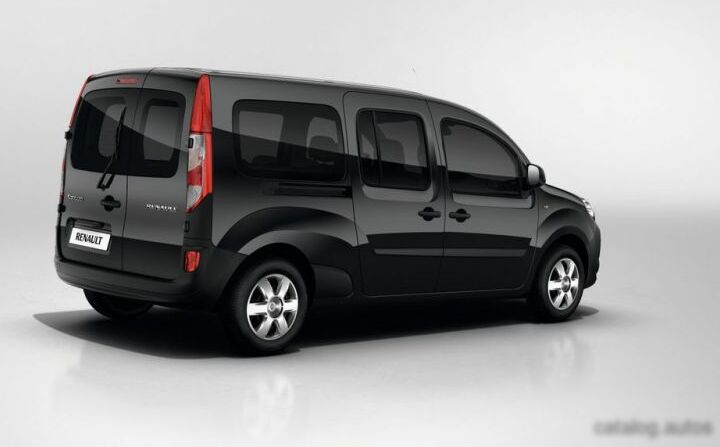
The Renault Grand Kangoo II, specifically the 1.5 dCi variant producing 90 horsepower, represented a practical and economical choice within the European light commercial vehicle and multi-purpose vehicle (MPV) segment. Introduced with the 2013 facelift, this version of the Kangoo aimed to balance affordability, fuel efficiency, and versatility for families and businesses alike. While the Kangoo was never a major seller in the US market due to the popularity of minivans and larger SUVs, it enjoyed considerable success in Europe as a compact, adaptable vehicle.
Technical Specifications
| Brand | Renault |
| Model | Kangoo |
| Generation | Grand Kangoo II (facelift 2013) |
| Type (Engine) | 1.5 dCi (90 Hp) |
| Start of production | 2013 |
| End of production | 2018 |
| Powertrain Architecture | Internal Combustion engine |
| Body type | Minivan |
| Seats | 7 |
| Doors | 5 |
| Fuel consumption (urban) | 5.9 l/100 km (39.9 US mpg, 47.9 UK mpg, 16.9 km/l) |
| Fuel consumption (extra urban) | 4.6 l/100 km (51.1 US mpg, 61.4 UK mpg, 21.7 km/l) |
| Fuel consumption (combined) | 5.1 l/100 km (46.1 US mpg, 55.4 UK mpg, 19.6 km/l) |
| CO2 emissions | 133 g/km |
| Fuel Type | Diesel |
| Acceleration 0 – 100 km/h | 13.3 sec |
| Acceleration 0 – 62 mph | 13.3 sec |
| Acceleration 0 – 60 mph | 12.6 sec |
| Maximum speed | 160 km/h (99.42 mph) |
| Emission standard | Euro 5 |
| Weight-to-power ratio | 15.9 kg/Hp, 62.9 Hp/tonne |
| Weight-to-torque ratio | 7.2 kg/Nm, 139.9 Nm/tonne |
| Power | 90 Hp @ 4000 rpm |
| Power per litre | 61.6 Hp/l |
| Torque | 200 Nm @ 1750 rpm (147.51 lb.-ft. @ 1750 rpm) |
| Engine layout | Front, Transverse |
| Engine Model/Code | K9K |
| Engine displacement | 1461 cm3 (89.16 cu. in.) |
| Number of cylinders | 4 |
| Engine configuration | Inline |
| Number of valves per cylinder | 2 |
| Fuel injection system | Diesel Commonrail |
| Engine aspiration | Turbocharger, Intercooler |
| Engine oil capacity | 4.5 l (4.76 US qt | 3.96 UK qt) |
| Coolant capacity | 7.2 l (7.61 US qt | 6.34 UK qt) |
| Kerb Weight | 1430 kg (3152.61 lbs.) |
| Max. weight | 2200 kg (4850.17 lbs.) |
| Max load | 770 kg (1697.56 lbs.) |
| Trunk (boot) space – minimum | 300 l (10.59 cu. ft.) |
| Trunk (boot) space – maximum | 930 l (32.84 cu. ft.) |
| Fuel tank capacity | 60 l (15.85 US gal | 13.2 UK gal) |
| Permitted trailer load with brakes (12%) | 1050 kg (2314.85 lbs.) |
| Permitted trailer load without brakes | 750 kg (1653.47 lbs.) |
| Length | 4666 mm (183.7 in.) |
| Width | 1829 mm (72.01 in.) |
| Width including mirrors | 2138 mm (84.17 in.) |
| Height | 1802 mm (70.94 in.) |
| Wheelbase | 3081 mm (121.3 in.) |
| Front track | 1521 mm (59.88 in.) |
| Rear track | 1533 mm (60.35 in.) |
| Front overhang | 875 mm (34.45 in.) |
| Rear overhang | 710 mm (27.95 in.) |
| Ride height (ground clearance) | 164-148 mm (6.46 – 5.83 in.) |
| Minimum turning circle | 11.9 m (39.04 ft.) |
| Drivetrain | Front wheel drive |
| Number of gears and type of gearbox | 5 gears, manual transmission |
| Front suspension | Independent type McPherson |
| Rear suspension | Torsion |
| Front brakes | Ventilated discs |
| Rear brakes | Disc |
| Assisting systems | ABS (Anti-lock braking system) |
| Steering type | Steering rack and pinion |
| Power steering | Electric Steering |
| Tires size | 195/65 R15 |
| Wheel rims size | 15 |
Positioning and Market Role
The 1.5 dCi 90 hp engine represented the entry-level powertrain option for the Grand Kangoo II after the 2013 facelift. Renault offered more powerful diesel variants, including a 110 hp version of the same 1.5 dCi engine, and even a 1.6L petrol engine. The 90 hp model was specifically targeted at buyers prioritizing fuel economy and lower running costs over outright performance. It was a popular choice for families needing a versatile vehicle for school runs and leisure activities, as well as for small businesses requiring a practical van for deliveries and service calls. The Grand Kangoo, with its seven-seat configuration, filled a niche between smaller MPVs and larger, more expensive people carriers.
Engine and Performance Characteristics
The K9K 1.5 dCi engine was a mainstay of Renault’s diesel lineup for many years, known for its robustness and fuel efficiency. The 90 hp version, while not particularly quick, provided adequate power for everyday driving. Its 200 Nm (147.51 lb.-ft.) of torque, available from 1750 rpm, made it reasonably drivable even when fully loaded. Acceleration from 0-60 mph took around 12.6 seconds, and top speed was limited to 99.42 mph. The engine’s turbocharger and intercooler helped to improve efficiency and reduce emissions, meeting Euro 5 standards. The five-speed manual transmission was the standard offering, contributing to the vehicle’s affordability and simplicity.
Comparison with Other Variants
Compared to the 110 hp version of the 1.5 dCi, the 90 hp model offered a noticeable difference in performance. The higher-powered engine provided quicker acceleration and more effortless cruising, particularly when carrying a full load or towing a trailer. However, the 110 hp variant also came with a slightly higher price tag and marginally lower fuel economy. The petrol-powered 1.6L engine offered a different driving experience, being generally smoother and quieter but significantly less fuel-efficient and lacking the low-end torque of the diesel. Maintenance costs for the 1.5 dCi 90 hp were generally lower than those for the petrol engine, due to the diesel’s inherent durability and the simpler emissions control systems (compared to later diesel variants with more complex particulate filters). The 90 hp model was also often favored by drivers who preferred the feel and responsiveness of a manual transmission.
Technology and Features
The 2013 facelift brought some updates to the Grand Kangoo II, including revised styling, improved interior materials, and enhanced safety features. The 1.5 dCi 90 hp model typically came equipped with features such as ABS, power steering, and a basic audio system. Optional extras included air conditioning, electric windows, and a navigation system. The Grand Kangoo’s modular interior was a key selling point, with its flexible seating arrangements and ample storage space. The rear seats could be folded flat or even removed completely, creating a large cargo area. The sliding rear doors provided easy access, particularly in tight parking spaces.
Reliability and Common Issues
The Renault Grand Kangoo II, in general, proved to be a relatively reliable vehicle, particularly the earlier diesel models. The 1.5 dCi engine, while robust, was not without its potential issues. Common problems included turbocharger failures, injector problems, and issues with the diesel particulate filter (DPF). Regular servicing and the use of high-quality oil were essential for maintaining the engine’s health. The electrical system could also be prone to occasional glitches. However, overall, the Grand Kangoo II 1.5 dCi 90 hp offered a good balance of practicality, affordability, and reliability, making it a popular choice for those seeking a versatile and economical MPV.