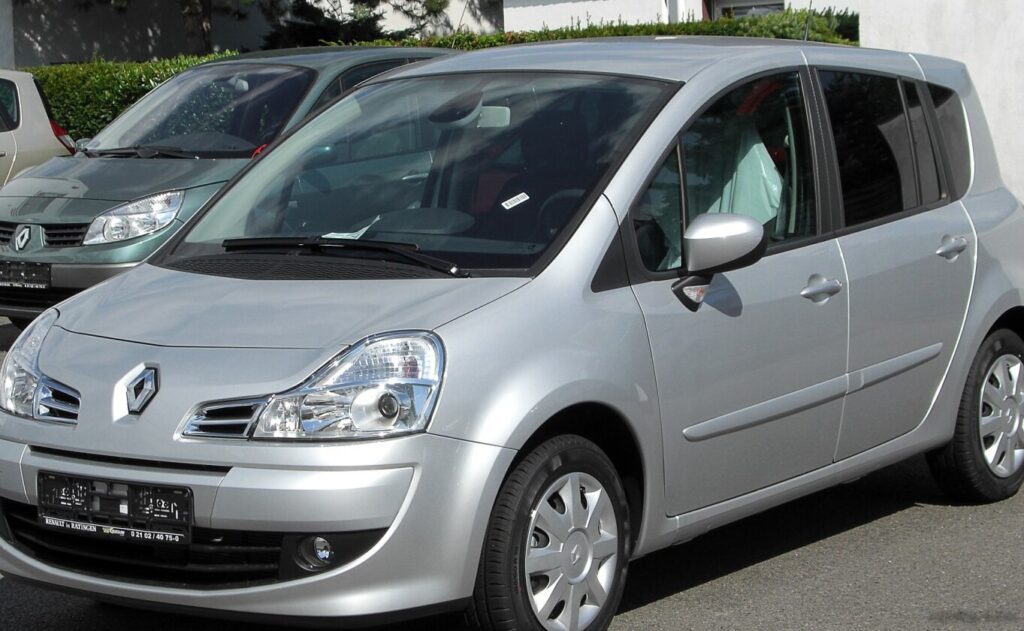
The Renault Grand Modus 1.2 TCe 16V (100 hp) represents a specific variant within the second-generation (Phase II) of Renault’s Modus mini MPV, produced from 2008 to 2012. Positioned as a mid-range offering, this version aimed to balance affordability with a more modern powertrain compared to the base 1.2 16V naturally aspirated engine. The Grand Modus, an evolution of the original Modus, offered increased practicality with its larger dimensions and more versatile interior, targeting families and individuals seeking a compact yet spacious vehicle. This particular 1.2 TCe engine was Renault’s first foray into direct injection turbocharged engines in this segment, offering improved performance and fuel efficiency.
Technical Specifications
| Brand | Renault |
| Model | Modus |
| Generation | Grand Modus (Phase II, 2008) |
| Type (Engine) | 1.2 TCe 16V (100 Hp) |
| Start of production | 2008 |
| End of production | 2012 |
| Powertrain Architecture | Internal Combustion engine |
| Body type | Hatchback |
| Seats | 5 |
| Doors | 5 |
| Fuel consumption (urban) | 7.6 l/100 km (30.9 US mpg, 37.2 UK mpg, 13.2 km/l) |
| Fuel consumption (extra urban) | 5 l/100 km (47 US mpg, 56.5 UK mpg, 20 km/l) |
| Fuel consumption (combined) | 5.9 l/100 km (39.9 US mpg, 47.9 UK mpg, 16.9 km/l) |
| CO2 emissions | 140 g/km |
| Fuel Type | Petrol (Gasoline) |
| Acceleration 0 – 100 km/h | 11.4 sec |
| Acceleration 0 – 62 mph | 11.4 sec |
| Acceleration 0 – 60 mph | 10.8 sec |
| Maximum speed | 180 km/h (111.85 mph) |
| Emission standard | Euro 4 |
| Weight-to-power ratio | 11.6 kg/Hp, 86.2 Hp/tonne |
| Weight-to-torque ratio | 8 kg/Nm, 125 Nm/tonne |
| Power | 100 Hp @ 5500 rpm |
| Power per litre | 87 Hp/l |
| Torque | 145 Nm @ 3000 rpm (106.95 lb.-ft. @ 3000 rpm) |
| Engine layout | Front, Transverse |
| Engine Model/Code | D4F Turbo |
| Engine displacement | 1149 cm3 (70.12 cu. in.) |
| Number of cylinders | 4 |
| Engine configuration | Inline |
| Cylinder Bore | 69 mm (2.72 in.) |
| Piston Stroke | 76.8 mm (3.02 in.) |
| Compression ratio | 9.8:1 |
| Number of valves per cylinder | 4 |
| Fuel injection system | Multi-port manifold injection |
| Engine aspiration | Turbocharger, Intercooler |
| Engine oil capacity | 4.2 l (4.44 US qt | 3.7 UK qt) |
| Coolant | 5.5 l (5.81 US qt | 4.84 UK qt) |
| Kerb Weight | 1160 kg (2557.36 lbs.) |
| Max. weight | 1650 kg (3637.63 lbs.) |
| Max load | 490 kg (1080.27 lbs.) |
| Trunk (boot) space – minimum | 305 l (10.77 cu. ft.) |
| Trunk (boot) space – maximum | 1454 l (51.35 cu. ft.) |
| Fuel tank capacity | 51 l (13.47 US gal | 11.22 UK gal) |
| Max. roof load | 80 kg (176.37 lbs.) |
| Permitted trailer load with brakes (12%) | 900 kg (1984.16 lbs.) |
| Permitted trailer load without brakes | 550 kg (1212.54 lbs.) |
| Permitted towbar download | 75 kg (165.35 lbs.) |
| Length | 4034 mm (158.82 in.) |
| Width | 1709 mm (67.28 in.) |
| Width including mirrors | 1960 mm (77.17 in.) |
| Height | 1589 mm (62.56 in.) |
| Wheelbase | 2575 mm (101.38 in.) |
| Front track | 1472 mm (57.95 in.) |
| Rear (Back) track | 1450 mm (57.09 in.) |
| Front overhang | 802 mm (31.57 in.) |
| Rear overhang | 657 mm (25.87 in.) |
| Ride height (ground clearance) | 120 mm (4.72 in.) |
| Minimum turning circle (turning diameter) | 10.4 m (34.12 ft.) |
| Drivetrain Architecture | The Internal combustion engine (ICE) drives the front wheels of the vehicle. |
| Drive wheel | Front wheel drive |
| Number of gears and type of gearbox | 5 gears, manual transmission |
| Front suspension | Independent, type McPherson with coil spring and anti-roll bar |
| Rear suspension | Semi-independent, coil spring |
| Front brakes | Ventilated discs |
| Rear brakes | Drum |
| Assisting systems | ABS (Anti-lock braking system) |
| Steering type | Steering rack and pinion |
| Tires size | 165/65 R15; 185/55 R16 |
| Wheel rims size | 15; 16 |
Powertrain & Engine Architecture
The heart of this Grand Modus variant is the D4F 812 engine, a 1.2-liter inline-four cylinder petrol engine equipped with a turbocharger and intercooler. This engine, part of Renault’s D4F family, utilizes multi-point fuel injection and a single overhead camshaft (SOHC) valvetrain with four valves per cylinder. The turbocharger, a Garrett GT15 unit, provides a boost to increase power output. The engine’s 9.8:1 compression ratio is a compromise between efficiency and performance. The 5-speed manual transmission was the standard offering, chosen for its balance of cost and usability. The gearbox featured relatively long gearing, prioritizing fuel economy over outright acceleration.
Driving Characteristics
The 100 hp 1.2 TCe engine provided a noticeable improvement in performance compared to the base 1.2-liter naturally aspirated engine. While not a particularly sporty vehicle, the turbocharged engine offered sufficient power for everyday driving and highway cruising. Acceleration from 0-60 mph took around 10.8 seconds, and top speed was approximately 112 mph. The turbocharger did exhibit some lag at lower engine speeds, but once boosted, the engine delivered a reasonably linear power delivery. The long gearing of the manual transmission meant that the engine often felt strained when accelerating hard, requiring frequent downshifts. Overall, the driving experience was comfortable and practical, but not particularly engaging.
Equipment & Trim Levels
The 1.2 TCe 16V Grand Modus typically came equipped with features such as air conditioning, power steering, electric front windows, and a basic audio system. Higher trim levels added features like alloy wheels, rear parking sensors, and upgraded interior trim. The interior was characterized by its functional design and durable materials. The rear seats were capable of sliding and folding, offering flexibility in terms of passenger and cargo space. Safety features included ABS brakes, front airbags, and seatbelt pretensioners.
Chassis & Braking
The Grand Modus utilized a McPherson strut front suspension and a semi-independent coil spring rear suspension. This setup provided a comfortable ride, but handling was not particularly sharp. The front brakes were ventilated discs, while the rear brakes were drums. The braking system was adequate for everyday use, but lacked the stopping power of more performance-oriented vehicles. The steering was light and easy to use, making it well-suited for urban driving.
Market Reception & Comparison
The Renault Grand Modus 1.2 TCe 16V was generally well-received by critics as a practical and affordable family vehicle. The turbocharged engine was praised for its improved performance and fuel efficiency compared to the base engine. However, some reviewers criticized the engine’s turbo lag and the long gearing of the manual transmission. Compared to other mini MPVs on the market, such as the Opel Meriva and Fiat Multipla, the Grand Modus offered a competitive level of space, practicality, and value for money. Fuel economy was a strong point, averaging around 40 mpg in combined driving.
Legacy
The D4F engine family, including the 1.2 TCe variant, proved to be relatively reliable, although some owners have reported issues with the turbocharger and fuel injectors. The Grand Modus 1.2 TCe remains a relatively affordable option on the used car market. Its practicality, fuel efficiency, and reasonable running costs make it a suitable choice for budget-conscious buyers seeking a small family vehicle. However, potential buyers should be aware of the potential for turbocharger and fuel injector issues and ensure that the vehicle has been properly maintained.