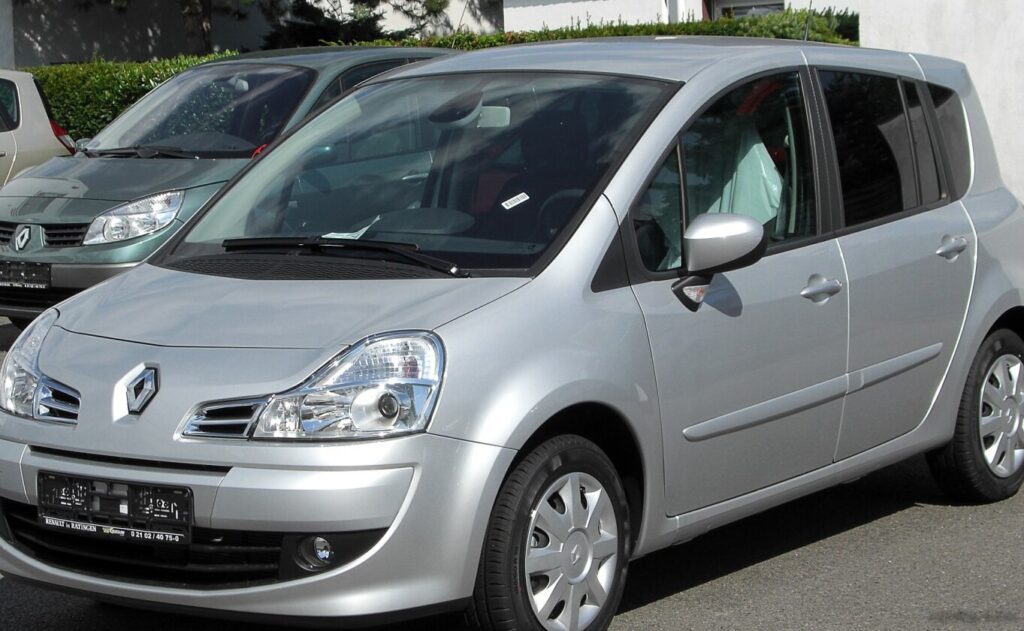
The Renault Grand Modus 1.5 dCi (103 hp) ESP FAP, produced between 2008 and 2012, represented a significant offering in the European micro-MPV segment. As a Phase II update to the original Modus, the Grand Modus offered increased practicality with its larger dimensions and five-seat configuration. This particular variant, powered by the 1.5-liter dCi diesel engine paired with a manual transmission, aimed to balance fuel efficiency with acceptable performance for everyday driving. It occupied a mid-range position within the Grand Modus lineup, offering a step up in power and features compared to the base engine options while remaining more affordable than the higher-output versions.
Technical Specifications
| Brand | Renault |
| Model | Modus |
| Generation | Grand Modus (Phase II, 2008) |
| Type (Engine) | 1.5 dCi (103 Hp) ESP FAP |
| Start of production | 2008 |
| End of production | 2012 |
| Powertrain Architecture | Internal Combustion engine |
| Body type | Hatchback |
| Seats | 5 |
| Doors | 5 |
| Fuel consumption (urban) | 5.7 l/100 km (41.3 US mpg, 49.6 UK mpg, 17.5 km/l) |
| Fuel consumption (extra urban) | 4.3 l/100 km (54.7 US mpg, 65.7 UK mpg, 23.3 km/l) |
| Fuel consumption (combined) | 4.7 l/100 km (50 US mpg, 60.1 UK mpg, 21.3 km/l) |
| CO2 emissions | 125 g/km |
| Fuel Type | Diesel |
| Acceleration 0 – 100 km/h | 11.9 sec |
| Acceleration 0 – 62 mph | 11.9 sec |
| Acceleration 0 – 60 mph | 11.3 sec |
| Maximum speed | 184 km/h (114.33 mph) |
| Emission standard | Euro 4 |
| Weight-to-power ratio | 11.9 kg/Hp, 83.7 Hp/tonne |
| Weight-to-torque ratio | 5.1 kg/Nm, 195.1 Nm/tonne |
| Power | 103 Hp @ 4000 rpm |
| Power per litre | 70.5 Hp/l |
| Torque | 240 Nm @ 2000 rpm (177.01 lb.-ft. @ 2000 rpm) |
| Engine layout | Front, Transverse |
| Engine Model/Code | K9K Turbo |
| Engine displacement | 1461 cm3 (89.16 cu. in.) |
| Number of cylinders | 4 |
| Engine configuration | Inline |
| Cylinder Bore | 76 mm (2.99 in.) |
| Piston Stroke | 80.5 mm (3.17 in.) |
| Compression ratio | 17.9:1 |
| Number of valves per cylinder | 2 |
| Fuel injection system | Diesel Commonrail |
| Engine aspiration | Turbocharger, Intercooler |
| Engine oil capacity | 4.6 l (4.86 US qt | 4.05 UK qt) |
| Coolant | 6.4 l (6.76 US qt | 5.63 UK qt) |
| Kerb Weight | 1230 kg (2711.69 lbs.) |
| Max. weight | 1715 kg (3780.93 lbs.) |
| Max load | 485 kg (1069.24 lbs.) |
| Trunk (boot) space – minimum | 305 l (10.77 cu. ft.) |
| Trunk (boot) space – maximum | 1454 l (51.35 cu. ft.) |
| Fuel tank capacity | 51 l (13.47 US gal | 11.22 UK gal) |
| Max. roof load | 80 kg (176.37 lbs.) |
| Permitted trailer load with brakes (12%) | 850 kg (1873.93 lbs.) |
| Permitted trailer load without brakes | 550 kg (1212.54 lbs.) |
| Permitted towbar download | 75 kg (165.35 lbs.) |
| Length | 4034 mm (158.82 in.) |
| Width | 1709 mm (67.28 in.) |
| Width including mirrors | 1960 mm (77.17 in.) |
| Height | 1589 mm (62.56 in.) |
| Wheelbase | 2575 mm (101.38 in.) |
| Front track | 1472 mm (57.95 in.) |
| Rear (Back) track | 1450 mm (57.09 in.) |
| Front overhang | 802 mm (31.57 in.) |
| Rear overhang | 657 mm (25.87 in.) |
| Ride height (ground clearance) | 120 mm (4.72 in.) |
| Minimum turning circle (turning diameter) | 10.4 m (34.12 ft.) |
| Drivetrain Architecture | The Internal combustion engine (ICE) drives the front wheels of the vehicle. |
| Drive wheel | Front wheel drive |
| Number of gears and type of gearbox | 6 gears, manual transmission |
| Front suspension | Independent, type McPherson with coil spring and anti-roll bar |
| Rear suspension | Semi-independent, coil spring |
| Front brakes | Ventilated discs |
| Rear brakes | Drum |
| Assisting systems | ABS (Anti-lock braking system) |
| Steering type | Steering rack and pinion |
| Power steering | Electric Steering |
| Tires size | 165/65 R15; 185/55 R16 |
| Wheel rims size | 15; 16 |
Powertrain & Engine Architecture
The heart of this Grand Modus variant is the Renault K9K 1.5-liter turbocharged diesel engine. This engine, a mainstay in Renault and Nissan vehicles for many years, is known for its robustness and fuel efficiency. The ‘K9K’ code designates a family of four-cylinder diesel engines, and this specific iteration, producing 103 horsepower at 4000 rpm and 240 Nm of torque at 2000 rpm, utilizes a common rail direct injection system. This system allows for precise fuel delivery, optimizing combustion and reducing emissions. The engine also features a turbocharger with an intercooler, enhancing power output. The six-speed manual transmission was the standard offering, providing a good balance between fuel economy and driver control. The transmission’s gear ratios were tuned to maximize the engine’s torque, providing adequate acceleration for everyday driving situations.
Driving Characteristics
The 1.5 dCi 103 hp Grand Modus offered a practical and economical driving experience. While not particularly sporty, the engine provided sufficient power for comfortable cruising and overtaking on highways. The manual transmission allowed drivers to maintain control over gear selection, optimizing fuel efficiency or extracting more power when needed. Compared to the lower-powered 1.5 dCi variants, this version offered noticeably improved acceleration and responsiveness. However, it didn’t match the performance of the more expensive petrol engines. The suspension setup, tuned for comfort, absorbed bumps and imperfections in the road well, making it a pleasant vehicle for long journeys. The steering was light and easy to use, making it maneuverable in urban environments.
Equipment & Trim Levels
The Grand Modus 1.5 dCi (103 hp) ESP FAP typically came equipped with features such as air conditioning, power steering, electric front windows, and a basic audio system. The ‘ESP’ designation indicates the inclusion of Electronic Stability Program, a crucial safety feature. ‘FAP’ stands for ‘Filtre à Particules,’ or particulate filter, designed to reduce harmful emissions. Higher trim levels offered options like alloy wheels, rear parking sensors, upgraded audio systems, and different interior upholstery choices. The interior was designed with practicality in mind, featuring durable materials and a modular seating system that allowed for flexible cargo space.
Chassis & Braking
The Grand Modus utilized a McPherson strut front suspension and a semi-independent coil spring rear suspension. This setup provided a good balance between ride comfort and handling. The front brakes were ventilated discs, offering good stopping power, while the rear brakes were drums, a cost-saving measure common in this segment. The electric power steering provided light and precise steering feel. The vehicle’s relatively lightweight construction contributed to its agility and fuel efficiency.
Market Reception & Comparison
The Renault Grand Modus 1.5 dCi (103 hp) was generally well-received by critics as a practical and economical family vehicle. It was praised for its spacious interior, fuel efficiency, and comfortable ride. However, some reviewers noted that the engine could feel strained when fully loaded or driving uphill. Compared to other micro-MPVs of the time, such as the Fiat Multipla or Opel Meriva, the Grand Modus offered a competitive level of practicality and fuel economy. The 1.5 dCi engine provided a good balance between performance and running costs, making it a popular choice for families and commuters.
Legacy
The Renault Grand Modus 1.5 dCi (103 hp) has proven to be a relatively reliable vehicle in the used car market. The K9K engine is known for its durability, and with regular maintenance, it can provide many years of service. However, potential buyers should be aware of the potential for issues with the diesel particulate filter (DPF), particularly if the vehicle has been primarily used for short journeys. Overall, the Grand Modus remains a practical and affordable option for those seeking a spacious and economical family vehicle.