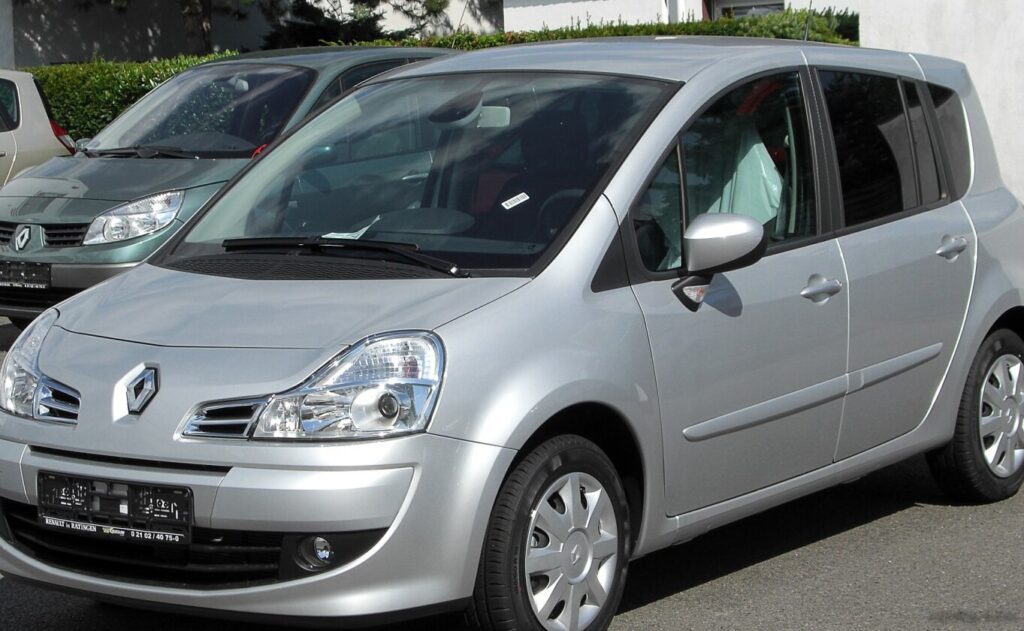
The Renault Grand Modus 1.5 dCi (86 hp) FAP, produced between 2008 and 2012, represented an entry-level diesel option within the second-generation (Phase II) Grand Modus range. Positioned as a practical and economical family vehicle, it aimed to provide affordable transportation with a focus on fuel efficiency. The Grand Modus itself was a five-door mini MPV, a larger version of the standard Modus, designed to offer increased interior space and versatility. This variant played a significant role in the European market, where compact MPVs were highly popular, offering a blend of hatchback practicality and MPV space.
Technical Specifications
| Brand | Renault |
| Model | Modus |
| Generation | Grand Modus (Phase II, 2008) |
| Type (Engine) | 1.5 dCi (86 Hp) FAP |
| Start of production | 2008 |
| End of production | 2012 |
| Powertrain Architecture | Internal Combustion engine |
| Body type | Hatchback |
| Seats | 5 |
| Doors | 5 |
| Fuel consumption (urban) | 5.7 l/100 km (41.3 US mpg, 49.6 UK mpg, 17.5 km/l) |
| Fuel consumption (extra urban) | 4.3 l/100 km (54.7 US mpg, 65.7 UK mpg, 23.3 km/l) |
| Fuel consumption (combined) | 4.7 l/100 km (50 US mpg, 60.1 UK mpg, 21.3 km/l) |
| CO2 emissions | 125 g/km |
| Fuel Type | Diesel |
| Acceleration 0 – 100 km/h | 13.7 sec |
| Acceleration 0 – 62 mph | 13.7 sec |
| Acceleration 0 – 60 mph | 13 sec |
| Maximum speed | 172 km/h (106.88 mph) |
| Emission standard | Euro 4 |
| Weight-to-power ratio | 14.3 kg/Hp, 69.9 Hp/tonne |
| Weight-to-torque ratio | 5.6 kg/Nm, 178.9 Nm/tonne |
| Power | 86 Hp @ 4000 rpm |
| Power per litre | 58.9 Hp/l |
| Torque | 220 Nm @ 2250 rpm (162.26 lb.-ft. @ 2250 rpm) |
| Engine layout | Front, Transverse |
| Engine Model/Code | K9K Turbo |
| Engine displacement | 1461 cm3 (89.16 cu. in.) |
| Number of cylinders | 4 |
| Engine configuration | Inline |
| Cylinder Bore | 76 mm (2.99 in.) |
| Piston Stroke | 80.5 mm (3.17 in.) |
| Compression ratio | 17.9:1 |
| Number of valves per cylinder | 2 |
| Fuel injection system | Diesel Commonrail |
| Engine aspiration | Turbocharger, Intercooler |
| Engine oil capacity | 4.6 l (4.86 US qt | 4.05 UK qt) |
| Coolant capacity | 5.7 l (6.02 US qt | 5.02 UK qt) |
| Kerb Weight | 1230 kg (2711.69 lbs.) |
| Max. weight | 1715 kg (3780.93 lbs.) |
| Max load | 485 kg (1069.24 lbs.) |
| Trunk (boot) space – minimum | 305 l (10.77 cu. ft.) |
| Trunk (boot) space – maximum | 1454 l (51.35 cu. ft.) |
| Fuel tank capacity | 51 l (13.47 US gal | 11.22 UK gal) |
| Max. roof load | 80 kg (176.37 lbs.) |
| Permitted trailer load with brakes (12%) | 850 kg (1873.93 lbs.) |
| Permitted trailer load without brakes | 550 kg (1212.54 lbs.) |
| Permitted towbar download | 75 kg (165.35 lbs.) |
| Length | 4034 mm (158.82 in.) |
| Width | 1709 mm (67.28 in.) |
| Width including mirrors | 1960 mm (77.17 in.) |
| Height | 1589 mm (62.56 in.) |
| Wheelbase | 2575 mm (101.38 in.) |
| Front track | 1472 mm (57.95 in.) |
| Rear track | 1450 mm (57.09 in.) |
| Front overhang | 802 mm (31.57 in.) |
| Rear overhang | 657 mm (25.87 in.) |
| Ride height (ground clearance) | 120 mm (4.72 in.) |
| Minimum turning circle | 10.4 m (34.12 ft.) |
| Drivetrain | Front wheel drive |
| Number of gears and type of gearbox | 6 gears, manual transmission |
| Front suspension | Independent, type McPherson with coil spring and anti-roll bar |
| Rear suspension | Semi-independent, coil spring |
| Front brakes | Ventilated discs |
| Rear brakes | Drum |
| Assisting systems | ABS (Anti-lock braking system) |
| Steering type | Steering rack and pinion |
| Tires size | 165/65 R15; 185/55 R16 |
| Wheel rims size | 15; 16 |
Powertrain & Engine Architecture
The heart of this Grand Modus variant is the Renault K9K 1.5-liter turbocharged diesel engine. This engine, part of the K-series family, had been a mainstay in Renault and Nissan vehicles for many years. The 86 hp version, often identified by specific engine codes, utilized a common rail direct injection system, delivering fuel at high pressure for improved combustion efficiency and reduced emissions. The turbocharger, coupled with an intercooler, boosted power output despite the relatively small displacement. The engine featured a two-valve per cylinder configuration and a relatively high compression ratio of 17.9:1, typical for diesel engines. The FAP (Filtre à Particules) or diesel particulate filter was a crucial component, designed to trap soot particles and reduce harmful emissions, meeting Euro 4 standards. The engine was transversely mounted, driving the front wheels through a six-speed manual transmission. This transmission was chosen for its balance of fuel economy and usability, although an automatic transmission was not offered with this specific engine.
Driving Characteristics
The 1.5 dCi 86 hp Grand Modus offered modest performance. Acceleration from 0-62 mph took around 13.7 seconds, and top speed was approximately 107 mph. The engine’s 220 Nm of torque, available from 2250 rpm, provided adequate pulling power for everyday driving and overtaking maneuvers, but it wasn’t a particularly sporty vehicle. The six-speed manual transmission helped to keep the engine in its optimal power band. Compared to higher-powered versions of the Grand Modus, such as those with the 1.6 petrol engine, the diesel felt less responsive but significantly more fuel-efficient. The gear ratios were tuned for economy rather than outright performance, resulting in a relaxed driving experience.
Equipment & Trim Levels
The 1.5 dCi 86 hp Grand Modus typically came with a reasonable level of standard equipment. This included power steering, central locking, electric front windows, and an ABS anti-lock braking system. Interior upholstery was generally cloth, with a functional, if somewhat basic, dashboard layout. Optional extras could include air conditioning, alloy wheels, a CD stereo system, and rear parking sensors. Trim levels varied depending on the market, but this engine was generally found in mid-range specifications, offering a good balance of features and affordability.
Chassis & Braking
The Grand Modus utilized a McPherson strut front suspension and a semi-independent coil spring rear suspension. This setup provided a comfortable ride, although it wasn’t particularly sporty in handling. Front brakes were ventilated discs, offering good stopping power, while rear brakes were drums, a cost-saving measure common in this segment. The suspension was tuned for comfort and practicality, prioritizing ride quality over sharp handling. Stabilizer bars were fitted to both axles to reduce body roll during cornering.
Market Reception & Comparison
The Renault Grand Modus 1.5 dCi 86 hp FAP was generally well-received as an economical and practical family vehicle. Critics praised its fuel efficiency and spacious interior, but some found the performance to be somewhat underwhelming. Compared to other diesel-powered mini MPVs of the time, such as the Opel Meriva or Fiat Multipla, the Grand Modus offered a competitive level of fuel economy and practicality. The diesel engine provided significantly better fuel economy than the petrol alternatives, making it a popular choice for drivers covering high mileages. Reliability was generally good, although the diesel particulate filter could require occasional maintenance.
Legacy
The Renault Grand Modus 1.5 dCi 86 hp FAP remains a relatively common sight on used car markets today. The K9K engine is known for its durability, although regular maintenance is essential, particularly regarding the diesel particulate filter. These vehicles offer affordable transportation and good fuel economy, making them a practical choice for budget-conscious buyers. While not a performance icon, the Grand Modus 1.5 dCi represents a sensible and economical option within the compact MPV segment, and the K9K engine has proven to be a reliable workhorse for many years.