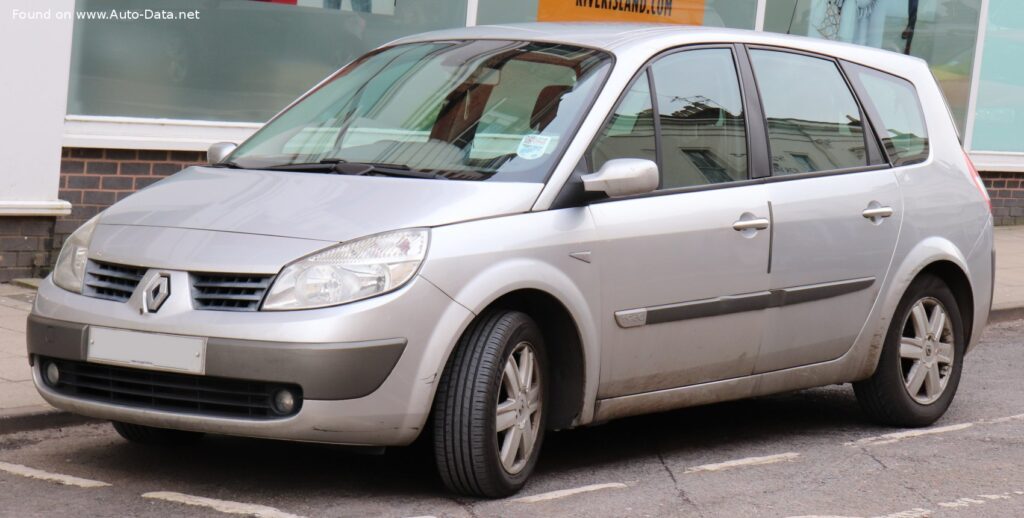
The Renault Grand Scenic II (Phase I) 1.6 16V, produced from 2004 to 2005, represents a significant iteration in Renault’s popular minivan lineup. Positioned as a compact multi-purpose vehicle (MPV), the Grand Scenic II aimed to provide family-oriented practicality with a focus on interior space and versatility. This model, while not officially sold in the United States, was a key player in the European market, competing with vehicles like the Citroën C4 Picasso and Opel Zafira. The “Grand” designation indicates a seven-seat configuration, differentiating it from the standard five-seat Scenic II.
Renault Grand Scenic II: An Overview
The Scenic line, launched in 1996, pioneered the modern compact MPV segment. The second generation, introduced in 2003, built upon this foundation with improved styling, enhanced interior quality, and a range of efficient engine options. The Phase I models, like the 1.6 16V, represent the initial release of the Grand Scenic II, setting the stage for subsequent updates and refinements. Its primary appeal lay in its ability to comfortably transport larger families while maintaining a relatively manageable footprint for urban driving.
Engine & Performance
The Grand Scenic II 1.6 16V is powered by Renault’s K4M engine, a 1.6-liter inline-four cylinder gasoline engine. This naturally aspirated engine produces 113 horsepower at 6000 rpm and 152 Nm (112.11 lb.-ft.) of torque at 4200 rpm. While not a performance-oriented engine, it provided adequate power for everyday driving and family transportation. The engine’s power-to-liter ratio is 70.7 hp/l. Acceleration from 0 to 100 km/h (0-62 mph) takes 12.9 seconds, and 0-60 mph is achieved in approximately 12.3 seconds. The top speed is rated at 185 km/h (114.95 mph). The engine is transversely mounted at the front of the vehicle and is paired with a five-speed manual transmission, driving the front wheels.
Fuel economy figures are rated at 9.6 l/100 km (24.5 US mpg) in urban conditions, 6.2 l/100 km (37.9 US mpg) on the extra-urban cycle, and a combined consumption of 7.4 l/100 km (31.8 US mpg). CO2 emissions are rated at 177 g/km, placing it within the Euro 4 emission standard for its time. The weight-to-power ratio is 12.8 kg/Hp, and the weight-to-torque ratio is 9.5 kg/Nm.
Design & Features
The Renault Grand Scenic II (Phase I) features a distinctive MPV body style characterized by its tall roofline, large windows, and practical interior layout. The five-door design provides easy access to all seating positions. A key feature is its seven-seat configuration, with the third-row seats folding flat into the floor when not in use, maximizing cargo space. The interior is designed with family needs in mind, offering a modular seating system and numerous storage compartments.
Safety features for the time included ABS (Anti-lock Braking System). The Grand Scenic II prioritized practicality and comfort over outright luxury. Interior materials were durable and easy to clean, reflecting its intended use as a family vehicle. The dashboard layout was functional and ergonomically designed, with controls within easy reach of the driver. Trunk space is a significant asset, offering 513 liters (18.12 cu. ft.) with all seats in place and expanding to 2015 liters (71.16 cu. ft.) with the rear seats folded down.
Technical Specifications
| Brand | Renault |
| Model | Scenic |
| Generation | Grand Scenic II (Phase I) |
| Type (Engine) | 1.6 16V (113 Hp) |
| Start of production | 2004 |
| End of production | 2005 |
| Powertrain Architecture | Internal Combustion engine |
| Body type | Minivan |
| Seats | 7 |
| Doors | 5 |
| Fuel consumption (urban) | 9.6 l/100 km (24.5 US mpg) |
| Fuel consumption (extra urban) | 6.2 l/100 km (37.9 US mpg) |
| Fuel consumption (combined) | 7.4 l/100 km (31.8 US mpg) |
| CO2 emissions | 177 g/km |
| Fuel Type | Petrol (Gasoline) |
| Acceleration 0 – 100 km/h | 12.9 sec |
| Acceleration 0 – 62 mph | 12.9 sec |
| Acceleration 0 – 60 mph | 12.3 sec |
| Maximum speed | 185 km/h (114.95 mph) |
| Emission standard | Euro 4 |
| Weight-to-power ratio | 12.8 kg/Hp |
| Weight-to-torque ratio | 9.5 kg/Nm |
| Power | 113 Hp @ 6000 rpm |
| Torque | 152 Nm @ 4200 rpm (112.11 lb.-ft. @ 4200 rpm) |
| Engine layout | Front, Transverse |
| Engine Model/Code | K4M |
| Engine displacement | 1598 cm3 (97.52 cu. in.) |
| Number of cylinders | 4 |
| Engine configuration | Inline |
| Cylinder Bore | 79.5 mm (3.13 in.) |
| Piston Stroke | 80.5 mm (3.17 in.) |
| Compression ratio | 10:1 |
| Number of valves per cylinder | 4 |
| Fuel injection system | Multi-port manifold injection |
| Engine aspiration | Naturally aspirated engine |
| Valvetrain | DOHC |
| Engine oil capacity | 4.8 l (5.07 US qt | 4.22 UK qt) |
| Kerb Weight | 1445 kg (3185.68 lbs.) |
| Max. weight | 2120 kg (4673.8 lbs.) |
| Max load | 675 kg (1488.12 lbs.) |
| Trunk (boot) space – minimum | 513 l (18.12 cu. ft.) |
| Trunk (boot) space – maximum | 2015 l (71.16 cu. ft.) |
| Fuel tank capacity | 60 l (15.85 US gal | 13.2 UK gal) |
| Max. roof load | 80 kg (176.37 lbs.) |
| Permitted trailer load with brakes (12%) | 1300 kg (2866.01 lbs.) |
| Permitted trailer load without brakes | 650 kg (1433 lbs.) |
| Permitted towbar download | 75 kg (165.35 lbs.) |
| Length | 4493 mm (176.89 in.) |
| Width | 1810 mm (71.26 in.) |
| Width including mirrors | 2087 mm (82.17 in.) |
| Height | 1636 mm (64.41 in.) |
| Wheelbase | 2736 mm (107.72 in.) |
| Front track | 1506 mm (59.29 in.) |
| Rear (Back) track | 1506 mm (59.29 in.) |
| Front overhang | 851 mm (33.5 in.) |
| Rear overhang | 906 mm (35.67 in.) |
| Ride height (ground clearance) | 130 mm (5.12 in.) |
| Minimum turning circle (turning diameter) | 10.85 m (35.6 ft.) |
| Drive wheel | Front wheel drive |
| Number of gears and type of gearbox | 5 gears, manual transmission |
| Front suspension | Independent type McPherson |
| Rear suspension | Elastic beam |
| Front brakes | Ventilated discs, 300 mm |
| Rear brakes | Disc, 274 mm |
| Assisting systems | ABS (Anti-lock braking system) |
| Steering type | Steering rack and pinion |
| Tires size | 205/60 R16 |
| Wheel rims size | 16 |