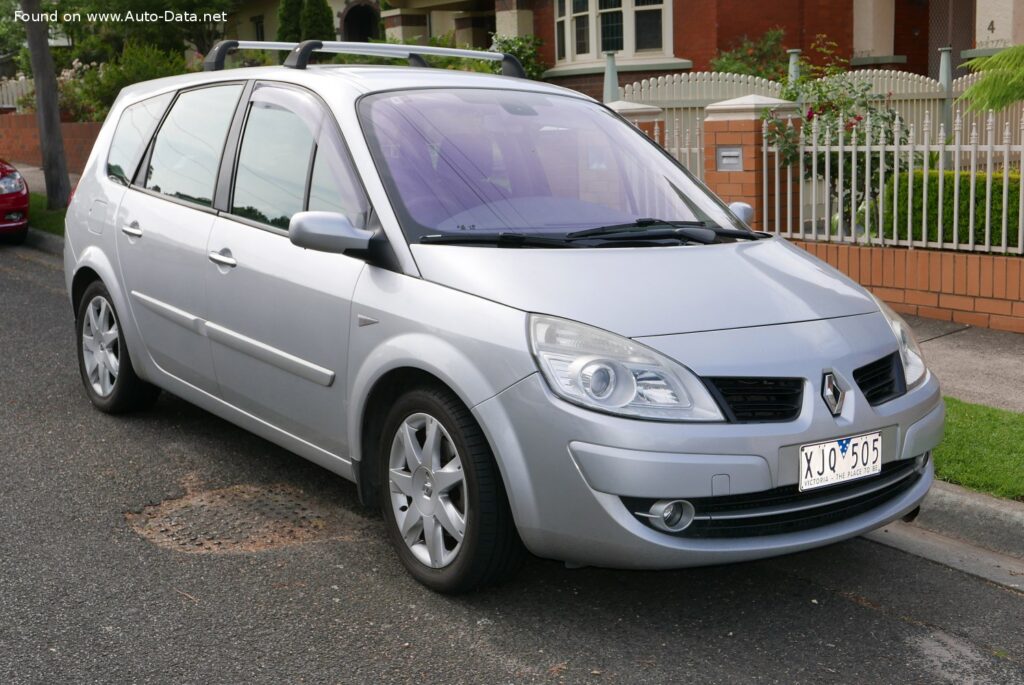
The Renault Grand Scenic II (Phase II) 1.5 dCi (103 Hp) FAP is a compact minivan produced by the French automaker Renault from 2006 to 2009. Part of the second generation of the Scenic range, the Grand Scenic II offered increased practicality with seven-seat capability, distinguishing it from the standard five-seat Scenic. This model was primarily aimed at the European market, where compact MPVs (Multi-Purpose Vehicles) were – and continue to be – highly popular due to their versatility and efficient use of space. The Phase II update brought minor cosmetic and equipment revisions to the original Grand Scenic II, enhancing its appeal to family buyers.
Renault Grand Scenic II: A Detailed Overview
The Grand Scenic II represented Renault’s commitment to innovative family transport. It built upon the success of the original Scenic, offering a more spacious and flexible interior. The “Grand” designation signified the extended wheelbase and subsequent third-row seating, making it a viable option for larger families or those requiring occasional extra passenger capacity. The 1.5 dCi engine, a common choice in Europe for its balance of fuel economy and performance, was a key component of the Grand Scenic II’s appeal. The FAP (Filtre à Particules) denoted the inclusion of a diesel particulate filter, a technology increasingly mandated by European emissions regulations.
Engine & Performance
The Renault Grand Scenic II 1.5 dCi (103 Hp) FAP is powered by a 1.5-liter inline-four cylinder diesel engine, designated K9K. This engine produces 103 horsepower at 4000 rpm and 240 Nm (177 lb-ft) of torque at 2000 rpm. The engine utilizes a turbocharger with an intercooler to enhance power output and efficiency. Power is delivered to the front wheels via a six-speed manual transmission. Performance figures include a 0-100 km/h (0-62 mph) acceleration time of 12.8 seconds and a maximum speed of 176 km/h (109.36 mph). While not a performance-oriented vehicle, the 1.5 dCi engine provides adequate power for everyday driving and highway cruising, particularly when considering the vehicle’s intended role as a family transport. The engine’s fuel consumption is rated at 5.3 liters per 100 kilometers (44.4 US mpg) on a combined cycle, with CO2 emissions of 140 g/km, reflecting its relatively efficient operation.
Design & Features
The Renault Grand Scenic II (Phase II) features a distinctive minivan silhouette, characterized by its tall roofline and elongated body. The Phase II models received subtle styling updates, including revised front and rear fascias, and updated interior trim. The vehicle’s interior is designed with practicality in mind, offering a flexible seating arrangement with individual, movable second-row seats and a fold-flat third-row bench. This allows for a variety of seating configurations to accommodate passengers and cargo. Key features include a spacious cabin, ample storage compartments, and a user-friendly dashboard layout. Safety features, typical for vehicles of this era, include ABS (Anti-lock Braking System), and driver/passenger airbags. The Grand Scenic II prioritized family convenience, offering features like a panoramic sunroof (optional) and a comprehensive infotainment system for the time. The vehicle’s trunk space is generous, ranging from 533 liters (18.82 cu ft) with all seats in place to 1960 liters (69.22 cu ft) with the rear seats folded down.
Technical Specifications
| Brand | Renault |
| Model | Scenic |
| Generation | Grand Scenic II (Phase II) |
| Type (Engine) | 1.5 dCi (103 Hp) FAP |
| Start of production | 2006 |
| End of production | 2009 |
| Powertrain Architecture | Internal Combustion engine |
| Body type | Minivan |
| Seats | 7 |
| Doors | 5 |
| Fuel consumption (urban) | 6.5 l/100 km (36.2 US mpg) |
| Fuel consumption (extra urban) | 4.7 l/100 km (50 US mpg) |
| Fuel consumption (combined) | 5.3 l/100 km (44.4 US mpg) |
| CO2 emissions | 140 g/km |
| Fuel Type | Diesel |
| Acceleration 0 – 100 km/h | 12.8 sec |
| Acceleration 0 – 62 mph | 12.8 sec |
| Acceleration 0 – 60 mph | 12.2 sec |
| Maximum speed | 176 km/h (109.36 mph) |
| Emission standard | Euro 4 |
| Weight-to-power ratio | 13.9 kg/Hp |
| Weight-to-torque ratio | 6 kg/Nm |
| Power | 103 Hp @ 4000 rpm |
| Torque | 240 Nm @ 2000 rpm (177.01 lb.-ft. @ 2000 rpm) |
| Engine layout | Front, Transverse |
| Engine Model/Code | K9K |
| Engine displacement | 1461 cm3 (89.16 cu. in.) |
| Number of cylinders | 4 |
| Engine configuration | Inline |
| Number of valves per cylinder | 2 |
| Fuel injection system | Diesel Commonrail |
| Engine oil capacity | 4.5 l (4.76 US qt | 3.96 UK qt) |
| Coolant | 7.5 l (7.93 US qt | 6.6 UK qt) |
| Kerb Weight | 1430 kg (3152.61 lbs.) |
| Max. weight | 2095 kg (4618.68 lbs.) |
| Max load | 665 kg (1466.07 lbs.) |
| Trunk (boot) space – minimum | 533 l (18.82 cu. ft.) |
| Trunk (boot) space – maximum | 1960 l (69.22 cu. ft.) |
| Fuel tank capacity | 60 l (15.85 US gal | 13.2 UK gal) |
| Max. roof load | 80 kg (176.37 lbs.) |
| Permitted trailer load with brakes (12%) | 1300 kg (2866.01 lbs.) |
| Permitted trailer load without brakes | 650 kg (1433 lbs.) |
| Permitted towbar download | 75 kg (165.35 lbs.) |
| Length | 4496 mm (177.01 in.) |
| Width | 1810 mm (71.26 in.) |
| Width including mirrors | 2087 mm (82.17 in.) |
| Height | 1636 mm (64.41 in.) |
| Wheelbase | 2736 mm (107.72 in.) |
| Front track | 1506 mm (59.29 in.) |
| Rear (Back) track | 1506 mm (59.29 in.) |
| Ride height (ground clearance) | 130 mm (5.12 in.) |
| Minimum turning circle (turning diameter) | 10.85 m (35.6 ft.) |
| Drive wheel | Front wheel drive |
| Number of gears and type of gearbox | 6 gears, manual transmission |
| Front suspension | Independent type McPherson |
| Rear suspension | Elastic beam |
| Front brakes | Ventilated discs, 280 mm |
| Rear brakes | Disc, 270 mm |
| Assisting systems | ABS (Anti-lock braking system) |
| Steering type | Steering rack and pinion |
| Tires size | 205/60 R16 |
| Wheel rims size | 16 |