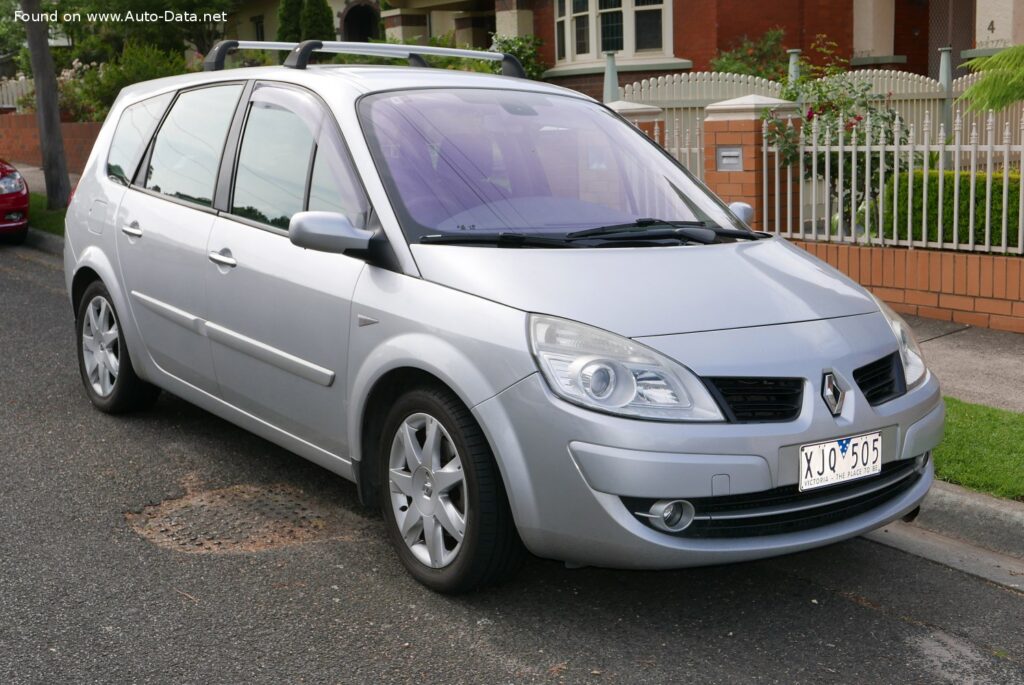
The Renault Grand Scenic II (Phase II) 1.9 dCi (130 Hp) FAP Automatic is a compact minivan produced by the French automaker Renault between 2006 and 2009. As part of the second generation of the Scenic range, the Grand Scenic II offered increased practicality with optional seven-passenger seating, distinguishing it from the standard five-seater Scenic. This model was primarily aimed at the European market, where compact MPVs (Multi-Purpose Vehicles) were – and continue to be – highly popular due to their versatility and efficient use of space. The Phase II update brought styling revisions and improvements to the interior and equipment levels. It represented Renault’s commitment to providing family-focused transportation with a blend of comfort, practicality, and relatively economical diesel power.
Renault Grand Scenic II (Phase II): An Overview
The Grand Scenic II occupied a crucial position in Renault’s lineup, catering to families seeking a vehicle larger than a traditional hatchback but smaller and more manageable than a full-size van. The Phase II version, introduced in 2006, built upon the success of the original Grand Scenic, addressing some customer feedback and incorporating updated technology. The 1.9 dCi engine, coupled with an automatic transmission and a Diesel Particulate Filter (FAP), was a common configuration, offering a balance between performance, fuel efficiency, and reduced emissions. The vehicle’s design prioritized interior space and modularity, making it adaptable to various family needs.
Engine & Performance
The Renault Grand Scenic II (Phase II) 1.9 dCi was powered by a 1.9-liter inline-four cylinder diesel engine, designated F9Q. This engine produced 130 horsepower at 4,000 rpm and 300 Nm (221.27 lb.-ft.) of torque at 1,600 rpm. The torque output, available at relatively low engine speeds, provided good responsiveness for everyday driving and aided in effortless cruising. The engine featured a turbocharger and intercooler to enhance performance, and a common rail direct fuel injection system for improved efficiency and reduced emissions. The automatic transmission, with four forward gears, provided convenient gear changes, although it wasn’t known for particularly rapid shifts by modern standards. Acceleration from 0 to 100 km/h (0-62 mph) took 11.3 seconds, while the top speed was rated at 190 km/h (118.06 mph). The weight-to-power ratio of 11.8 kg/Hp indicated a reasonable, if not particularly sporty, performance characteristic.
Design & Features
The Grand Scenic II (Phase II) maintained the distinctive styling of the original model, characterized by its flowing lines and generous glass area. The minivan body style offered a practical and spacious interior. The Phase II update included minor cosmetic changes to the front and rear fascias, as well as revised interior trim. A key feature of the Grand Scenic was its versatile interior layout. The second and third-row seats could be folded flat or even removed entirely, creating a large, flat load area. With all seats in place, the trunk offered 533 liters (18.82 cu. ft.) of space, expanding to a substantial 1960 liters (69.22 cu. ft.) with the rear seats folded. Standard features typically included air conditioning, power windows, and a basic audio system. Safety features, while not as comprehensive as those found in modern vehicles, included ABS (Anti-lock Braking System) and driver/passenger airbags. The Grand Scenic II was designed with family practicality in mind, offering numerous storage compartments and a comfortable ride.
Technical Specifications
| Brand | Renault |
| Model | Scenic |
| Generation | Grand Scenic II (Phase II) |
| Type (Engine) | 1.9 dCi (130 Hp) FAP Automatic |
| Start of production | 2006 |
| End of production | 2009 |
| Powertrain Architecture | Internal Combustion engine |
| Body type | Minivan |
| Seats | 7 |
| Doors | 5 |
| Fuel consumption (urban) | 9.5 l/100 km (24.8 US mpg) |
| Fuel consumption (extra urban) | 5.8 l/100 km (40.6 US mpg) |
| Fuel consumption (combined) | 7.1 l/100 km (33.1 US mpg) |
| CO2 emissions | 188 g/km |
| Fuel Type | Diesel |
| Acceleration 0 – 100 km/h | 11.3 sec |
| Acceleration 0 – 62 mph | 11.3 sec |
| Acceleration 0 – 60 mph | 10.7 sec |
| Maximum speed | 190 km/h (118.06 mph) |
| Emission standard | Euro 4 |
| Weight-to-power ratio | 11.8 kg/Hp |
| Weight-to-torque ratio | 5.1 kg/Nm |
| Power | 130 Hp @ 4000 rpm |
| Torque | 300 Nm @ 1600 rpm (221.27 lb.-ft. @ 1600 rpm) |
| Engine layout | Front, Transverse |
| Engine Model/Code | F9Q |
| Engine displacement | 1870 cm3 (114.11 cu. in.) |
| Number of cylinders | 4 |
| Engine configuration | Inline |
| Cylinder Bore | 80 mm (3.15 in.) |
| Piston Stroke | 93 mm (3.66 in.) |
| Number of valves per cylinder | 2 |
| Fuel injection system | Diesel Commonrail |
| Engine aspiration | Turbocharger, Intercooler |
| Engine oil capacity | 4.9 l (5.18 US qt | 4.31 UK qt) |
| Coolant | 7.6 l (8.03 US qt | 6.69 UK qt) |
| Kerb Weight | 1540 kg (3395.12 lbs.) |
| Max. weight | 2210 kg (4872.22 lbs.) |
| Max load | 670 kg (1477.1 lbs.) |
| Trunk (boot) space – minimum | 533 l (18.82 cu. ft.) |
| Trunk (boot) space – maximum | 1960 l (69.22 cu. ft.) |
| Fuel tank capacity | 60 l (15.85 US gal | 13.2 UK gal) |
| Max. roof load | 80 kg (176.37 lbs.) |
| Permitted trailer load with brakes (12%) | 1250 kg (2755.78 lbs.) |
| Permitted trailer load without brakes | 650 kg (1433 lbs.) |
| Permitted towbar download | 75 kg (165.35 lbs.) |
| Length | 4496 mm (177.01 in.) |
| Width | 1810 mm (71.26 in.) |
| Width including mirrors | 2087 mm (82.17 in.) |
| Height | 1636 mm (64.41 in.) |
| Wheelbase | 2736 mm (107.72 in.) |
| Front track | 1506 mm (59.29 in.) |
| Rear (Back) track | 1506 mm (59.29 in.) |
| Ride height (ground clearance) | 130 mm (5.12 in.) |
| Minimum turning circle (turning diameter) | 10.85 m (35.6 ft.) |
| Drivetrain Architecture | Front wheel drive |
| Number of gears and type of gearbox | 4 gears, automatic transmission |
| Front suspension | Independent type McPherson |
| Rear suspension | Elastic beam |
| Front brakes | Ventilated discs, 300 mm |
| Rear brakes | Disc, 270 mm |
| Assisting systems | ABS (Anti-lock braking system) |
| Steering type | Steering rack and pinion |
| Power steering | Electric Steering |
| Tires size | 205/60 R16 |
| Wheel rims size | 16 |