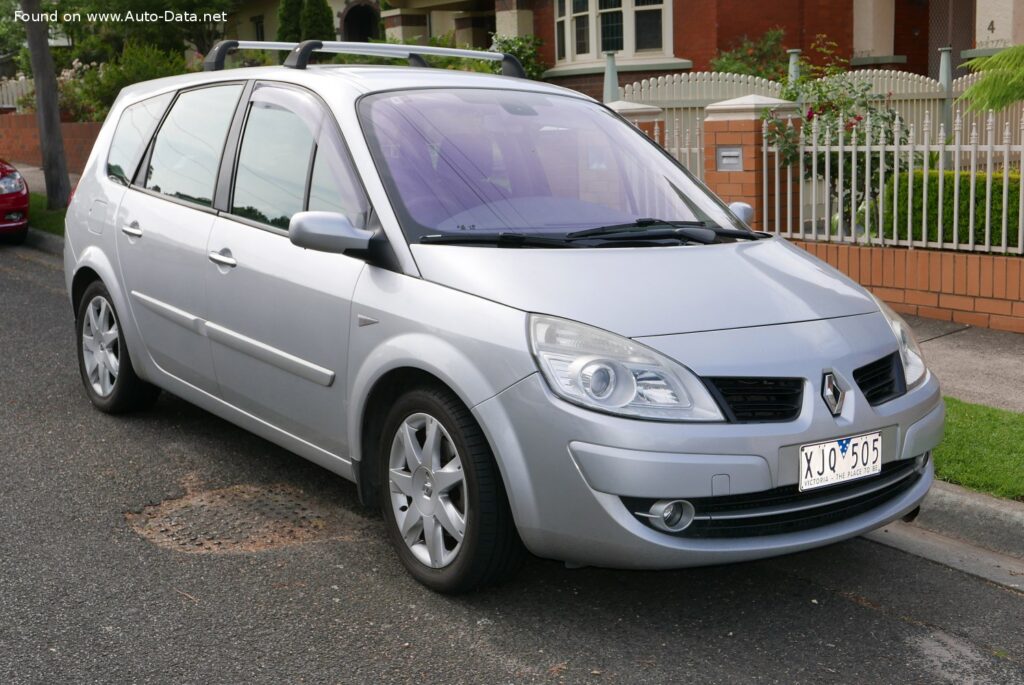
The Renault Grand Scenic II (Phase II) 2.0 dCi (150 Hp) is a compact minivan produced by the French automaker Renault from 2006 to 2009. As part of the second generation of the Scenic range, the Grand Scenic II offered increased practicality with optional seven-passenger seating, distinguishing it from the standard five-seater Scenic. This model was primarily aimed at the European market, where compact MPVs (Multi-Purpose Vehicles) were – and continue to be – highly popular due to their versatility and efficient use of space. The Phase II update brought styling revisions and refinements to the engine lineup, including the 2.0 dCi diesel engine detailed here.
Renault Grand Scenic II: An Overview
The Grand Scenic II represented Renault’s commitment to providing family-focused transportation. It competed with vehicles like the Citroën C4 Picasso, Opel/Vauxhall Zafira, and Ford C-Max. The Phase II version, introduced in 2006, featured subtle cosmetic changes, improved interior materials, and enhanced safety features. The 2.0 dCi engine was a key component of the Grand Scenic II’s appeal, offering a balance of performance and fuel economy, crucial for European drivers facing high fuel costs and stringent emissions regulations.
Engine & Performance
The Renault Grand Scenic II 2.0 dCi is powered by a 1995 cc (121.74 cu. in.) inline-four cylinder diesel engine, designated the M9R. This engine produces 150 horsepower (Hp) at 4000 rpm and 340 Newton-meters (250.77 lb.-ft.) of torque at 2000 rpm. The engine utilizes a turbocharger with an intercooler and a diesel commonrail fuel injection system to optimize power delivery and efficiency. The engine’s power-to-liter ratio is 75.2 Hp/l. This powertrain configuration allows for a 0-100 km/h (0-62 mph) acceleration time of 9.8 seconds, and a 0-60 mph time of 9.3 seconds, with a maximum speed of 204 km/h (126.76 mph). The engine is transversely mounted at the front of the vehicle, driving the front wheels through a six-speed manual transmission. The weight-to-power ratio is 10.2 kg/Hp, and the weight-to-torque ratio is 4.5 kg/Nm.
Design & Features
The Renault Grand Scenic II is a five-door minivan designed to maximize interior space and practicality. Its key feature is the availability of seven seats, configured in a 2-3-2 arrangement. The rear seats can be folded flat or even removed entirely to create a larger cargo area. The trunk (boot) space ranges from a minimum of 533 liters (18.82 cu. ft.) with all seats in place to a maximum of 1960 liters (69.22 cu. ft.) with the rear seats folded. The Phase II update included minor styling tweaks to the front and rear fascias, as well as improved interior trim. Safety features included ABS (Anti-lock Braking System) as standard, and the vehicle met Euro 4 emission standards. The Grand Scenic II also offered features common for its class, such as power steering, air conditioning, and a range of audio systems. The vehicle’s dimensions are 4496 mm (177.01 in.) in length, 1810 mm (71.26 in.) in width, and 1636 mm (64.41 in.) in height. The wheelbase is 2736 mm (107.72 in.).
Technical Specifications
| Brand | Renault |
| Model | Scenic |
| Generation | Grand Scenic II (Phase II) |
| Type (Engine) | 2.0 dCi (150 Hp) |
| Start of production | 2006 |
| End of production | 2009 |
| Powertrain Architecture | Internal Combustion engine |
| Body type | Minivan |
| Seats | 7 |
| Doors | 5 |
| Fuel consumption (urban) | 7.3 l/100 km (32.2 US mpg, 38.7 UK mpg, 13.7 km/l) |
| Fuel consumption (extra urban) | 5.0 l/100 km (47 US mpg, 56.5 UK mpg, 20 km/l) |
| Fuel consumption (combined) | 5.8 l/100 km (40.6 US mpg, 48.7 UK mpg, 17.2 km/l) |
| CO2 emissions | 154 g/km |
| Fuel Type | Diesel |
| Acceleration 0 – 100 km/h | 9.8 sec |
| Acceleration 0 – 62 mph | 9.8 sec |
| Acceleration 0 – 60 mph | 9.3 sec |
| Maximum speed | 204 km/h (126.76 mph) |
| Emission standard | Euro 4 |
| Weight-to-power ratio | 10.2 kg/Hp |
| Weight-to-torque ratio | 4.5 kg/Nm |
| Power | 150 Hp @ 4000 rpm |
| Torque | 340 Nm @ 2000 rpm (250.77 lb.-ft. @ 2000 rpm) |
| Engine layout | Front, Transverse |
| Engine Model/Code | M9R |
| Engine displacement | 1995 cm3 (121.74 cu. in.) |
| Number of cylinders | 4 |
| Engine configuration | Inline |
| Cylinder Bore | 84 mm (3.31 in.) |
| Piston Stroke | 90 mm (3.54 in.) |
| Number of valves per cylinder | 2 |
| Fuel injection system | Diesel Commonrail |
| Engine aspiration | Turbocharger, Intercooler |
| Engine oil capacity | 6.6 l (6.97 US qt | 5.81 UK qt) |
| Coolant | 7.5 l (7.93 US qt | 6.6 UK qt) |
| Kerb Weight | 1535 kg (3384.1 lbs.) |
| Max. weight | 2215 kg (4883.24 lbs.) |
| Max load | 680 kg (1499.14 lbs.) |
| Trunk (boot) space – minimum | 533 l (18.82 cu. ft.) |
| Trunk (boot) space – maximum | 1960 l (69.22 cu. ft.) |
| Fuel tank capacity | 60 l (15.85 US gal | 13.2 UK gal) |
| Max. roof load | 80 kg (176.37 lbs.) |
| Permitted trailer load with brakes (12%) | 1300 kg (2866.01 lbs.) |
| Permitted trailer load without brakes | 650 kg (1433 lbs.) |
| Permitted towbar download | 75 kg (165.35 lbs.) |
| Length | 4496 mm (177.01 in.) |
| Width | 1810 mm (71.26 in.) |
| Width including mirrors | 2087 mm (82.17 in.) |
| Height | 1636 mm (64.41 in.) |
| Wheelbase | 2736 mm (107.72 in.) |
| Front track | 1506 mm (59.29 in.) |
| Rear (Back) track | 1506 mm (59.29 in.) |
| Ride height (ground clearance) | 130 mm (5.12 in.) |
| Minimum turning circle (turning diameter) | 10.85 m (35.6 ft.) |
| Drivetrain Architecture | Front wheel drive |
| Number of gears and type of gearbox | 6 gears, manual transmission |
| Front suspension | Independent type McPherson |
| Rear suspension | Elastic beam |
| Front brakes | Ventilated discs, 300 mm |
| Rear brakes | Disc, 270 mm |
| Assisting systems | ABS (Anti-lock braking system) |
| Steering type | Steering rack and pinion |
| Power steering | Electric Steering |
| Tires size | 205/60 R16 |
| Wheel rims size | 16 |
The Renault Grand Scenic II (Phase II) 2.0 dCi (150 Hp) remains a practical and efficient choice for families seeking a versatile vehicle. Its combination of spaciousness, fuel economy, and reasonable performance made it a popular option in the European market during its production run.