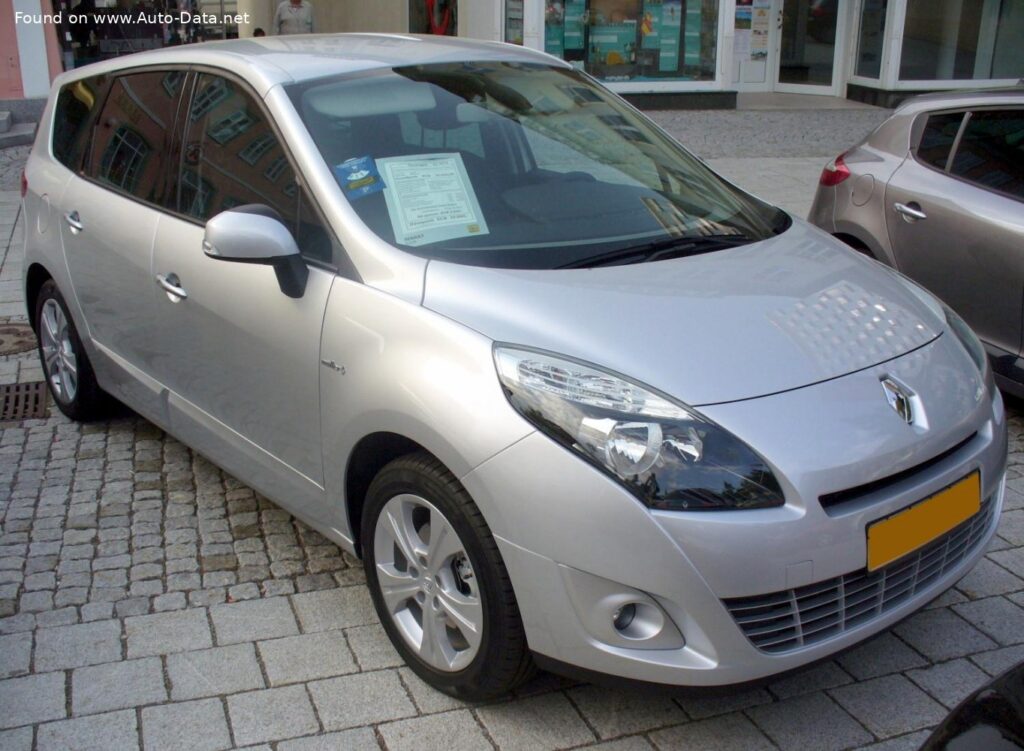
The Renault Grand Scenic III (Phase I) 1.5 dCi (110 Hp) FAP 7 Seat, produced between 2009 and 2011, represents a significant iteration in Renault’s popular minivan lineup. Positioned as a compact multi-purpose vehicle (MPV), the Grand Scenic aimed to provide family-oriented practicality with a focus on interior space and versatility. This particular version, equipped with a 1.5-liter diesel engine, was primarily marketed in Europe, where MPVs enjoyed considerable popularity due to their ability to accommodate larger families and varying cargo needs. The “Grand” designation signifies the availability of seven seats, differentiating it from the standard five-seat Scenic.
Renault Grand Scenic III: A Detailed Overview
The Grand Scenic III, launched in 2009, built upon the success of its predecessors, offering a more refined design, improved interior quality, and enhanced technology. Phase I models, like the 1.5 dCi variant, represent the initial release of the third generation. Renault focused on creating a vehicle that was both functional and aesthetically pleasing, appealing to a broad range of buyers seeking a practical and comfortable family vehicle. The inclusion of a Diesel Particulate Filter (FAP) demonstrates Renault’s early efforts to meet increasingly stringent European emission standards.
Engine & Performance
The heart of the Grand Scenic III 1.5 dCi is a 1.5-liter inline-four cylinder diesel engine, designated K9K. This engine produces 110 horsepower (Hp) at 4000 rpm and 240 Newton-meters (177.01 lb.-ft.) of torque at 1750 rpm. The engine utilizes a turbocharger and intercooler to enhance performance and efficiency. Power is delivered to the front wheels via a six-speed manual transmission. Acceleration from 0 to 100 km/h (0-62 mph) takes 12.5 seconds, while 0 to 60 mph is achieved in 11.9 seconds. The top speed is rated at 180 km/h (111.85 mph). Fuel economy is a strong point, with combined cycle consumption rated at 5.3 liters per 100 kilometers (44.4 US mpg or 53.3 UK mpg). CO2 emissions are 138 g/km, placing it within Euro 4 emission standards.
Design & Features
The Renault Grand Scenic III (Phase I) is a five-door minivan characterized by its flowing lines and modern aesthetic. Its key feature is its spacious interior, designed to comfortably accommodate up to seven passengers. The flexible seating arrangement allows for various configurations, maximizing cargo space when needed. With all rear seats folded, the trunk space expands to a substantial 2063 liters (72.85 cu. ft.), while the minimum trunk capacity is 208 liters (7.35 cu. ft.). Safety features included ABS (Anti-lock Braking System) as standard. The vehicle’s dimensions are 4560 mm (179.53 in) in length, 1845 mm (72.64 in) in width, and 1675 mm (65.94 in) in height. The wheelbase measures 2769 mm (109.02 in), contributing to a stable ride. Electric power steering provides ease of maneuverability.
Technical Specifications
| Brand | Renault |
| Model | Scenic |
| Generation | Grand Scenic III (Phase I) |
| Type | 1.5 dCi (110 Hp) FAP 7 Seat |
| Start of production | 2009 |
| End of production | 2011 |
| Powertrain Architecture | Internal Combustion engine |
| Body type | Minivan |
| Seats | 7 |
| Doors | 5 |
| Fuel consumption (urban) | 6.5 l/100 km (36.2 US mpg, 43.5 UK mpg, 15.4 km/l) |
| Fuel consumption (extra urban) | 4.6 l/100 km (51.1 US mpg, 61.4 UK mpg, 21.7 km/l) |
| Fuel consumption (combined) | 5.3 l/100 km (44.4 US mpg, 53.3 UK mpg, 18.9 km/l) |
| CO2 emissions | 138 g/km |
| Fuel Type | Diesel |
| Acceleration 0 – 100 km/h | 12.5 sec |
| Acceleration 0 – 62 mph | 12.5 sec |
| Acceleration 0 – 60 mph | 11.9 sec |
| Maximum speed | 180 km/h (111.85 mph) |
| Emission standard | Euro 4 |
| Weight-to-power ratio | 13 kg/Hp, 76.9 Hp/tonne |
| Weight-to-torque ratio | 6 kg/Nm, 167.8 Nm/tonne |
| Power | 110 Hp @ 4000 rpm |
| Power per litre | 75.3 Hp/l |
| Torque | 240 Nm @ 1750 rpm (177.01 lb.-ft. @ 1750 rpm) |
| Engine layout | Front, Transverse |
| Engine Model/Code | K9K |
| Engine displacement | 1461 cm3 (89.16 cu. in.) |
| Number of cylinders | 4 |
| Engine configuration | Inline |
| Cylinder Bore | 76 mm (2.99 in.) |
| Piston Stroke | 80.5 mm (3.17 in.) |
| Compression ratio | 15.2:1 |
| Number of valves per cylinder | 2 |
| Fuel injection system | Diesel Commonrail |
| Engine aspiration | Turbocharger, Intercooler |
| Engine oil capacity | 4.5 l (4.76 US qt | 3.96 UK qt) |
| Coolant | 6.5 l (6.87 US qt | 5.72 UK qt) |
| Kerb Weight | 1430 kg (3152.61 lbs.) |
| Max. weight | 2128 kg (4691.44 lbs.) |
| Max load | 698 kg (1538.83 lbs.) |
| Trunk (boot) space – minimum | 208 l (7.35 cu. ft.) |
| Trunk (boot) space – maximum | 2063 l (72.85 cu. ft.) |
| Fuel tank capacity | 60 l (15.85 US gal | 13.2 UK gal) |
| Max. roof load | 80 kg (176.37 lbs.) |
| Permitted trailer load with brakes (12%) | 1300 kg (2866.01 lbs.) |
| Permitted trailer load without brakes | 750 kg (1653.47 lbs.) |
| Permitted towbar download | 75 kg (165.35 lbs.) |
| Length | 4560 mm (179.53 in.) |
| Width | 1845 mm (72.64 in.) |
| Width including mirrors | 2077 mm (81.77 in.) |
| Height | 1675 mm (65.94 in.) |
| Wheelbase | 2769 mm (109.02 in.) |
| Front track | 1536 mm (60.47 in.) |
| Rear (Back) track | 1539 mm (60.59 in.) |
| Front overhang | 888 mm (34.96 in.) |
| Rear overhang | 903 mm (35.55 in.) |
| Ride height (ground clearance) | 120 mm (4.72 in.) |
| Minimum turning circle (turning diameter) | 11.29 m (37.04 ft.) |
| Drivetrain Architecture | Front wheel drive |
| Number of gears and type of gearbox | 6 gears, manual transmission |
| Front suspension | Independent type McPherson |
| Rear suspension | Elastic beam |
| Front brakes | Ventilated discs, 296 mm |
| Rear brakes | Disc, 274 mm |
| Assisting systems | ABS (Anti-lock braking system) |
| Steering type | Steering rack and pinion |
| Power steering | Electric Steering |
| Tires size | 205/60 R16 |
| Wheel rims size | 16 |
The Renault Grand Scenic III (Phase I) 1.5 dCi (110 Hp) FAP 7 Seat offered a compelling package for families seeking a practical, efficient, and reasonably priced minivan. While not officially sold in the United States, it was a popular choice in Europe, demonstrating Renault’s ability to cater to the specific needs of that market.