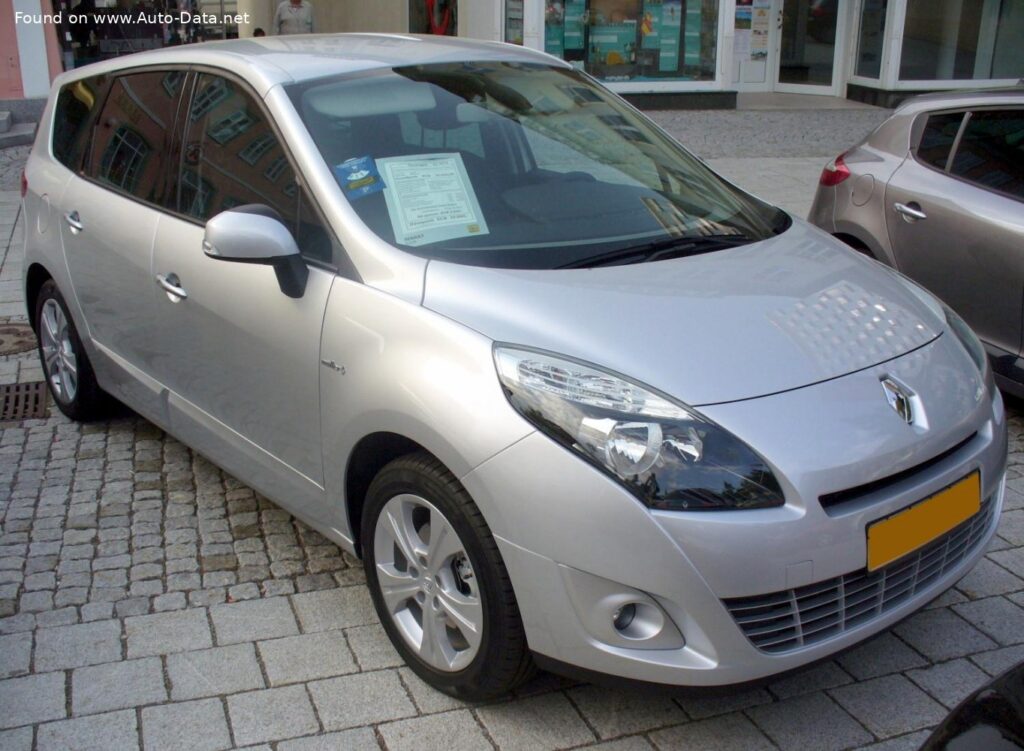
The Renault Grand Scenic III (Phase I) 1.6 16V, produced between 2009 and 2011, is a compact minivan designed to cater to families needing flexible seating and ample cargo space. As a key model in Renault’s lineup, the Grand Scenic III represented a significant evolution in the minivan segment, offering a blend of practicality, comfort, and modern features. While primarily marketed and sold in Europe, it exemplifies Renault’s commitment to innovative family transportation. This generation of the Scenic, and particularly the Grand Scenic variant, aimed to provide a more refined and spacious alternative to traditional five-seater hatchbacks and larger MPVs.
Renault Grand Scenic III: An Overview
The Grand Scenic III (Phase I) distinguishes itself with its seven-seat configuration, making it a popular choice for larger families. It falls into the compact minivan segment, competing with vehicles like the Citroën C4 Picasso and Opel Zafira. The Phase I designation refers to the initial iteration of the third-generation Scenic, characterized by specific styling cues and feature sets. The 1.6 16V engine option, producing 110 horsepower, was a common choice, balancing fuel efficiency with adequate performance for everyday driving.
Engine & Performance
Powering the Renault Grand Scenic III (Phase I) 1.6 16V is a 1.6-liter inline-four cylinder gasoline engine, designated the K4M. This naturally aspirated engine delivers 110 horsepower at 6000 rpm and 151 Nm (111.37 lb.-ft.) of torque at 4250 rpm. While not a performance-oriented engine, it provides sufficient power for typical family duties. The engine’s power-to-liter ratio is 68.8 hp/l. Acceleration from 0 to 100 km/h (0-62 mph) takes 12.6 seconds, and it achieves a maximum speed of 185 km/h (114.95 mph). The engine is paired with a six-speed manual transmission, driving the front wheels. Fuel economy is rated at 7.5 l/100 km (31.4 US mpg) combined, with 9.9 l/100 km (23.8 US mpg) in urban conditions and 6.1 l/100 km (38.6 US mpg) on the extra-urban cycle. CO2 emissions are rated at 177 g/km, meeting Euro 4 emission standards.
Design & Features
The Renault Grand Scenic III (Phase I) boasts a distinctive and modern design for its time. Its minivan body style prioritizes interior space and practicality. The vehicle offers five doors and seven seats, with the rear seats typically folding flat into the floor to maximize cargo capacity. The trunk space ranges from a minimum of 208 liters (7.35 cu. ft.) with all seats in use to a substantial 2063 liters (72.85 cu. ft.) with the rear seats folded. Key features include a comfortable interior, a relatively high driving position for good visibility, and a range of storage compartments throughout the cabin. Safety features, typical for vehicles of this era, include ABS (Anti-lock Braking System). The Grand Scenic III also offers a decent level of equipment, including power steering, and air conditioning. The vehicle’s dimensions are 4560 mm (179.53 in) in length, 1845 mm (72.64 in) in width, and 1675 mm (65.94 in) in height. The wheelbase measures 2769 mm (109.02 in), contributing to a stable ride.
Technical Specifications
| Brand | Renault |
| Model | Scenic |
| Generation | Grand Scenic III (Phase I) |
| Type (Engine) | 1.6 16V (110 Hp) 7 Seat |
| Start of production | 2009 |
| End of production | 2011 |
| Powertrain Architecture | Internal Combustion engine |
| Body type | Minivan |
| Seats | 7 |
| Doors | 5 |
| Fuel consumption (urban) | 9.9 l/100 km (23.8 US mpg) |
| Fuel consumption (extra urban) | 6.1 l/100 km (38.6 US mpg) |
| Fuel consumption (combined) | 7.5 l/100 km (31.4 US mpg) |
| CO2 emissions | 177 g/km |
| Fuel Type | Petrol (Gasoline) |
| Acceleration 0 – 100 km/h | 12.6 sec |
| Acceleration 0 – 62 mph | 12.6 sec |
| Acceleration 0 – 60 mph | 12 sec |
| Maximum speed | 185 km/h (114.95 mph) |
| Emission standard | Euro 4 |
| Weight-to-power ratio | 13.1 kg/Hp |
| Weight-to-torque ratio | 9.6 kg/Nm |
| Power | 110 Hp @ 6000 rpm |
| Torque | 151 Nm @ 4250 rpm (111.37 lb.-ft. @ 4250 rpm) |
| Engine layout | Front, Transverse |
| Engine Model/Code | K4M |
| Engine displacement | 1598 cm3 (97.52 cu. in.) |
| Number of cylinders | 4 |
| Engine configuration | Inline |
| Cylinder Bore | 79.5 mm (3.13 in.) |
| Piston Stroke | 80.5 mm (3.17 in.) |
| Compression ratio | 9.7:1 |
| Number of valves per cylinder | 4 |
| Fuel injection system | Multi-port manifold injection |
| Engine aspiration | Naturally aspirated engine |
| Engine oil capacity | 5 l (5.28 US qt | 4.4 UK qt) |
| Coolant | 5.3 l (5.6 US qt | 4.66 UK qt) |
| Kerb Weight | 1444 kg (3183.48 lbs.) |
| Max. weight | 2074 kg (4572.39 lbs.) |
| Max load | 630 kg (1388.91 lbs.) |
| Trunk (boot) space – minimum | 208 l (7.35 cu. ft.) |
| Trunk (boot) space – maximum | 2063 l (72.85 cu. ft.) |
| Fuel tank capacity | 60 l (15.85 US gal | 13.2 UK gal) |
| Max. roof load | 80 kg (176.37 lbs.) |
| Permitted trailer load with brakes (12%) | 1300 kg (2866.01 lbs.) |
| Permitted trailer load without brakes | 750 kg (1653.47 lbs.) |
| Permitted towbar download | 75 kg (165.35 lbs.) |
| Length | 4560 mm (179.53 in.) |
| Width | 1845 mm (72.64 in.) |
| Width including mirrors | 2077 mm (81.77 in.) |
| Height | 1675 mm (65.94 in.) |
| Wheelbase | 2769 mm (109.02 in.) |
| Front track | 1536 mm (60.47 in.) |
| Rear (Back) track | 1539 mm (60.59 in.) |
| Front overhang | 888 mm (34.96 in.) |
| Rear overhang | 903 mm (35.55 in.) |
| Ride height (ground clearance) | 120 mm (4.72 in.) |
| Minimum turning circle (turning diameter) | 11.29 m (37.04 ft.) |
| Drive wheel | Front wheel drive |
| Number of gears and type of gearbox | 6 gears, manual transmission |
| Front suspension | Independent type McPherson |
| Rear suspension | Elastic beam |
| Front brakes | Ventilated discs, 296 mm |
| Rear brakes | Disc, 274 mm |
| Assisting systems | ABS (Anti-lock braking system) |
| Steering type | Steering rack and pinion |
| Power steering | Electric Steering |
| Tires size | 205/55 R17 |
| Wheel rims size | 17 |