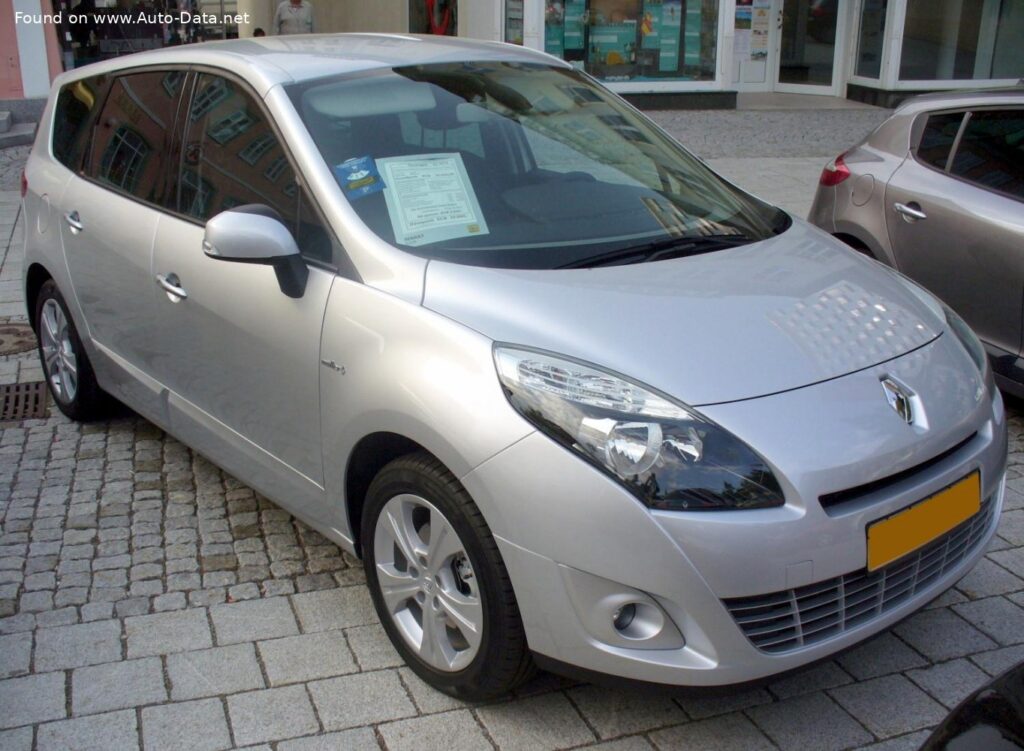
The Renault Grand Scenic III (Phase I) 1.6 Energy dCi (130 Hp) S&S is a compact minivan produced by the French automaker Renault from 2011. Part of the third generation of the Scenic range, the Grand Scenic offered increased practicality with seven-seat availability, appealing to families. This particular variant, powered by a 1.6-liter turbocharged diesel engine, was primarily sold in the European market, where fuel efficiency and versatility were highly valued. The “S&S” designation indicates the inclusion of Renault’s Start & Stop system, designed to reduce fuel consumption in urban driving conditions. The Grand Scenic competed with vehicles like the Citroën C4 Picasso, Opel Zafira, and Ford C-Max.
Renault Grand Scenic III: A Detailed Overview
The Grand Scenic III represented a significant evolution in Renault’s minivan offerings. Building upon the success of its predecessors, it aimed to provide a more refined and technologically advanced experience. The Phase I models, produced in 2011, established the design language and core features that would define the generation. The vehicle’s focus was on maximizing interior space and providing a comfortable ride, while also incorporating modern safety and convenience features.
Engine & Performance
The heart of the Grand Scenic III 1.6 Energy dCi (130 Hp) S&S is a 1.6-liter inline-four cylinder diesel engine, designated the R9M. This engine utilizes a turbocharger and intercooler to deliver a power output of 130 horsepower at 4000 rpm and 320 Nm (236.02 lb.-ft.) of torque at 1750 rpm. The common rail direct fuel injection system contributes to efficient combustion and reduced emissions. The engine’s specific output is 81.4 horsepower per liter. Coupled with a six-speed manual transmission, the Grand Scenic achieves a 0-100 km/h (0-62 mph) acceleration time of 10.5 seconds and a maximum speed of 195 km/h (121.17 mph). The Start & Stop system automatically shuts off the engine when the vehicle is stationary, such as at traffic lights, to conserve fuel. Fuel economy figures are rated at 4.5 liters per 100 kilometers (52.3 US mpg) on a combined cycle, with urban and extra-urban figures of 5.2 l/100km (45.2 US mpg) and 4.1 l/100km (57.4 US mpg) respectively. The engine meets Euro 5 emission standards, and incorporates a particulate filter to further reduce harmful emissions.
Design & Features
The Renault Grand Scenic III (Phase I) is a five-door minivan with a distinctive and modern design. Its elongated body accommodates up to seven passengers, with the rearmost seats typically being suitable for children or shorter adults. The interior is characterized by a spacious and flexible layout, with numerous storage compartments and configurable seating arrangements. Key features include a panoramic sunroof (optional), integrated navigation system, and climate control. Safety features were a priority, with standard equipment including ABS (Anti-lock Braking System), electronic stability control, and multiple airbags. The vehicle’s design emphasized practicality and family-friendliness, with a focus on creating a comfortable and versatile interior space. The exterior styling featured Renault’s signature design cues, including a prominent front grille and sculpted body lines. Trunk space is generous, ranging from 564 liters (19.92 cu. ft.) with all seats in use to 1863 liters (65.79 cu. ft.) with the rear seats folded down.
Technical Specifications
| Brand | Renault |
| Model | Scenic |
| Generation | Grand Scenic III (Phase I) |
| Type (Engine) | 1.6 Energy dCi (130 Hp) S&S |
| Start of production | 2011 |
| End of production | 2011 |
| Powertrain Architecture | Internal Combustion engine |
| Body type | Minivan |
| Seats | 5 |
| Doors | 5 |
| Fuel consumption (urban) | 5.2 l/100 km (45.2 US mpg) |
| Fuel consumption (extra urban) | 4.1 l/100 km (57.4 US mpg) |
| Fuel consumption (combined) | 4.5 l/100 km (52.3 US mpg) |
| CO2 emissions | 117 g/km |
| Fuel Type | Diesel |
| Acceleration 0 – 100 km/h | 10.5 sec |
| Acceleration 0 – 62 mph | 10.5 sec |
| Acceleration 0 – 60 mph | 10 sec |
| Maximum speed | 195 km/h (121.17 mph) |
| Emission standard | Euro 5 |
| Weight-to-power ratio | 11.8 kg/Hp |
| Weight-to-torque ratio | 4.8 kg/Nm |
| Power | 130 Hp @ 4000 rpm |
| Torque | 320 Nm @ 1750 rpm (236.02 lb.-ft. @ 1750 rpm) |
| Engine layout | Front, Transverse |
| Engine Model/Code | R9M |
| Engine displacement | 1598 cm3 (97.52 cu. in.) |
| Number of cylinders | 4 |
| Engine configuration | Inline |
| Fuel injection system | Diesel Commonrail |
| Engine oil capacity | 5.5 l (5.81 US qt | 4.84 UK qt) |
| Coolant capacity | 6.7 l (7.08 US qt | 5.9 UK qt) |
| Kerb Weight | 1529 kg (3370.87 lbs.) |
| Max. weight | 2179 kg (4803.87 lbs.) |
| Max load | 650 kg (1433 lbs.) |
| Trunk (boot) space – minimum | 564-702 l (19.92 – 24.79 cu. ft.) |
| Trunk (boot) space – maximum | 1863 l (65.79 cu. ft.) |
| Fuel tank capacity | 60 l (15.85 US gal | 13.2 UK gal) |
| Max. roof load | 80 kg (176.37 lbs.) |
| Permitted trailer load with brakes (12%) | 1300 kg (2866.01 lbs.) |
| Permitted trailer load without brakes | 750 kg (1653.47 lbs.) |
| Permitted towbar download | 75 kg (165.35 lbs.) |
| Length | 4560 mm (179.53 in.) |
| Width | 1845 mm (72.64 in.) |
| Width including mirrors | 2077 mm (81.77 in.) |
| Height | 1675 mm (65.94 in.) |
| Wheelbase | 2769 mm (109.02 in.) |
| Front track | 1536 mm (60.47 in.) |
| Rear track | 1539 mm (60.59 in.) |
| Front overhang | 888 mm (34.96 in.) |
| Rear overhang | 903 mm (35.55 in.) |
| Ride height (ground clearance) | 120 mm (4.72 in.) |
| Minimum turning circle | 11.29 m (37.04 ft.) |
| Drivetrain | Front wheel drive |
| Number of gears | 6 gears, manual transmission |
| Front suspension | Independent type McPherson |
| Rear suspension | Elastic beam |
| Front brakes | Ventilated discs, 296 mm |
| Rear brakes | Disc, 274 mm |
| Tires size | 205/60 R16 |
| Wheel rims size | 16 |