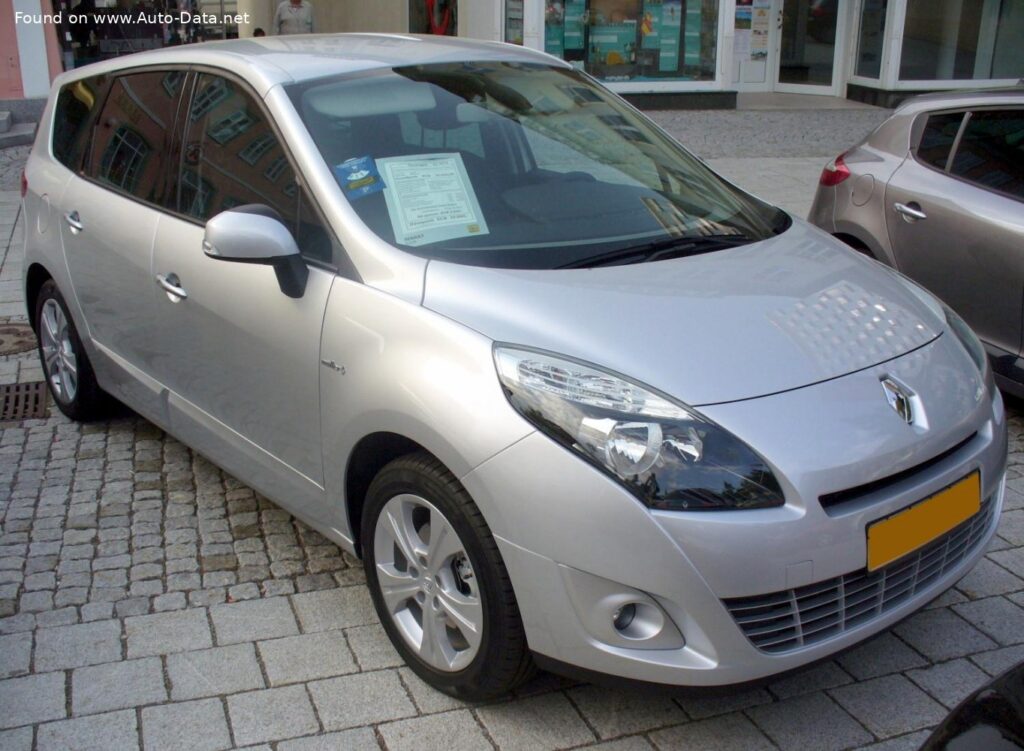
The Renault Grand Scenic III (Phase I) 2.0 16V (140 Hp) CVT, produced between 2009 and 2011, represents Renault’s offering in the compact minivan segment. This vehicle, primarily marketed in Europe, aimed to provide a spacious and practical family vehicle with a focus on comfort and versatility. While not officially sold in the United States, understanding its specifications and features provides insight into the European automotive landscape of the late 2000s. The Grand Scenic III built upon the success of its predecessors, offering improved styling, enhanced interior features, and a range of efficient engine options, including the 2.0-liter 16-valve petrol engine paired with a Continuously Variable Transmission (CVT).
Renault Grand Scenic III: An Overview
The Grand Scenic III was a significant update to the Scenic line, known for its innovative interior packaging and family-friendly features. The “Grand” designation indicates a longer wheelbase and seven-seat configuration, offering increased passenger and cargo space compared to the standard Scenic. The Phase I models, produced from 2009 to 2011, established the design language and technological features that would define the third generation. The vehicle competed with other European minivans such as the Citroën C4 Picasso and the Opel/Vauxhall Zafira, emphasizing practicality and comfort over outright performance.
Engine & Performance
The 2.0 16V engine powering the Grand Scenic III delivers 140 horsepower at 6000 rpm and 195 Nm (143.82 lb.-ft.) of torque at 3750 rpm. This naturally aspirated, inline-four cylinder engine, designated M4R, displaces 1997 cm3 (121.86 cu. in.) and features multi-port fuel injection. The engine’s power-to-liter ratio is 70.1 Hp/l. Paired with a CVT, the powertrain prioritizes smooth acceleration and fuel efficiency over sporty driving dynamics. Acceleration from 0 to 100 km/h (0-62 mph) takes 10.8 seconds, while 0-60 mph is achieved in approximately 10.3 seconds. The Grand Scenic III achieves a maximum speed of 190 km/h (118.06 mph). Fuel economy is rated at 7.7 l/100 km (30.5 US mpg) combined, with 10.3 l/100 km (22.8 US mpg) in urban conditions and 6.2 l/100 km (37.9 US mpg) on the extra-urban cycle. CO2 emissions are rated at 183 g/km, meeting Euro 4 emission standards.
Design & Features
The Renault Grand Scenic III (Phase I) is a five-door minivan with a distinctive, flowing design. Its elongated body accommodates up to seven passengers across three rows of seats, although the third row is best suited for children or shorter adults. The interior is characterized by its modularity, with sliding and folding rear seats allowing for flexible cargo configurations. Trunk space ranges from 564 liters (19.92 cu. ft.) with all seats in place to a maximum of 1863 liters (65.79 cu. ft.) with the rear seats folded down.
Key features of the Phase I model include ABS (Anti-lock Braking System), electric power steering, and a McPherson independent suspension at the front and an elastic beam suspension at the rear. Safety features were a priority, with the Grand Scenic III incorporating a robust chassis and a range of passive safety systems. The vehicle’s dimensions are: length 4560 mm (179.53 in.), width 1845 mm (72.64 in.), height 1675 mm (65.94 in.), and wheelbase 2769 mm (109.02 in.). The curb weight is 1430 kg (3152.61 lbs), with a maximum permissible weight of 2128 kg (4691.44 lbs).
Technical Specifications
| Brand | Renault |
| Model | Scenic |
| Generation | Grand Scenic III (Phase I) |
| Type (Engine) | 2.0 16V (140 Hp) CVT |
| Start of production | 2009 |
| End of production | 2011 |
| Powertrain Architecture | Internal Combustion engine |
| Body type | Minivan |
| Seats | 5 |
| Doors | 5 |
| Fuel consumption (urban) | 10.3 l/100 km (22.8 US mpg) |
| Fuel consumption (extra urban) | 6.2 l/100 km (37.9 US mpg) |
| Fuel consumption (combined) | 7.7 l/100 km (30.5 US mpg) |
| CO2 emissions | 183 g/km |
| Fuel Type | Petrol (Gasoline) |
| Acceleration 0 – 100 km/h | 10.8 sec |
| Acceleration 0 – 62 mph | 10.8 sec |
| Acceleration 0 – 60 mph | 10.3 sec |
| Maximum speed | 190 km/h (118.06 mph) |
| Emission standard | Euro 4 |
| Weight-to-power ratio | 10.2 kg/Hp |
| Weight-to-torque ratio | 7.3 kg/Nm |
| Power | 140 Hp @ 6000 rpm |
| Torque | 195 Nm @ 3750 rpm (143.82 lb.-ft. @ 3750 rpm) |
| Engine layout | Front, Transverse |
| Engine Model/Code | M4R |
| Engine displacement | 1997 cm3 (121.86 cu. in.) |
| Number of cylinders | 4 |
| Engine configuration | Inline |
| Cylinder Bore | 84 mm (3.31 in.) |
| Piston Stroke | 90.1 mm (3.55 in.) |
| Compression ratio | 10.2:1 |
| Number of valves per cylinder | 4 |
| Fuel injection system | Multi-port manifold injection |
| Engine oil capacity | 4.4 l (4.65 US qt | 3.87 UK qt) |
| Coolant | 6.8 l (7.19 US qt | 5.98 UK qt) |
| Kerb Weight | 1430 kg (3152.61 lbs.) |
| Max. weight | 2128 kg (4691.44 lbs.) |
| Max load | 698 kg (1538.83 lbs.) |
| Trunk (boot) space – minimum | 564-702 l (19.92 – 24.79 cu. ft.) |
| Trunk (boot) space – maximum | 1863 l (65.79 cu. ft.) |
| Fuel tank capacity | 60 l (15.85 US gal | 13.2 UK gal) |
| Max. roof load | 80 kg (176.37 lbs.) |
| Permitted trailer load with brakes (12%) | 1300 kg (2866.01 lbs.) |
| Permitted trailer load without brakes | 750 kg (1653.47 lbs.) |
| Permitted towbar download | 75 kg (165.35 lbs.) |
| Length | 4560 mm (179.53 in.) |
| Width | 1845 mm (72.64 in.) |
| Width including mirrors | 2077 mm (81.77 in.) |
| Height | 1675 mm (65.94 in.) |
| Wheelbase | 2769 mm (109.02 in.) |
| Front track | 1536 mm (60.47 in.) |
| Rear (Back) track | 1539 mm (60.59 in.) |
| Ride height (ground clearance) | 120 mm (4.72 in.) |
| Minimum turning circle (turning diameter) | 11.29 m (37.04 ft.) |
| Drive wheel | Front wheel drive |
| Number of gears and type of gearbox | automatic transmission CVT |
| Front suspension | Independent type McPherson |
| Rear suspension | Elastic beam |
| Front brakes | Ventilated discs, 296 mm |
| Rear brakes | Disc, 274 mm |
| Tires size | 205 /60 R16 |
| Wheel rims size | 16 |
The Renault Grand Scenic III (Phase I) 2.0 16V (140 Hp) CVT, while not a performance vehicle, offered a compelling package of practicality, comfort, and fuel efficiency for European families. Its spacious interior, versatile seating arrangements, and reasonable running costs made it a popular choice in its segment.