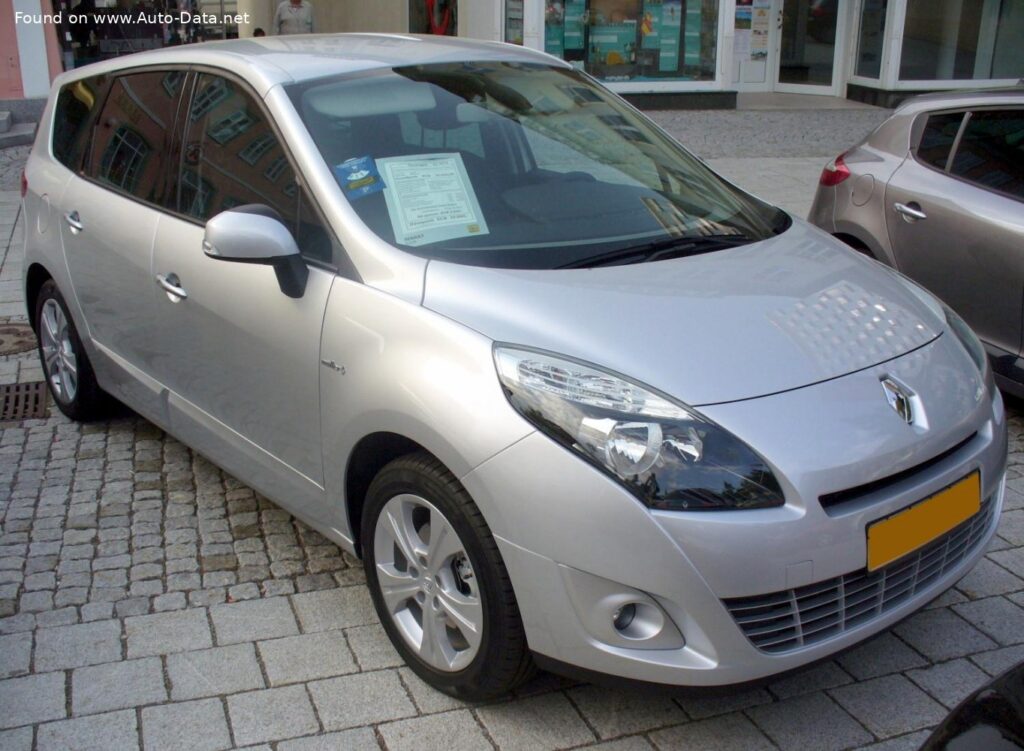
The Renault Grand Scenic III (Phase I) 2.0 dCi (150 Hp) FAP Automatic is a compact minivan produced by the French automaker Renault from 2009 to 2011. Part of the third generation of the Scenic range, the Grand Scenic offered increased practicality with seven-seat availability, distinguishing it from the standard five-seat Scenic. This model was primarily aimed at the European market, where compact MPVs (Multi-Purpose Vehicles) were highly popular due to their versatility and efficient use of space. The Phase I designation refers to the initial iteration of the third-generation model, characterized by specific styling and equipment features. It represented Renault’s attempt to blend family-friendly functionality with a degree of style and modern technology.
Renault Grand Scenic III: An Overview
The Grand Scenic III built upon the success of its predecessors, offering a more refined and spacious interior, improved ride quality, and a range of efficient engine options. The 2.0 dCi variant, equipped with a 150 horsepower diesel engine and an automatic transmission, was a popular choice for buyers seeking a balance between performance and fuel economy. The inclusion of a Diesel Particulate Filter (FAP) demonstrated Renault’s commitment to reducing emissions and meeting increasingly stringent European environmental standards. The vehicle competed with other compact MPVs such as the Citroën C4 Picasso, Peugeot 5008, and Volkswagen Touran.
Engine & Performance
The heart of the Grand Scenic III 2.0 dCi is a 1995 cc inline-four cylinder diesel engine, designated the M9R. This engine produces 150 horsepower at 3750 rpm and 340 Nm (250.77 lb.-ft.) of torque at 1750 rpm. The engine utilizes a turbocharger and intercooler to enhance performance and efficiency. The common rail direct fuel injection system ensures precise fuel delivery, contributing to both power output and reduced emissions. Coupled with a six-speed automatic transmission, the Grand Scenic III delivers smooth and responsive acceleration. Performance figures include a 0-100 km/h (0-62 mph) time of 10.0 seconds and a maximum speed of 200 km/h (124.27 mph). The weight-to-power ratio of 10.7 kg/Hp and weight-to-torque ratio of 4.7 kg/Nm indicate a reasonably efficient powertrain.
Design & Features
The Renault Grand Scenic III (Phase I) features a distinctive exterior design characterized by its flowing lines and sculpted bodywork. The minivan body style provides ample interior space for passengers and luggage. The vehicle offers seating for up to seven occupants, with the third-row seats typically folding flat into the floor when not in use. Key features include a panoramic sunroof (optional), integrated navigation system, and a range of safety technologies. The interior is designed with practicality in mind, offering numerous storage compartments and flexible seating configurations. Safety features included ABS (Anti-lock Braking System) and driver/passenger airbags. The Grand Scenic III aimed to provide a comfortable and convenient driving experience for families, with a focus on versatility and functionality. Trunk space ranges from 564 liters (19.92 cu. ft.) with all seats in place to 1863 liters (65.79 cu. ft.) with the rear seats folded down.
Technical Specifications
| Brand | Renault |
| Model | Scenic |
| Generation | Grand Scenic III (Phase I) |
| Type (Engine) | 2.0 dCi (150 Hp) FAP Automatic |
| Start of production | 2009 |
| End of production | 2011 |
| Powertrain Architecture | Internal Combustion engine |
| Body type | Minivan |
| Seats | 5 |
| Doors | 5 |
| Fuel consumption (urban) | 9.0 l/100 km (26.1 US mpg, 31.4 UK mpg, 11.1 km/l) |
| Fuel consumption (extra urban) | 5.9 l/100 km (39.9 US mpg, 47.9 UK mpg, 16.9 km/l) |
| Fuel consumption (combined) | 7.0 l/100 km (33.6 US mpg, 40.4 UK mpg, 14.3 km/l) |
| CO2 emissions | 184 g/km |
| Fuel Type | Diesel |
| Acceleration 0 – 100 km/h | 10.0 sec |
| Acceleration 0 – 62 mph | 10.0 sec |
| Acceleration 0 – 60 mph | 9.5 sec |
| Maximum speed | 200 km/h (124.27 mph) |
| Emission standard | Euro 5 |
| Weight-to-power ratio | 10.7 kg/Hp |
| Weight-to-torque ratio | 4.7 kg/Nm |
| Power | 150 Hp @ 3750 rpm |
| Power per litre | 75.2 Hp/l |
| Torque | 340 Nm @ 1750 rpm (250.77 lb.-ft. @ 1750 rpm) |
| Engine layout | Front, Transverse |
| Engine Model/Code | M9R |
| Engine displacement | 1995 cm3 (121.74 cu. in.) |
| Number of cylinders | 4 |
| Engine configuration | Inline |
| Cylinder Bore | 84 mm (3.31 in.) |
| Piston Stroke | 90 mm (3.54 in.) |
| Compression ratio | 15.1:1 |
| Number of valves per cylinder | 4 |
| Fuel injection system | Diesel Commonrail |
| Engine aspiration | Turbocharger, Intercooler |
| Engine oil capacity | 7.4 l (7.82 US qt | 6.51 UK qt) |
| Coolant | 7.5 l (7.93 US qt | 6.6 UK qt) |
| Kerb Weight | 1610 kg (3549.44 lbs.) |
| Max. weight | 2270 kg (5004.49 lbs.) |
| Max load | 660 kg (1455.05 lbs.) |
| Trunk (boot) space – minimum | 564-702 l (19.92 – 24.79 cu. ft.) |
| Trunk (boot) space – maximum | 1863 l (65.79 cu. ft.) |
| Fuel tank capacity | 60 l (15.85 US gal | 13.2 UK gal) |
| Max. roof load | 80 kg (176.37 lbs.) |
| Permitted trailer load with brakes (12%) | 1300 kg (2866.01 lbs.) |
| Permitted trailer load without brakes | 750 kg (1653.47 lbs.) |
| Permitted towbar download | 75 kg (165.35 lbs.) |
| Length | 4560 mm (179.53 in.) |
| Width | 1845 mm (72.64 in.) |
| Width including mirrors | 2077 mm (81.77 in.) |
| Height | 1675 mm (65.94 in.) |
| Wheelbase | 2769 mm (109.02 in.) |
| Front track | 1536 mm (60.47 in.) |
| Rear (Back) track | 1539 mm (60.59 in.) |
| Front overhang | 888 mm (34.96 in.) |
| Rear overhang | 903 mm (35.55 in.) |
| Ride height (ground clearance) | 120 mm (4.72 in.) |
| Minimum turning circle (turning diameter) | 11.29 m (37.04 ft.) |
| Drivetrain Architecture | Front wheel drive |
| Number of gears and type of gearbox | 6 gears, automatic transmission |
| Front suspension | Independent type McPherson |
| Rear suspension | Elastic beam |
| Front brakes | Ventilated discs, 320 mm |
| Rear brakes | Disc, 290 mm |
| Tires size | 225/50 R17 98V |
| Wheel rims size | 7J x 17 |