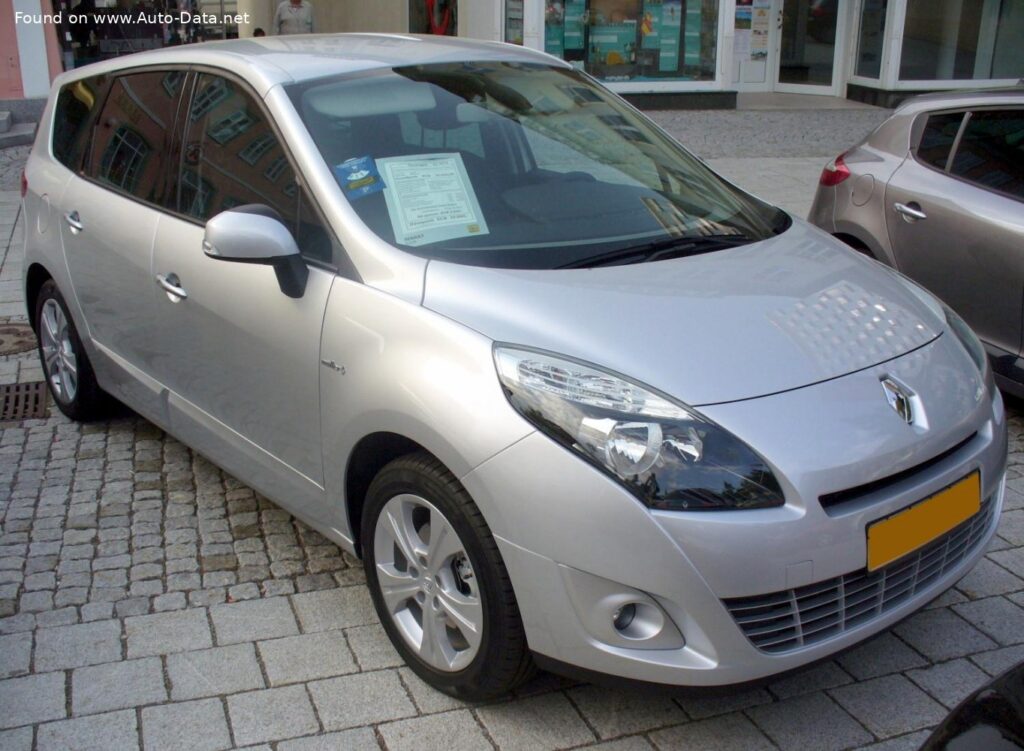
The Renault Grand Scenic III (Phase I) 2.0 dCi (160 Hp) FAP is a five-seater minivan produced by the French automaker Renault from 2009 to 2011. Part of the third generation of the Scenic range, the Grand Scenic offered increased practicality and space compared to the standard Scenic, catering to families needing a versatile vehicle. This model was primarily sold in Europe and was not officially offered in the North American market. It represented Renault’s commitment to providing innovative and family-focused transportation solutions within the competitive European MPV (Multi-Purpose Vehicle) segment.
Renault Grand Scenic III: An Overview
The Grand Scenic III, particularly the 2.0 dCi variant, aimed to balance fuel efficiency with respectable performance. It built upon the success of its predecessors, offering a more refined interior, improved ride quality, and a range of modern features for the time. The “Phase I” designation refers to the initial iteration of the third-generation model, with subsequent phases introducing styling and equipment updates. The 2.0 dCi engine was a popular choice in Europe, offering a good compromise between power and economy for long-distance travel and everyday use.
Engine & Performance
The heart of the Grand Scenic III 2.0 dCi is a 1995 cc inline-four cylinder diesel engine, designated the M9R. This engine produces 160 horsepower at 3750 rpm and a substantial 380 Nm (280.27 lb.-ft.) of torque at 1750 rpm. The engine utilizes a diesel commonrail fuel injection system and is equipped with a turbocharger and intercooler to enhance performance and efficiency. Power is delivered to the front wheels via a six-speed manual transmission. Performance figures include a 0-100 km/h (0-62 mph) acceleration time of 9.3 seconds and a maximum speed of 205 km/h (127.38 mph). The engine’s torque output provides strong acceleration in everyday driving situations, making it well-suited for carrying passengers and luggage. The weight-to-power ratio is 9.9 kg/Hp, and the weight-to-torque ratio is 4.2 kg/Nm, indicating a reasonably efficient powertrain.
Design & Features
The Renault Grand Scenic III (Phase I) features a distinctive and modern design for its time. Its minivan body style prioritizes interior space and practicality. The vehicle offers five seats as standard, with a flexible seating arrangement allowing for increased cargo capacity when needed. The exterior design incorporates Renault’s styling cues of the late 2000s, with a prominent front grille, sculpted headlights, and a flowing roofline. Inside, the cabin is designed with family use in mind, featuring durable materials and a user-friendly layout. Key features included air conditioning, power windows, central locking, and an audio system. Safety features, crucial for a family vehicle, included ABS (Anti-lock Braking System), driver and passenger airbags, and seatbelt pretensioners. The Grand Scenic also offered a generous amount of storage compartments throughout the cabin, enhancing its practicality. Trunk space ranges from 564 liters (19.92 cu. ft.) with all seats in place to a maximum of 1863 liters (65.79 cu. ft.) with the rear seats folded down.
Technical Specifications
| Brand | Renault |
| Model | Scenic |
| Generation | Grand Scenic III (Phase I) |
| Type (Engine) | 2.0 dCi (160 Hp) FAP |
| Start of production | 2009 |
| End of production | 2011 |
| Powertrain Architecture | Internal Combustion engine |
| Body type | Minivan |
| Seats | 5 |
| Doors | 5 |
| Fuel consumption (urban) | 8.3 l/100 km (28.3 US mpg, 34 UK mpg, 12 km/l) |
| Fuel consumption (extra urban) | 5.6 l/100 km (42 US mpg, 50.4 UK mpg, 17.9 km/l) |
| Fuel consumption (combined) | 6.6 l/100 km (35.6 US mpg, 42.8 UK mpg, 15.2 km/l) |
| CO2 emissions | 173 g/km |
| Fuel Type | Diesel |
| Acceleration 0 – 100 km/h | 9.3 sec |
| Acceleration 0 – 62 mph | 9.3 sec |
| Acceleration 0 – 60 mph | 8.8 sec |
| Maximum speed | 205 km/h (127.38 mph) |
| Emission standard | Euro 5 |
| Weight-to-power ratio | 9.9 kg/Hp |
| Weight-to-torque ratio | 4.2 kg/Nm |
| Power | 160 Hp @ 3750 rpm |
| Torque | 380 Nm @ 1750 rpm (280.27 lb.-ft. @ 1750 rpm) |
| Engine layout | Front, Transverse |
| Engine Model/Code | M9R |
| Engine displacement | 1995 cm3 (121.74 cu. in.) |
| Number of cylinders | 4 |
| Engine configuration | Inline |
| Cylinder Bore | 84 mm (3.31 in.) |
| Piston Stroke | 90 mm (3.54 in.) |
| Compression ratio | 15.1:1 |
| Number of valves per cylinder | 4 |
| Fuel injection system | Diesel Commonrail |
| Engine aspiration | Turbocharger, Intercooler |
| Engine oil capacity | 7.4 l (7.82 US qt | 6.51 UK qt) |
| Coolant | 7.2 l (7.61 US qt | 6.34 UK qt) |
| Kerb Weight | 1591 kg (3507.55 lbs.) |
| Max. weight | 2251 kg (4962.61 lbs.) |
| Max load | 660 kg (1455.05 lbs.) |
| Trunk (boot) space – minimum | 564-702 l (19.92 – 24.79 cu. ft.) |
| Trunk (boot) space – maximum | 1863 l (65.79 cu. ft.) |
| Fuel tank capacity | 60 l (15.85 US gal | 13.2 UK gal) |
| Max. roof load | 80 kg (176.37 lbs.) |
| Permitted trailer load with brakes (12%) | 1300 kg (2866.01 lbs.) |
| Permitted trailer load without brakes | 750 kg (1653.47 lbs.) |
| Permitted towbar download | 75 kg (165.35 lbs.) |
| Length | 4560 mm (179.53 in.) |
| Width | 1845 mm (72.64 in.) |
| Width including mirrors | 2077 mm (81.77 in.) |
| Height | 1675 mm (65.94 in.) |
| Wheelbase | 2769 mm (109.02 in.) |
| Front track | 1536 mm (60.47 in.) |
| Rear (Back) track | 1539 mm (60.59 in.) |
| Front overhang | 888 mm (34.96 in.) |
| Rear overhang | 903 mm (35.55 in.) |
| Ride height (ground clearance) | 120 mm (4.72 in.) |
| Minimum turning circle (turning diameter) | 11.29 m (37.04 ft.) |
| Drivetrain Architecture | Front wheel drive |
| Number of gears and type of gearbox | 6 gears, manual transmission |
| Front suspension | Independent type McPherson |
| Rear suspension | Elastic beam |
| Front brakes | Ventilated discs, 320 mm |
| Rear brakes | Disc, 290 mm |
| Tires size | 225/50 R17 98V |
| Wheel rims size | 7J x 17 |
The Renault Grand Scenic III (Phase I) 2.0 dCi (160 Hp) FAP, while not sold in the US, was a significant vehicle in the European market, offering a practical and efficient solution for families. Its blend of space, comfort, and fuel economy made it a popular choice among buyers seeking a versatile MPV.