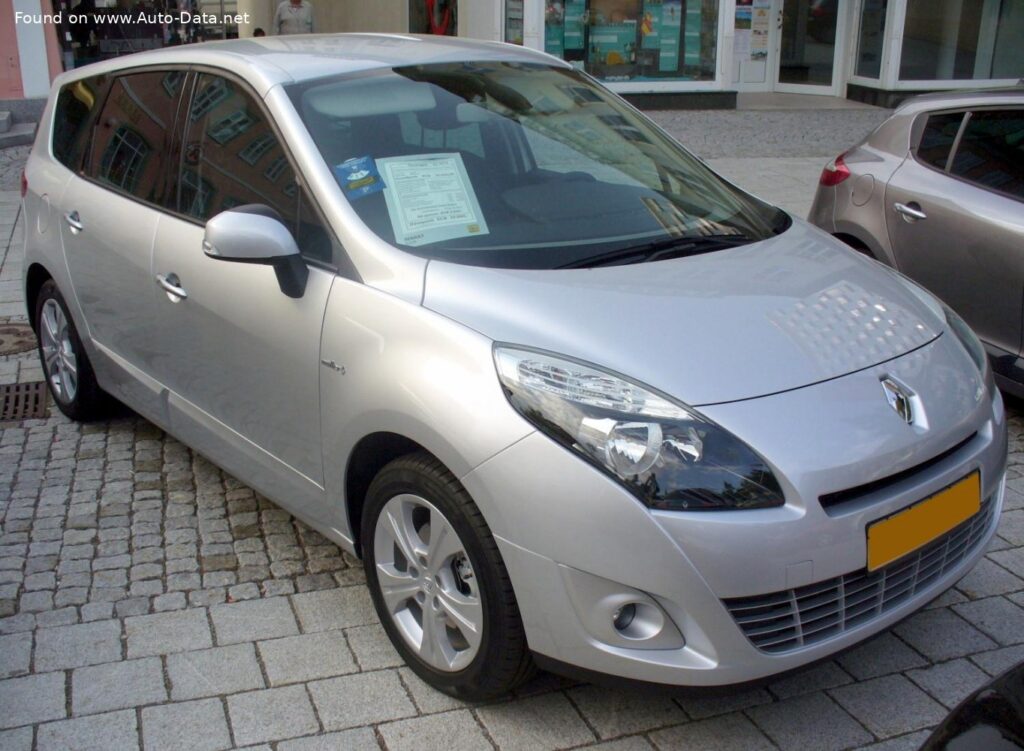
The Renault Grand Scenic III (Phase I) 2.0 dCi (160 Hp) FAP 7 Seat, produced between 2009 and 2011, represents a significant iteration in Renault’s popular minivan lineup. Positioned as a compact multi-purpose vehicle (MPV), the Grand Scenic III aimed to provide a practical and spacious solution for families, offering seven-seat capability within a relatively manageable footprint. This model was primarily marketed in Europe, where the demand for MPVs remained strong, offering a compelling alternative to larger, more expensive people carriers. The “Grand” designation signifies the extended wheelbase and subsequent increase in interior space compared to the standard Scenic III, specifically designed to accommodate the third row of seats.
Renault Grand Scenic III: An Overview
The Grand Scenic III (Phase I) built upon the success of its predecessors, introducing a revised design, improved interior quality, and enhanced technology. The Phase I designation refers to the initial production run of the third-generation Grand Scenic, characterized by specific styling cues and equipment levels. The 2.0 dCi engine, a mainstay of Renault’s diesel offerings, provided a balance of performance and fuel efficiency, making it a popular choice for long-distance family travel. The inclusion of a Diesel Particulate Filter (FAP) demonstrated Renault’s commitment to reducing emissions and meeting increasingly stringent European environmental standards.
Engine & Performance
Powering the Grand Scenic III 2.0 dCi is a 1995 cc inline-four cylinder diesel engine, designated the M9R. This engine produces 160 horsepower at 3750 rpm and a substantial 380 Nm (280.27 lb.-ft.) of torque at 1750 rpm. The engine utilizes a diesel commonrail fuel injection system and is equipped with a turbocharger and intercooler to optimize performance and efficiency. This configuration allows for brisk acceleration, with a 0-100 km/h (0-62 mph) time of 9.5 seconds and a top speed of 205 km/h (127.38 mph). The engine’s relatively high compression ratio of 15.1:1 contributes to its efficiency, while the FAP system effectively reduces particulate matter emissions, ensuring compliance with Euro 5 emission standards. The engine is transversely mounted at the front of the vehicle, driving the front wheels through a six-speed manual transmission.
Design & Features
The Renault Grand Scenic III (Phase I) features a distinctive minivan silhouette, characterized by its flowing lines and generous glass area. The vehicle’s five-door configuration provides easy access to all seating positions. The interior is designed with practicality in mind, offering a flexible seating arrangement that can be adapted to accommodate varying passenger and cargo needs. The seven-seat configuration is a key selling point, making it suitable for larger families or those who frequently transport passengers. When all seats are in use, trunk space is limited to 208 liters (7.35 cu. ft.), but with the third-row seats folded and the second-row seats configured for maximum cargo space, the capacity expands to a substantial 2063 liters (72.85 cu. ft.). Standard features typically included air conditioning, power windows, central locking, and an audio system. Safety features, crucial for a family vehicle, included ABS (Anti-lock Braking System) and driver/passenger airbags. The Grand Scenic III also offered a range of optional extras, such as parking sensors, a navigation system, and panoramic sunroof.
Technical Specifications
| Brand | Renault |
| Model | Scenic |
| Generation | Grand Scenic III (Phase I) |
| Type | 2.0 dCi (160 Hp) FAP 7 Seat |
| Start of production | 2009 |
| End of production | 2011 |
| Powertrain Architecture | Internal Combustion engine |
| Body type | Minivan |
| Seats | 7 |
| Doors | 5 |
| Fuel consumption (urban) | 8.3 l/100 km (28.3 US mpg, 34 UK mpg, 12 km/l) |
| Fuel consumption (extra urban) | 5.6 l/100 km (42 US mpg, 50.4 UK mpg, 17.9 km/l) |
| Fuel consumption (combined) | 6.6 l/100 km (35.6 US mpg, 42.8 UK mpg, 15.2 km/l) |
| CO2 emissions | 173 g/km |
| Fuel Type | Diesel |
| Acceleration 0 – 100 km/h | 9.5 sec |
| Acceleration 0 – 62 mph | 9.5 sec |
| Acceleration 0 – 60 mph | 9 sec |
| Maximum speed | 205 km/h (127.38 mph) |
| Emission standard | Euro 5 |
| Weight-to-power ratio | 10.2 kg/Hp |
| Power | 160 Hp @ 3750 rpm |
| Torque | 380 Nm @ 1750 rpm (280.27 lb.-ft. @ 1750 rpm) |
| Engine layout | Front, Transverse |
| Engine Model/Code | M9R |
| Engine displacement | 1995 cm3 (121.74 cu. in.) |
| Number of cylinders | 4 |
| Engine configuration | Inline |
| Cylinder Bore | 84 mm (3.31 in.) |
| Piston Stroke | 90 mm (3.54 in.) |
| Compression ratio | 15.1:1 |
| Number of valves per cylinder | 4 |
| Fuel injection system | Diesel Commonrail |
| Engine oil capacity | 7.4 l (7.82 US qt | 6.51 UK qt) |
| Coolant | 7.2 l (7.61 US qt | 6.34 UK qt) |
| Kerb Weight | 1628 kg (3589.13 lbs.) |
| Max. weight | 2251 kg (4962.61 lbs.) |
| Max load | 623 kg (1373.48 lbs.) |
| Trunk (boot) space – minimum | 208 l (7.35 cu. ft.) |
| Trunk (boot) space – maximum | 2063 l (72.85 cu. ft.) |
| Fuel tank capacity | 60 l (15.85 US gal | 13.2 UK gal) |
| Length | 4560 mm (179.53 in.) |
| Width | 1845 mm (72.64 in.) |
| Height | 1675 mm (65.94 in.) |
| Wheelbase | 2769 mm (109.02 in.) |
| Drive wheel | Front wheel drive |
| Number of gears | 6 gears, manual transmission |
The Renault Grand Scenic III (Phase I) 2.0 dCi offered a compelling package for families seeking a versatile and efficient MPV. Its spacious interior, practical features, and refined diesel engine contributed to its popularity in the European market. While not officially sold in the United States, it represents a significant example of European MPV design and engineering.