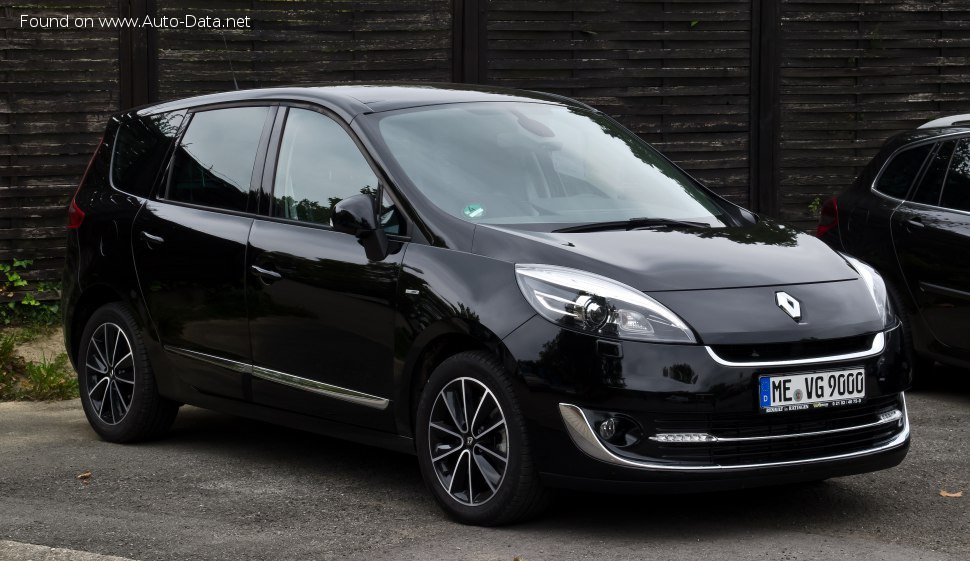
The Renault Grand Scenic III (Phase II, collection 2012) 1.6 dCi energy is a compact minivan produced by the French automaker Renault. Introduced as part of the third generation of the Scenic range, this model represents a mid-life refresh, known as Phase II, and was available from 2012 to 2013. The Grand Scenic, distinguished by its seven-seat configuration, aimed to provide a practical and versatile family vehicle, particularly popular in the European market. It competed with other compact MPVs like the Citroën C4 Picasso and Opel Zafira, offering a blend of space, comfort, and fuel efficiency. This version specifically features a 1.6-liter turbocharged diesel engine with Start/Stop technology, emphasizing Renault’s focus on reducing emissions and improving fuel economy.
Renault Grand Scenic III: A Detailed Overview
The Renault Scenic line, launched in 1996, pioneered the compact minivan segment, offering a more stylish and driver-focused alternative to traditional people carriers. The third generation, introduced in 2009, continued this trend with a more refined design and improved interior quality. The Phase II update in 2012 brought subtle styling changes, enhanced equipment levels, and the introduction of more efficient engine options, including the 1.6 dCi energy featured here. The Grand Scenic, with its extended wheelbase and third-row seating, catered to larger families or those requiring greater cargo capacity. While not officially sold in the United States, the Scenic range was a significant player in the European automotive landscape, known for its innovative features and practicality.
Engine & Performance
The heart of the Grand Scenic III 1.6 dCi energy is a 1.6-liter inline-four cylinder diesel engine, designated R9M by Renault. This engine produces 130 horsepower at 4,000 rpm and a substantial 320 Nm (236 lb-ft) of torque at 1750 rpm. The engine utilizes a turbocharger and intercooler to enhance performance and efficiency. A diesel commonrail fuel injection system ensures precise fuel delivery, contributing to both power output and reduced emissions. The inclusion of a Start/Stop system further improves fuel economy in urban driving conditions by automatically shutting off the engine when the vehicle is stationary. Power is delivered to the front wheels via a six-speed manual transmission. Acceleration from 0 to 100 km/h (0-62 mph) takes 11.1 seconds, while the top speed is rated at 195 km/h (121.17 mph). The engine’s power-to-weight ratio is 12 kg/Hp, and the torque-to-weight ratio is 4.9 kg/Nm.
Design & Features
The Renault Grand Scenic III Phase II maintains the distinctive styling of the third-generation Scenic, characterized by its flowing lines and sculpted bodywork. As a minivan, its primary focus is on maximizing interior space and practicality. The vehicle offers seating for seven passengers across three rows, with the third row being suitable for children or occasional adult use. The interior is designed with family needs in mind, featuring durable materials and a flexible seating configuration. The rear seats can be folded flat or removed entirely to create a larger cargo area. The trunk offers a minimum capacity of 564 liters (19.92 cu ft) with all seats in place, expanding to a generous 2063 liters (72.85 cu ft) with the rear seats folded. Safety features include ABS (Anti-lock Braking System) and a robust chassis design. The Phase II update included minor cosmetic enhancements and improvements to the infotainment system, though specific features varied depending on trim level.
Technical Specifications
| Brand | Renault |
| Model | Scenic |
| Generation | Grand Scenic III (Phase II, collection 2012) |
| Type (Engine) | 1.6 dCi energy (130 Hp) Start/Stop |
| Start of production | 2012 |
| End of production | 2013 |
| Powertrain Architecture | Internal Combustion engine |
| Body type | Minivan |
| Seats | 7 |
| Doors | 5 |
| Fuel consumption (urban) | 5.1 l/100 km (46.1 US mpg, 55.4 UK mpg, 19.6 km/l) |
| Fuel consumption (extra urban) | 4 l/100 km (58.8 US mpg, 70.6 UK mpg, 25 km/l) |
| Fuel consumption (combined) | 4.4 l/100 km (53.5 US mpg, 64.2 UK mpg, 22.7 km/l) |
| Fuel Type | Diesel |
| Acceleration 0 – 100 km/h | 11.1 sec |
| Acceleration 0 – 62 mph | 11.1 sec |
| Acceleration 0 – 60 mph | 10.5 sec |
| Maximum speed | 195 km/h (121.17 mph) |
| Weight-to-power ratio | 12 kg/Hp |
| Weight-to-torque ratio | 4.9 kg/Nm |
| Power | 130 Hp @ 4000 rpm |
| Power per litre | 81.4 Hp/l |
| Torque | 320 Nm @ 1750 rpm (236.02 lb.-ft. @ 1750 rpm) |
| Engine layout | Front, Transverse |
| Engine Model/Code | R9M |
| Engine displacement | 1598 cm3 (97.52 cu. in.) |
| Number of cylinders | 4 |
| Engine configuration | Inline |
| Cylinder Bore | 80 mm (3.15 in.) |
| Piston Stroke | 79.5 mm (3.13 in.) |
| Compression ratio | 15.4:1 |
| Number of valves per cylinder | 4 |
| Fuel injection system | Diesel Commonrail |
| Engine aspiration | Turbocharger, Intercooler |
| Engine oil capacity | 5.5 l (5.81 US qt | 4.84 UK qt) |
| Coolant | 6.7 l (7.08 US qt | 5.9 UK qt) |
| Kerb Weight | 1563 kg (3445.83 lbs.) |
| Max. weight | 2495 kg (5500.53 lbs.) |
| Max load | 932 kg (2054.71 lbs.) |
| Trunk (boot) space – minimum | 564 l (19.92 cu. ft.) |
| Trunk (boot) space – maximum | 2063 l (72.85 cu. ft.) |
| Fuel tank capacity | 60 l (15.85 US gal | 13.2 UK gal) |
| Length | 4573 mm (180.04 in.) |
| Width | 1845 mm (72.64 in.) |
| Height | 1645 mm (64.76 in.) |
| Wheelbase | 2770 mm (109.06 in.) |
| Front track | 1536 mm (60.47 in.) |
| Rear (Back) track | 1539 mm (60.59 in.) |
| Minimum turning circle | 11.29 m (37.04 ft.) |
| Drivetrain Architecture | Front wheel drive |
| Number of gears | 6 gears, manual transmission |
| Front suspension | Independent type McPherson |
| Front brakes | Ventilated discs |
| Rear brakes | Disc |
| Tires size | 205/60 R16 96 H |
| Wheel rims size | 6.5J x 16 |