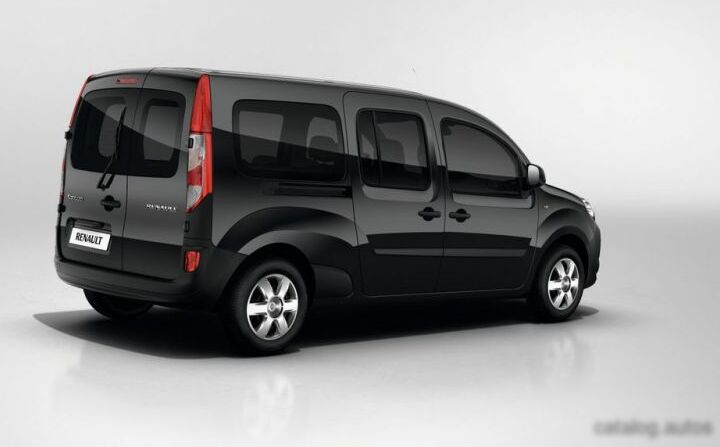
The Renault Grand Scenic IV, specifically the Phase I 1.3 Energy TCe (140 Hp) 7 Seat model, represents Renault’s fourth generation of the Scenic line, a compact multi-purpose vehicle (MPV) popular in Europe. Introduced in 2017 and produced through 2018, this iteration of the Grand Scenic aimed to blend practicality, comfort, and modern technology within a stylish package. While not officially sold in the United States, the Scenic has been a significant player in the European family car market, offering a versatile alternative to traditional hatchbacks and small SUVs. The Grand Scenic, in particular, distinguishes itself with its seven-seat configuration, catering to larger families or those requiring flexible passenger and cargo space.
Renault Grand Scenic IV: Overview and Market Position
The Grand Scenic IV arrived as part of Renault’s broader strategy to refresh its lineup with more contemporary designs and advanced features. It competed directly with other European MPVs like the Citroën Grand C4 Picasso (now C4 SpaceTourer) and the Volkswagen Touran. The Phase I models, like the 1.3 Energy TCe, were characterized by their initial engine offerings and feature sets, setting the stage for subsequent updates in later phases. The vehicle’s focus was on providing a comfortable and technologically advanced experience for families, emphasizing interior space, modularity, and driver assistance systems.
Engine & Performance
The 1.3 Energy TCe engine powering this Grand Scenic is a 1330cc, inline four-cylinder petrol (gasoline) engine equipped with direct fuel injection and a turbocharger with intercooler. This configuration produces 140 horsepower at 5000 rpm and 240 Nm (177.01 lb.-ft.) of torque at 1600 rpm. The engine’s relatively small displacement, combined with turbocharging, aims to deliver a balance between performance and fuel efficiency. Power is delivered to the front wheels via a six-speed manual transmission. Performance figures include a 0-100 km/h (0-62 mph) acceleration time of 10.3 seconds, and a 0-60 mph time of 9.8 seconds, with a maximum speed of 195 km/h (121.17 mph). The weight-to-power ratio is 10.7 kg/Hp, and the weight-to-torque ratio is 6.2 kg/Nm.
Design & Features
The Renault Grand Scenic IV Phase I boasts a distinctive exterior design, characterized by flowing lines and a sculpted profile. Its body type is a five-door minivan, offering easy access to the spacious interior. A key feature is its seven-seat configuration, with the third row of seats foldable and often removable to maximize cargo space. The interior is designed with practicality in mind, featuring modular seating arrangements and ample storage compartments. Safety features included in the Phase I models typically encompassed ABS (Anti-lock Braking System), and a range of driver assistance systems depending on trim level. The vehicle’s dimensions – 4635 mm (182.48 in) in length, 1866 mm (73.46 in) in width, and 1655 mm (65.16 in) in height – contribute to its spaciousness and comfortable ride. Trunk space ranges from a minimum of 189 liters (6.67 cu. ft.) with all seats in place to a maximum of 1737 liters (61.34 cu. ft.) with the rear seats folded down.
Technical Specifications
| Brand | Renault |
| Model | Scenic |
| Generation | Grand Scenic IV (Phase I) |
| Type (Engine) | 1.3 Energy TCe (140 Hp) 7 Seat |
| Start of production | 2017 |
| End of production | 2018 |
| Powertrain Architecture | Internal Combustion engine |
| Body type | Minivan |
| Seats | 7 |
| Doors | 5 |
| Fuel consumption (urban) | 7.1 l/100 km (33.1 US mpg, 39.8 UK mpg, 14.1 km/l) |
| Fuel consumption (extra urban) | 4.8 l/100 km (49 US mpg, 58.9 UK mpg, 20.8 km/l) |
| Fuel consumption (combined) | 5.6 l/100 km (42 US mpg, 50.4 UK mpg, 17.9 km/l) |
| CO2 emissions | 125 g/km |
| Fuel Type | Petrol (Gasoline) |
| Acceleration 0 – 100 km/h | 10.3 sec |
| Acceleration 0 – 62 mph | 10.3 sec |
| Acceleration 0 – 60 mph | 9.8 sec |
| Maximum speed | 195 km/h (121.17 mph) |
| Emission standard | Euro 6b |
| Weight-to-power ratio | 10.7 kg/Hp |
| Weight-to-torque ratio | 6.2 kg/Nm |
| Power | 140 Hp @ 5000 rpm |
| Torque | 240 Nm @ 1600 rpm (177.01 lb.-ft. @ 1600 rpm) |
| Engine layout | Front, Transverse |
| Engine Model/Code | H5H |
| Engine displacement | 1330 cm3 (81.16 cu. in.) |
| Number of cylinders | 4 |
| Engine configuration | Inline |
| Cylinder Bore | 72.2 mm (2.84 in.) |
| Piston Stroke | 81.2 mm (3.2 in.) |
| Number of valves per cylinder | 4 |
| Fuel injection system | Direct injection |
| Engine aspiration | Turbocharger, Intercooler |
| Engine oil capacity | 5.5 l (5.81 US qt | 4.84 UK qt) |
| Coolant | 6.5 l (6.87 US qt | 5.72 UK qt) |
| Kerb Weight | 1495 kg (3295.91 lbs.) |
| Max. weight | 2243 kg (4944.97 lbs.) |
| Max load | 748 kg (1649.06 lbs.) |
| Trunk (boot) space – minimum | 189 l (6.67 cu. ft.) |
| Trunk (boot) space – maximum | 1737 l (61.34 cu. ft.) |
| Fuel tank capacity | 53 l (14 US gal | 11.66 UK gal) |
| Max. roof load | 80 kg (176.37 lbs.) |
| Permitted trailer load with brakes (12%) | 1850 kg (4078.55 lbs.) |
| Permitted trailer load without brakes | 750 kg (1653.47 lbs.) |
| Permitted towbar download | 75 kg (165.35 lbs.) |
| Length | 4635 mm (182.48 in.) |
| Width | 1866 mm (73.46 in.) |
| Width including mirrors | 2128 mm (83.78 in.) |
| Height | 1655 mm (65.16 in.) |
| Wheelbase | 2804 mm (110.39 in.) |
| Front track | 1602 mm (63.07 in.) |
| Rear (Back) track | 1596 mm (62.83 in.) |
| Front overhang | 931 mm (36.65 in.) |
| Rear overhang | 899 mm (35.39 in.) |
| Ride height (ground clearance) | 159 mm (6.26 in.) |
| Minimum turning circle (turning diameter) | 11.39 m (37.37 ft.) |
| Drivetrain Architecture | Front wheel drive |
| Number of gears and type of gearbox | 6 gears, manual transmission |
| Front suspension | Independent type McPherson |
| Rear suspension | Semi-independent, coil spring |
| Front brakes | Ventilated discs, 320 mm |
| Rear brakes | Disc, 290 mm |
| Steering type | Steering rack and pinion |
| Power steering | Electric Steering |
| Tires size | 195/55 R20 |
| Wheel rims size | 20 |