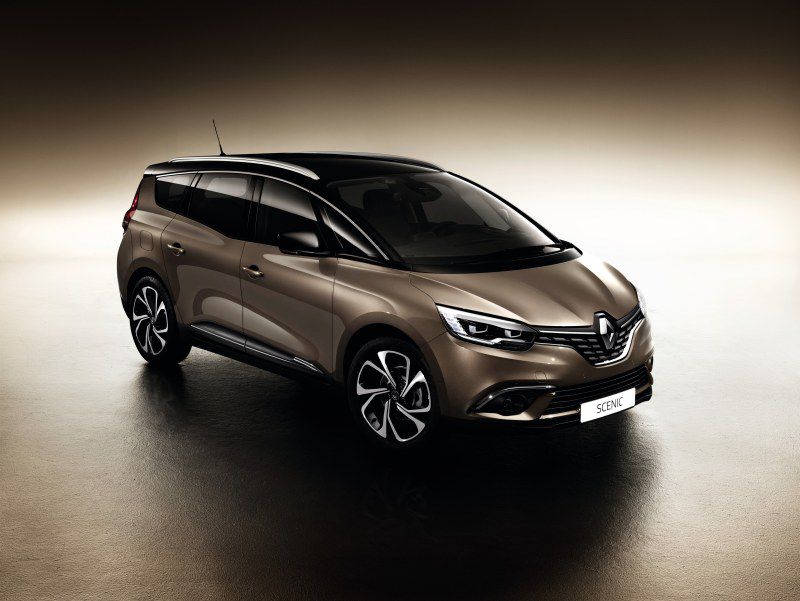
The Renault Grand Scenic IV (Phase I) 1.7 Blue dCi is a seven-seat minivan produced by the French automaker Renault from September 2018 to October 2020. Representing the fourth generation of the Scenic line, the Grand Scenic IV aimed to provide a practical and spacious family vehicle with a focus on fuel efficiency and modern technology. While not officially sold in the United States, the Scenic has been a popular choice in Europe for its versatility and innovative features, competing with models like the Citroën Grand C4 Picasso and Volkswagen Touran. This particular variant, equipped with the 1.7 Blue dCi diesel engine producing 120 horsepower, was designed to balance performance with low running costs, catering to the demands of European drivers.
Renault Grand Scenic IV: A Detailed Overview
The Grand Scenic IV marked a significant evolution in the Scenic lineup, moving towards a more crossover-inspired design while retaining the practicality expected of a minivan. The Phase I models, produced between 2018 and 2020, established the core features and design language of the fourth generation. The vehicle’s primary appeal lies in its flexible interior, offering seven seats across three rows, making it suitable for larger families or those requiring occasional extra passenger capacity. The 1.7 Blue dCi engine option was a key component of Renault’s strategy to offer a range of efficient powertrain choices, aligning with increasingly stringent European emissions regulations.
Engine & Performance
The Renault Grand Scenic IV 1.7 Blue dCi is powered by a 1.7-liter inline four-cylinder diesel engine, designated the R9N. This engine produces 120 horsepower at 3500 rpm and 300 Nm (221.27 lb.-ft.) of torque at 1750 rpm. The engine utilizes a turbocharger and intercooler to enhance performance and efficiency. Power is delivered to the front wheels via a six-speed manual transmission. The engine’s design prioritizes fuel economy, achieving a combined fuel consumption of 4.8 l/100 km (49 US mpg / 58.9 UK mpg), and CO2 emissions of 126 g/km (WLTP). Performance figures include a 0-100 km/h (0-62 mph) acceleration time of 15.2 seconds and a maximum speed of 193 km/h (119.92 mph). The weight-to-power ratio is 14.6 kg/Hp, and the weight-to-torque ratio is 5.8 kg/Nm, indicating a reasonable balance between weight and engine output.
Design & Features
The Grand Scenic IV features a distinctive exterior design characterized by its sculpted lines and bold front grille. The minivan body style offers a spacious and versatile interior. Key features include a configurable seating arrangement allowing for various passenger and cargo configurations. The Phase I models were equipped with a range of technology features, including a touchscreen infotainment system, digital instrument cluster, and advanced driver-assistance systems (ADAS) such as automatic emergency braking and lane departure warning. Safety was a key consideration, with the Grand Scenic IV achieving high scores in Euro NCAP crash tests. The vehicle’s interior is designed with practicality in mind, featuring numerous storage compartments and a user-friendly layout. Trunk space ranges from a minimum of 189 liters (6.67 cu. ft.) with all seven seats in use to a maximum of 1737 liters (61.34 cu. ft.) with the rear seats folded down. The vehicle also includes a 53-liter (14 US gal) fuel tank and a 17-liter (4.49 US gal) AdBlue tank for reducing NOx emissions.
Technical Specifications
| Brand | Renault |
| Model | Scenic |
| Generation | Grand Scenic IV (Phase I) |
| Type | 1.7 Blue dCi (120 Hp) 7 Seat |
| Start of production | September, 2018 |
| End of production | October, 2020 |
| Powertrain Architecture | Internal Combustion engine |
| Body type | Minivan |
| Seats | 7 |
| Doors | 5 |
| Combined fuel consumption (WLTP) | 4.8 l/100 km (49 US mpg / 58.9 UK mpg) |
| CO2 emissions (WLTP) | 126 g/km |
| Fuel consumption (economy) – combined | 4.9 l/100 km (48 US mpg / 57.6 UK mpg) |
| CO2 emissions | 127 g/km |
| Fuel Type | Diesel |
| Acceleration 0 – 100 km/h | 15.2 sec |
| Acceleration 0 – 62 mph | 15.2 sec |
| Acceleration 0 – 60 mph | 14.4 sec |
| Maximum speed | 193 km/h (119.92 mph) |
| Emission standard | Euro 6 |
| Weight-to-power ratio | 14.6 kg/Hp |
| Weight-to-torque ratio | 5.8 kg/Nm |
| Power | 120 Hp @ 3500 rpm |
| Power per litre | 68.6 Hp/l |
| Torque | 300 Nm @ 1750 rpm (221.27 lb.-ft. @ 1750 rpm) |
| Engine layout | Front, Transverse |
| Engine Model/Code | R9N |
| Engine displacement | 1749 cm3 (106.73 cu. in.) |
| Number of cylinders | 4 |
| Engine configuration | Inline |
| Number of valves per cylinder | 4 |
| Fuel injection system | Diesel Commonrail |
| Engine aspiration | Turbocharger, Intercooler |
| Engine oil capacity | 5.9 l (6.23 US qt | 5.19 UK qt) |
| Coolant | 7 l (7.4 US qt | 6.16 UK qt) |
| Kerb Weight | 1753 kg (3864.7 lbs.) |
| Max. weight | 2366 kg (5216.14 lbs.) |
| Max load | 613 kg (1351.43 lbs.) |
| Trunk (boot) space – minimum | 189 l (6.67 cu. ft.) |
| Trunk (boot) space – maximum | 1737 l (61.34 cu. ft.) |
| Fuel tank capacity | 53 l (14 US gal | 11.66 UK gal) |
| AdBlue tank | 17 l (4.49 US gal | 3.74 UK gal) |
| Max. roof load | 80 kg (176.37 lbs.) |
| Permitted trailer load with brakes (12%) | 1800 kg (3968.32 lbs.) |
| Permitted trailer load without brakes | 750 kg (1653.47 lbs.) |
| Length | 4635 mm (182.48 in.) |
| Width | 1866 mm (73.46 in.) |
| Width including mirrors | 2128 mm (83.78 in.) |
| Height | 1655 mm (65.16 in.) |
| Wheelbase | 2804 mm (110.39 in.) |
| Front track | 1602 mm (63.07 in.) |
| Rear (Back) track | 1596 mm (62.83 in.) |
| Drivetrain Architecture | Front wheel drive |
| Number of gears and type of gearbox | 6 gears, manual transmission |
| Front suspension | Independent type McPherson |
| Rear suspension | Semi-independent, coil spring |
| Front brakes | Ventilated discs, 320 mm |
| Rear brakes | Disc, 290 mm |
| Tires size | 195/55 R20 |
| Wheel rims size | 20 |