Technical Specifications
| Brand | Renault |
| Model | Kadjar |
| Type (Engine) | 1.5 Energy dCi (110 Hp) EDC Eco |
| Start of production | 2015 |
| End of production | 2018 |
| Fuel consumption (urban) | 3.8 – 4.0 l/100 km (61.9 – 58.8 US mpg) |
| Fuel consumption (extra urban) | 3.8 – 3.9 l/100 km (61.9 – 60.3 US mpg) |
| Fuel consumption (combined) | 3.8 – 3.9 l/100 km (61.9 – 60.3 US mpg) |
| CO2 emissions | 99 – 103 g/km |
| Fuel Type | Diesel |
| Acceleration 0 – 100 km/h | 11.7 sec |
| Acceleration 0 – 62 mph | 11.7 sec |
| Acceleration 0 – 60 mph | 11.1 sec |
| Maximum speed | 181 km/h (112.47 mph) |
| Emission standard | Euro 6 |
| Weight-to-power ratio | 12.8 kg/Hp |
| Weight-to-torque ratio | 5.6 kg/Nm |
| Power | 110 Hp @ 4000 rpm |
| Torque | 250 Nm @ 1750 rpm (184.39 lb.-ft. @ 1750 rpm) |
| Engine layout | Front, Transverse |
| Engine Model/Code | K9K |
| Engine displacement | 1461 cm3 (89.16 cu. in.) |
| Number of cylinders | 4 |
| Engine configuration | Inline |
| Cylinder Bore | 76 mm (2.99 in.) |
| Piston Stroke | 80.5 mm (3.17 in.) |
| Number of valves per cylinder | 2 |
| Fuel injection system | Diesel Commonrail |
| Engine aspiration | Turbocharger, Intercooler |
| Engine oil capacity | 4.8 l (5.07 US qt | 4.22 UK qt) |
| Coolant capacity | 6.4 l (6.76 US qt | 5.63 UK qt) |
| Kerb Weight | 1407-1421 kg (3101.9 – 3132.77 lbs.) |
| Max. weight | 1943-1951 kg (4283.58 – 4301.22 lbs.) |
| Max load | 530-536 kg (1168.45 – 1181.68 lbs.) |
| Trunk (boot) space – minimum | 409 l (14.44 cu. ft.) |
| Trunk (boot) space – maximum | 1478 l (52.2 cu. ft.) |
| Fuel tank capacity | 55 l (14.53 US gal | 12.1 UK gal) |
| Max. roof load | 75 kg (165.35 lbs.) |
| Permitted trailer load with brakes (12%) | 1450 kg (3196.7 lbs.) |
| Permitted trailer load without brakes | 740-745 kg (1631.42 – 1642.44 lbs.) |
| Length | 4449 mm (175.16 in.) |
| Width | 1836 mm (72.28 in.) |
| Width including mirrors | 2058 mm (81.02 in.) |
| Height | 1607 mm (63.27 in.) |
| Wheelbase | 2646 mm (104.17 in.) |
| Front track | 1556 mm (61.26 in.) |
| Rear track | 1542 mm (60.71 in.) |
| Ride height (ground clearance) | 200 mm (7.87 in.) |
| Minimum turning circle | 10.72 m (35.17 ft.) |
| Front brakes | Ventilated discs |
| Rear brakes | Disc |
| Number of gears | 6 |
| Type of gearbox | automatic transmission EDC |
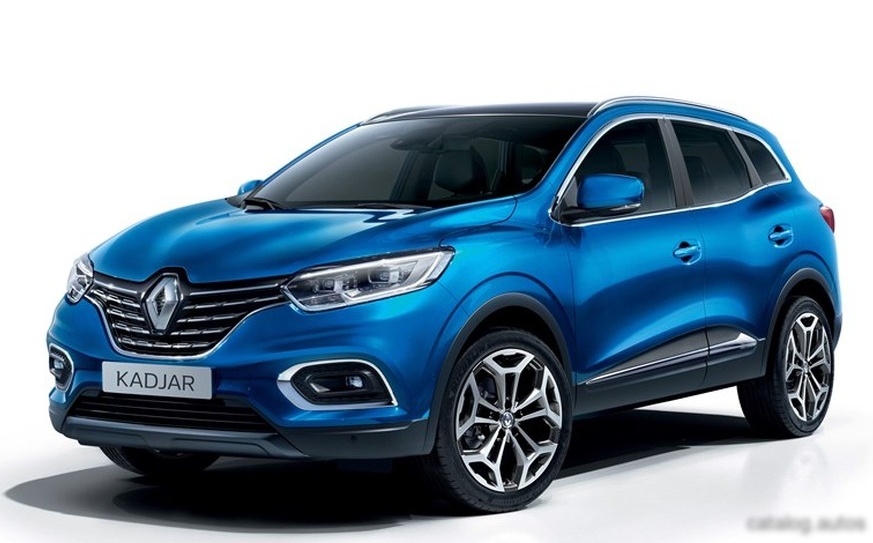
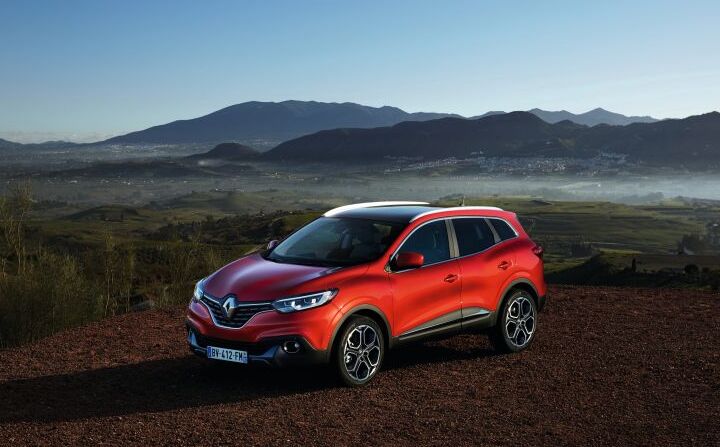
The Renault Kadjar 1.5 Energy dCi (110 hp) EDC Eco, launched in 2015, represented Renault’s attempt to capture a significant share of the burgeoning European crossover market. Built on the Common Module Family (CMF) platform – a joint venture between Renault and Nissan – the Kadjar aimed to offer a compelling blend of practicality, fuel efficiency, and modern styling. The “Energy dCi” designation signified Renault’s focus on downsized diesel engines designed to minimize fuel consumption and emissions. The EDC (Efficient Dual Clutch) transmission was a key feature, offering smoother and quicker gear changes compared to traditional automatic transmissions. This particular variant served as a more accessible entry point into the Kadjar range, appealing to buyers prioritizing economy over outright performance.
Powertrain & Engine Architecture
At the heart of the Kadjar 1.5 dCi EDC Eco lies the K9K engine, a 1.5-liter four-cylinder diesel engine. This engine is a member of Renault’s well-established dCi family, known for its efficiency and reliability. The K9K utilizes a common rail direct injection system, delivering fuel directly into the combustion chamber at extremely high pressure for optimized combustion. A turbocharger with an intercooler further enhances performance by forcing more air into the engine. The engine produces 110 horsepower at 4000 rpm and 250 Nm (184 lb-ft) of torque at 1750 rpm. The EDC transmission is a six-speed dual-clutch unit, offering both automatic and manual shifting modes. This transmission provides faster and more seamless gear changes than a conventional torque converter automatic, contributing to improved fuel economy and a more engaging driving experience.
Driving Characteristics
The 110 hp output and EDC transmission combination in the Kadjar resulted in a driving experience geared towards comfort and efficiency rather than outright sportiness. Acceleration from 0 to 62 mph (0-100 km/h) takes around 11.7 seconds, which is typical for this class of vehicle with a similar engine size. The EDC transmission is well-programmed, providing smooth upshifts and downshifts in automatic mode. In manual mode, drivers have more control over gear selection, but the transmission isn’t particularly responsive to paddle shifts. The engine delivers adequate torque for everyday driving, making it easy to navigate urban environments and maintain comfortable cruising speeds on the highway. Compared to higher-powered Kadjar variants (like those with the 1.6 dCi engine), this version feels less eager to accelerate, but it compensates with superior fuel economy.
Equipment & Trim Levels
The Kadjar 1.5 dCi EDC Eco typically came equipped with a reasonable level of standard features. These included air conditioning, a touchscreen infotainment system with Bluetooth connectivity, cruise control, and electric windows. Safety features such as ABS, ESP (Electronic Stability Program), and multiple airbags were also standard. Interior upholstery was typically cloth, and the dashboard featured a functional, if not particularly luxurious, design. Optional extras included features like a panoramic sunroof, leather upholstery, a reversing camera, and parking sensors. Trim levels varied slightly depending on the market, but the EDC Eco generally represented a mid-range offering, bridging the gap between basic entry-level models and more fully-equipped versions.
Chassis & Braking
The Kadjar’s chassis was tuned for comfort and stability. It utilizes a MacPherson strut front suspension and a multi-link rear suspension, providing a good balance between ride quality and handling. The front brakes are ventilated discs, while the rear brakes are solid discs. The steering is electric power-assisted, offering light and precise control. The Kadjar’s weight-to-power ratio of 12.8 kg/hp contributes to its stable handling characteristics. The suspension setup is generally well-suited to absorbing bumps and imperfections in the road, providing a comfortable ride for passengers.
Market Reception & Comparison
The Renault Kadjar 1.5 dCi EDC Eco was generally well-received by automotive critics. It was praised for its fuel efficiency, comfortable ride, and practical interior. However, some reviewers noted that the 110 hp engine could feel underpowered, particularly when fully loaded or tackling steep hills. Compared to other crossovers in its class, such as the Nissan Qashqai and Peugeot 3008, the Kadjar offered a competitive package in terms of price and features. Its fuel economy was particularly noteworthy, often exceeding that of its rivals. Reliability reports suggest that the K9K engine is generally robust, but some owners have reported issues with the EDC transmission, such as occasional jerky shifts.
Legacy
The Renault Kadjar 1.5 Energy dCi (110 hp) EDC Eco remains a relatively common sight on European roads today. The K9K engine has proven to be a durable and reliable unit, and with proper maintenance, it can provide many years of service. The EDC transmission, while occasionally prone to issues, is generally well-regarded for its efficiency and smoothness. In the used car market, this variant represents a good value proposition for buyers seeking an affordable and economical crossover. Its fuel efficiency and practicality continue to make it a popular choice for families and commuters.