Technical Specifications
| Brand | Renault |
| Model | Kangoo |
| Generation | Kangoo II Express (facelift 2013) |
| Type (Engine) | 1.2 Energy TCe (115 Hp) start&stop |
| Start of production | 2015 |
| End of production | 2018 |
| Powertrain Architecture | Internal Combustion engine |
| Body type | Minivan |
| Seats | 2 |
| Doors | 3 |
| Fuel consumption (combined) | 6.2-6.3 l/100 km (37.9 – 37.3 US mpg, 45.6 – 44.8 UK mpg, 16.1 – 15.9 km/l) |
| CO2 emissions | 140-143 g/km |
| Fuel Type | Petrol (Gasoline) |
| Acceleration 0 – 100 km/h | 11.7 sec |
| Acceleration 0 – 62 mph | 11.7 sec |
| Acceleration 0 – 60 mph | 11.1 sec |
| Maximum speed | 173 km/h (107.5 mph) |
| Emission standard | Euro 5 |
| Weight-to-power ratio | 10.8 kg/Hp, 92.4 Hp/tonne |
| Weight-to-torque ratio | 6.6 kg/Nm, 152.6 Nm/tonne |
| Power | 115 Hp @ 4500 rpm |
| Power per litre | 96.1 Hp/l |
| Torque | 190 Nm @ 2000 rpm (140.14 lb.-ft. @ 2000 rpm) |
| Engine layout | Front, Transverse |
| Engine Model/Code | H5FT |
| Engine displacement | 1197 cm3 (73.05 cu. in.) |
| Number of cylinders | 4 |
| Engine configuration | Inline |
| Number of valves per cylinder | 4 |
| Fuel injection system | Direct injection |
| Engine aspiration | Turbocharger, Intercooler |
| Engine oil capacity | 4.2 l (4.44 US qt | 3.7 UK qt) |
| Coolant | 6.9 l (7.29 US qt | 6.07 UK qt) |
| Kerb Weight | 1245-1430 kg (2744.76 – 3152.61 lbs.) |
| Max. weight | 1920 kg (4232.88 lbs.) |
| Max load | 490-675 kg (1080.27 – 1488.12 lbs.) |
| Trunk (boot) space – minimum | 3000 l (105.94 cu. ft.) |
| Trunk (boot) space – maximum | 3500 l (123.6 cu. ft.) |
| Fuel tank capacity | 56 l (14.79 US gal | 12.32 UK gal) |
| Permitted trailer load with brakes (12%) | 1050 kg (2314.85 lbs.) |
| Permitted trailer load without brakes | 670 kg (1477.1 lbs.) |
| Length | 4282 mm (168.58 in.) |
| Width | 1829 mm (72.01 in.) |
| Width including mirrors | 2138 mm (84.17 in.) |
| Height | 1805 mm (71.06 in.) |
| Wheelbase | 2697 mm (106.18 in.) |
| Front track | 1521 mm (59.88 in.) |
| Rear (Back) track | 1533 mm (60.35 in.) |
| Front overhang | 875 mm (34.45 in.) |
| Rear overhang | 710 mm (27.95 in.) |
| Ride height (ground clearance) | 210-157 mm (8.27 – 6.18 in.) |
| Minimum turning circle (turning diameter) | 10.7 m (35.1 ft.) |
| Drivetrain Architecture | The Internal combustion engine (ICE) drives the front wheels of the vehicle. |
| Drive wheel | Front wheel drive |
| Number of gears and type of gearbox | 6 gears, manual transmission |
| Front suspension | Independent type McPherson |
| Rear suspension | Torsion |
| Front brakes | Ventilated discs |
| Rear brakes | Disc |
| Assisting systems | ABS (Anti-lock braking system) |
| Steering type | Steering rack and pinion |
| Power steering | Electric Steering |
| Tires size | 195/65 R15 |
| Wheel rims size | 15 |
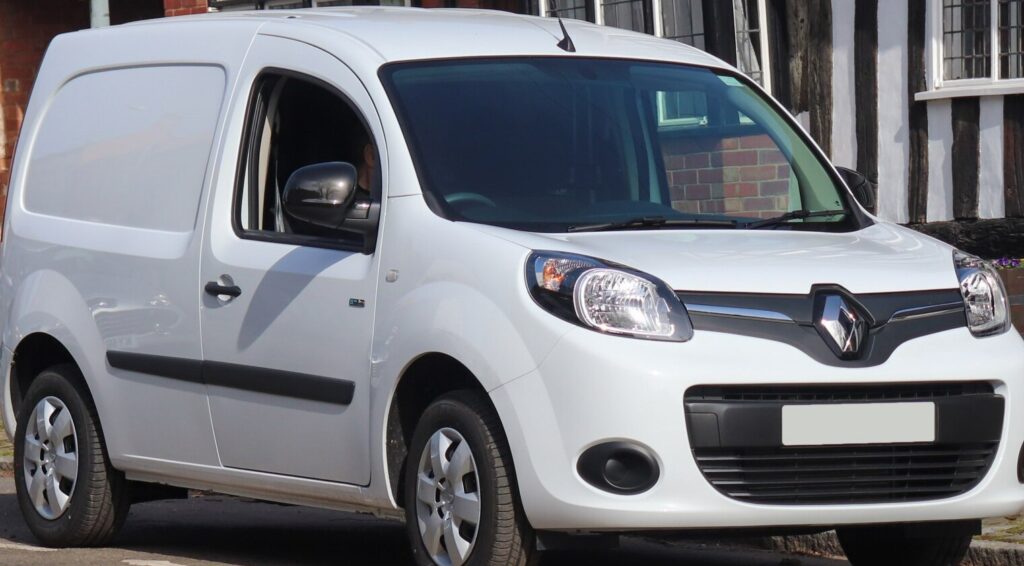
The Renault Kangoo II Express, particularly the facelifted version introduced in 2013, represented a significant step forward for Renault’s light commercial vehicle (LCV) offerings in Europe. The 1.2 Energy TCe (115 hp) start&stop variant, produced from 2015 to 2018, was positioned as a balance between fuel efficiency and practicality for businesses and tradespeople. This version of the Kangoo Express, a panel van derived from the Kangoo passenger vehicle, aimed to provide a cost-effective and versatile solution for urban deliveries and service applications. It falls within the second generation of the Kangoo, internally designated as the K9K series, and benefited from updates to the exterior styling, interior refinement, and engine technology introduced with the 2013 facelift.
Powertrain & Engine Architecture
The heart of the Kangoo II Express 1.2 TCe is the Renault H5FT engine, a 1.2-liter turbocharged four-cylinder petrol engine. This engine is part of Renault’s “Energy” family, designed for improved fuel efficiency. It features direct fuel injection, which allows for precise fuel delivery and optimized combustion. The H5FT engine utilizes a single-scroll turbocharger with an intercooler to boost power output. The engine’s valvetrain employs four valves per cylinder, contributing to its breathing efficiency. The 115 hp version of this engine benefits from specific engine management calibrations to balance performance and economy. The engine is transversely mounted at the front of the vehicle, driving the front wheels. The 6-speed manual transmission was the standard offering for this variant, providing a good balance of fuel economy and drivability. The start&stop system, a key feature of this model, automatically shuts off the engine when the vehicle is stationary (e.g., at traffic lights) to reduce fuel consumption and emissions.
Driving Characteristics
The 1.2 TCe 115 hp engine in the Kangoo Express provides adequate performance for typical commercial applications. While not exceptionally quick, with a 0-60 mph time of around 11.1 seconds, it offers sufficient power for urban deliveries and highway cruising when unladen. The turbocharger provides a noticeable boost in torque at lower engine speeds, making it relatively easy to navigate city traffic. The 6-speed manual transmission allows drivers to keep the engine in its optimal power band. Compared to the diesel variants (like the 1.5 dCi), the 1.2 TCe offers a smoother and quieter driving experience, but sacrifices some low-end torque and overall fuel economy. The gear ratios are tuned for practicality, prioritizing fuel efficiency over outright acceleration. The Kangoo’s relatively lightweight construction helps to mitigate the engine’s modest power output.
Equipment & Trim Levels
The Kangoo II Express 1.2 TCe typically came with a functional, no-frills interior focused on durability and practicality. Standard equipment included a driver’s airbag, ABS brakes, power steering, and a basic audio system. The cabin featured durable plastic trim and hard-wearing seat upholstery. The driver’s seat was typically adjustable for height and lumbar support. Optional extras included air conditioning, a passenger airbag, rear parking sensors, and upgraded audio systems. The trim level was generally basic, reflecting the van’s commercial focus. The emphasis was on providing a reliable and functional work vehicle rather than luxury features.
Chassis & Braking
The Kangoo II Express utilizes a McPherson strut independent suspension at the front and a torsion beam suspension at the rear. This setup provides a reasonable balance of ride comfort and handling. The front brakes are ventilated discs, while the rear brakes are solid discs. ABS (Anti-lock Braking System) is standard, enhancing braking performance and stability. The steering is rack and pinion with electric power assistance, providing light and precise steering feel. The suspension components are tuned to handle the van’s typical payload capacity without compromising ride quality. Stabilizer bars are fitted to both the front and rear axles to reduce body roll during cornering.
Market Reception & Comparison
The Renault Kangoo II Express 1.2 TCe was generally well-received by critics as a practical and fuel-efficient light commercial vehicle. It was praised for its spacious cargo area, comfortable driving position, and relatively low running costs. However, some reviewers noted that the engine could feel strained when fully loaded or driving uphill. Compared to the diesel-powered Kangoo Express models, the 1.2 TCe offered a more refined driving experience but lower fuel economy. Against competitors like the Citroën Berlingo and Peugeot Partner, the Kangoo II Express 1.2 TCe held its own in terms of practicality, reliability, and value for money.
Legacy
The Renault Kangoo II Express 1.2 TCe (115 hp) has proven to be a relatively reliable workhorse in the used car market. The H5FT engine, while not without its quirks, is generally durable when properly maintained. Common issues include turbocharger wear and potential problems with the direct injection system. Regular oil changes and adherence to the manufacturer’s recommended service schedule are crucial for ensuring long-term reliability. Today, these vans represent a cost-effective option for small businesses and tradespeople seeking a practical and affordable light commercial vehicle. Their compact size and fuel efficiency make them well-suited for urban environments.