Technical Specifications
| Brand | Renault |
| Model | Kangoo |
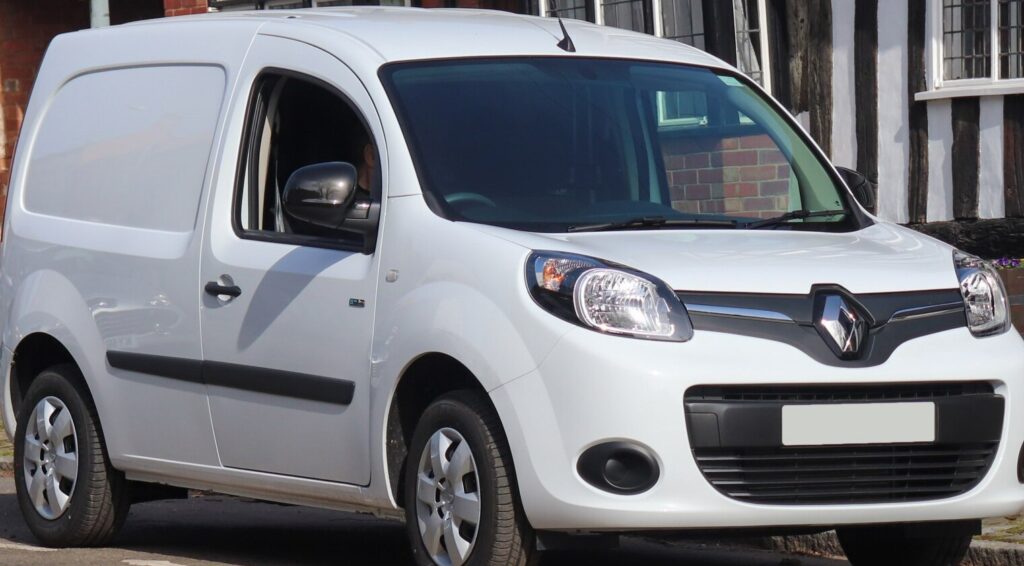
| Generation | Kangoo II Express (facelift 2013) |
| Type (Engine) | 1.5 Energy dCi (75 Hp) Stop&Start |
| Start of production | 2015 year |
| End of production | 2018 year |
| Powertrain Architecture | Internal Combustion engine |
| Body type | Minivan |
| Seats | 2 |
| Doors | 3 |
| Fuel consumption (combined) | 4.3-4.6 l/100 km (54.7 – 51.1 US mpg, 65.7 – 61.4 UK mpg, 23.3 – 21.7 km/l) |
| CO2 emissions | 112-119 g/km |
| Fuel Type | Diesel |
| Acceleration 0 – 100 km/h | 16.3 sec |
| Acceleration 0 – 62 mph | 16.3 sec |
| Acceleration 0 – 60 mph | 15.5 sec |
| Maximum speed | 150 km/h (93.21 mph) |
| Emission standard | Euro 5 |
| Weight-to-power ratio | 16.7 kg/Hp, 59.8 Hp/tonne |
| Weight-to-torque ratio | 6.3 kg/Nm, 159.4 Nm/tonne |
| Power | 75 Hp @ 4000 rpm |
| Power per litre | 51.3 Hp/l |
| Torque | 200 Nm @ 1750 rpm (147.51 lb.-ft. @ 1750 rpm) |
| Engine layout | Front, Transverse |
| Engine Model/Code | K9K |
| Engine displacement | 1461 cm3 (89.16 cu. in.) |
| Number of cylinders | 4 |
| Engine configuration | Inline |
| Number of valves per cylinder | 2 |
| Fuel injection system | Diesel Commonrail |
| Engine aspiration | Turbocharger, Intercooler |
| Engine oil capacity | 4.5 l (4.76 US qt | 3.96 UK qt) |
| Coolant | 7.2 l (7.61 US qt | 6.34 UK qt) |
| Kerb Weight | 1255-1430 kg (2766.8 – 3152.61 lbs.) |
| Max. weight | 2100 kg (4629.71 lbs.) |
| Max load | 670-845 kg (1477.1 – 1862.91 lbs.) |
| Trunk (boot) space – minimum | 3000 l (105.94 cu. ft.) |
| Trunk (boot) space – maximum | 3500 l (123.6 cu. ft.) |
| Fuel tank capacity | 60 l (15.85 US gal | 13.2 UK gal) |
| Permitted trailer load with brakes (12%) | 1050 kg (2314.85 lbs.) |
| Permitted trailer load without brakes | 680 kg (1499.14 lbs.) |
| Length | 4282 mm (168.58 in.) |
| Width | 1829 mm (72.01 in.) |
| Width including mirrors | 2138 mm (84.17 in.) |
| Height | 1805 mm (71.06 in.) |
| Wheelbase | 2697 mm (106.18 in.) |
| Front track | 1521 mm (59.88 in.) |
| Rear (Back) track | 1533 mm (60.35 in.) |
| Front overhang | 875 mm (34.45 in.) |
| Rear overhang | 710 mm (27.95 in.) |
| Minimum turning circle | 10.7 m (35.1 ft.) |
| Drivetrain Architecture | The Internal combustion engine (ICE) drives the front wheels of the vehicle. |
| Drive wheel | Front wheel drive |
| Number of gears and type of gearbox | 5 gears, manual transmission |
| Front suspension | Independent type McPherson |
| Rear suspension | Torsion |
| Front brakes | Ventilated discs |
| Rear brakes | Drum |
| Assisting systems | ABS (Anti-lock braking system) |
| Steering type | Steering rack and pinion |
| Power steering | Electric Steering |
| Tires size | 195/65 R15 91 T |
| Wheel rims size | 15 |
The Renault Kangoo II Express, particularly the facelifted version introduced in 2013, represented a significant offering in the compact van segment, especially within the European market. The 1.5 Energy dCi (75 hp) Stop&Start variant, produced from 2015 to 2018, served as an entry-level option, prioritizing fuel efficiency and practicality for commercial users and small businesses. This version of the Kangoo Express was designed for urban delivery and service applications, offering a balance between low running costs and sufficient cargo capacity. It sat below the more powerful dCi 90 and dCi 110 models in the lineup, targeting buyers for whom outright performance was less critical than economy.
Powertrain & Engine Architecture
The heart of the Kangoo II Express 1.5 dCi 75 Stop&Start is the K9K engine, a member of Renault’s widely used family of small-displacement diesel engines. This 1.5-liter, inline-four cylinder engine utilizes a turbocharger with an intercooler to boost power output. The engine employs a diesel commonrail direct injection system, delivering fuel directly into the combustion chamber at high pressure for improved efficiency and reduced emissions. The K9K engine features two valves per cylinder and is known for its relatively simple design, contributing to its reliability. The Stop&Start system automatically shuts off the engine when the vehicle is stationary (e.g., at traffic lights) and restarts it instantly when the clutch is depressed, further enhancing fuel economy. The engine is transversely mounted at the front of the vehicle. The 5-speed manual transmission was the standard offering for this variant, chosen for its cost-effectiveness and suitability for commercial applications.
Driving Characteristics
The 75 horsepower output of this Kangoo Express variant translates to modest, but adequate, performance. Acceleration from 0-60 mph takes around 15.5 seconds, and top speed is limited to 93 mph. The engine’s 200 Nm (147.5 lb-ft) of torque, available from 1750 rpm, provides sufficient pulling power for typical delivery tasks and urban driving. The 5-speed manual gearbox is geared for economy, with taller ratios prioritizing fuel efficiency over rapid acceleration. Compared to the dCi 90 and dCi 110 models, the 75 hp version feels noticeably slower, particularly when fully loaded. However, the lower power output also contributes to improved fuel economy and reduced stress on the engine components.
Equipment & Trim Levels
The Kangoo II Express 1.5 dCi 75 Stop&Start was typically equipped as a work-focused vehicle. Standard features included a driver’s airbag, ABS brakes, power steering, and a basic audio system. The interior was functional and durable, with hard-wearing plastics and cloth upholstery. The cab was designed for practicality, with ample storage compartments and a comfortable driver’s seat. Optional extras included air conditioning, a passenger airbag, electric windows, and a rear parking sensor. The trim level was generally basic, reflecting the van’s intended use as a commercial vehicle.
Chassis & Braking
The Kangoo II Express utilizes a McPherson strut independent suspension at the front and a torsion beam suspension at the rear. This setup provides a reasonable balance between ride comfort and handling. The front brakes are ventilated discs, while the rear brakes are drums. This configuration was chosen to keep costs down and provide adequate stopping power for the vehicle’s weight class. The electric power steering offers light and precise steering feel, making it easy to maneuver in tight urban environments.
Market Reception & Comparison
The Renault Kangoo II Express 1.5 dCi 75 Stop&Start was well-received by businesses and tradespeople seeking a cost-effective and reliable van. Critics praised its fuel efficiency and low running costs, but noted its modest performance. Compared to the more powerful dCi 90 and dCi 110 variants, the 75 hp version offered a lower purchase price and better fuel economy, but at the expense of acceleration and load-carrying capacity. The 1.5 dCi engine proved to be relatively reliable, although regular maintenance was essential to ensure longevity.
Legacy
The 1.5 dCi K9K engine has proven to be a durable and long-lasting powertrain when properly maintained. In the used car market, the Kangoo II Express 1.5 dCi 75 Stop&Start remains a popular choice for budget-conscious buyers. Its simplicity and fuel efficiency continue to appeal to those seeking a practical and affordable van for urban delivery and service applications. While not the fastest or most luxurious option, this variant offers a compelling combination of value, reliability, and economy.