
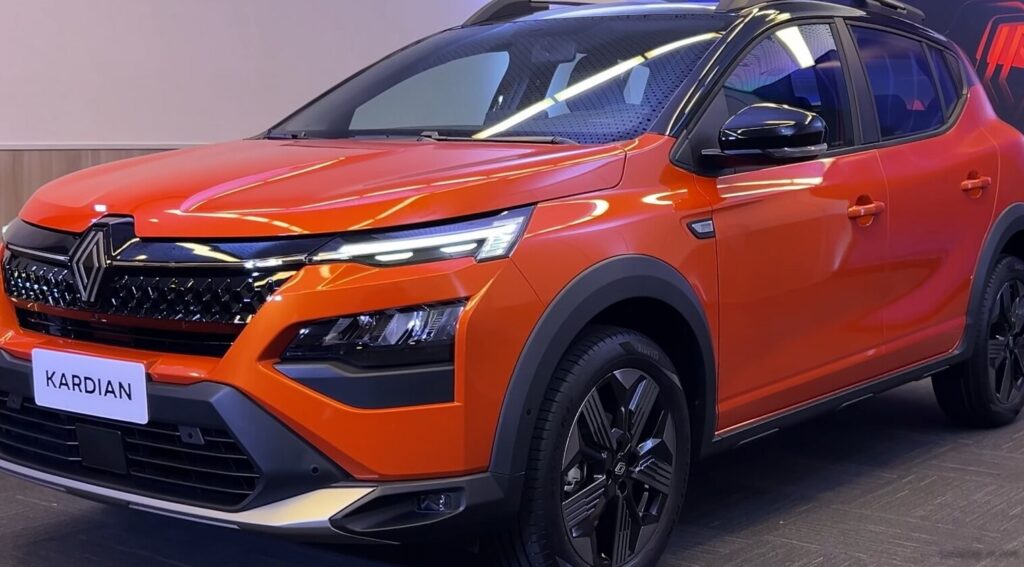
The Renault Kardian 1.0 TCe (120/125 hp) Flex-Fuel EDC is a subcompact crossover SUV introduced by Renault in late 2023. Positioned as a key model for the Latin American market, particularly Brazil and Argentina, the Kardian represents Renault’s entry into the rapidly growing segment of affordable, feature-rich SUVs. This specific variant, powered by the turbocharged 1.0-liter three-cylinder engine paired with a six-speed Efficient Dual Clutch (EDC) automatic transmission, aims to balance fuel efficiency, performance, and practicality for urban drivers. It builds upon the foundations of the Dacia Sandero Stepway, sharing its platform but receiving unique styling and features tailored for its target markets.
Technical Specifications
| Brand | Renault |
| Model | Kardian |
| Type (Engine) | 1.0 TCe (120/125 Hp) Flex-Fuel EDC |
| Start of production | November, 2023 |
| Powertrain Architecture | Internal Combustion engine |
| Body type | SUV, Crossover |
| Seats | 5 |
| Doors | 5 |
| Fuel consumption (economy) – urban | 7.6 l/100 km (30.9 US mpg) |
| Fuel consumption (economy) – urban (Ethanol – E85) | 11.1 l/100 km |
| Fuel consumption (economy) – extra urban | 7.2 l/100 km (32.7 US mpg) |
| Fuel consumption (economy) – extra urban (Ethanol – E85) | 10.3 l/100 km |
| Fuel Type | Petrol / Ethanol – E85 |
| Acceleration 0 – 100 km/h | 10.7 sec |
| Acceleration 0 – 62 mph | 10.7 sec |
| Acceleration 0 – 100 km/h (Ethanol – E85) | 9.9 sec |
| Acceleration 0 – 60 mph | 10.2 sec |
| Maximum speed | 180 km/h (111.85 mph) |
| Weight-to-power ratio | 9.7 kg/Hp |
| Weight-to-torque ratio | 5.8 kg/Nm |
| Power | 120 Hp @ 5000 rpm |
| Power per litre | 120.1 Hp/l |
| Power (Ethanol – E85) | 125 Hp @ 5000 rpm |
| Power per litre (Ethanol – E85) | 125.1 Hp/l |
| Torque | 200 Nm @ 2000 rpm (147.51 lb.-ft. @ 2000 rpm) |
| Torque (Ethanol – E85) | 220 Nm @ 2250 rpm |
| Engine layout | Front, Transverse |
| Engine displacement | 999 cm3 (60.96 cu. in.) |
| Number of cylinders | 3 |
| Engine configuration | Inline |
| Compression ratio | 11:1 |
| Number of valves per cylinder | 4 |
| Fuel injection system | Direct injection |
| Engine aspiration | Turbocharger, Intercooler |
| Valvetrain | VVT |
| Engine systems | Start & Stop System |
| Kerb Weight | 1166-1186 kg (2570.59 – 2614.68 lbs.) |
| Trunk (boot) space – minimum | 410 l (14.48 cu. ft.) |
| Fuel tank capacity | 50 l (13.21 US gal | 11 UK gal) |
| Length | 4119 mm (162.17 in.) |
| Width | 1747 mm (68.78 in.) |
| Width including mirrors | 2025 mm (79.72 in.) |
| Height | 1596 mm (62.83 in.) |
| Wheelbase | 2604 mm (102.52 in.) |
| Front track | 1517 mm (59.72 in.) |
| Rear (Back) track | 1509 mm (59.41 in.) |
| Front overhang | 829 mm (32.64 in.) |
| Rear overhang | 687 mm (27.05 in.) |
| Ride height (ground clearance) | 209 mm (8.23 in.) |
| Minimum turning circle | 10.5 m (34.45 ft.) |
| Approach angle | 20° |
| Departure angle | 36° |
| Drivetrain Architecture | Front wheel drive |
| Number of gears and type of gearbox | 6 gears, automatic transmission EDC |
| Front suspension | Spring Strut, Independent, type McPherson with coil spring and anti-roll bar |
| Rear suspension | Spring Strut, Transverse stabilizer, Coil spring, Torsion |
| Front brakes | Ventilated discs |
| Rear brakes | Drum |
| Assisting systems | ABS (Anti-lock braking system) |
| Steering type | Steering rack and pinion |
| Power steering | Electric Steering |
| Tires size | 205/60 R16; 205/55 R17 |
| Wheel rims size | 16; 17 |
Powertrain & Engine Architecture
The heart of the Kardian 1.0 TCe is the H5Ft engine, a 999cc turbocharged three-cylinder unit. This engine is part of Renault’s latest generation of downsized, direct-injection gasoline engines. It features a single-scroll turbocharger and intercooler to boost power and efficiency. The engine utilizes variable valve timing (VVT) on both intake and exhaust valves for optimized performance across the rev range. The direct fuel injection system ensures precise fuel delivery, contributing to improved combustion and reduced emissions. The engine is flex-fuel capable, meaning it can run on gasoline, ethanol, or any blend of the two, with the engine control unit (ECU) automatically adjusting parameters for optimal operation. The EDC (Efficient Dual Clutch) six-speed automatic transmission provides smooth and quick gear changes, enhancing the driving experience. This transmission is known for its efficiency and responsiveness compared to traditional torque-converter automatics.
Driving Characteristics
The 120 hp (or 125 hp on ethanol) and 200 Nm (147.5 lb-ft) of torque provide adequate performance for everyday driving. Acceleration from 0-100 km/h takes around 10.7 seconds, which is competitive within its segment. The EDC transmission contributes to a more engaging driving experience than a conventional automatic, offering quicker shifts and a more direct feel. While not a performance-oriented vehicle, the Kardian 1.0 TCe offers sufficient power for overtaking and merging onto highways. The turbocharger does exhibit some lag at lower RPMs, but the power delivery becomes more linear as the engine revs climb. Compared to potential higher-output versions (if offered in the future), this variant prioritizes fuel economy and affordability over outright speed. The automatic transmission, while convenient, may not offer the same level of control as a manual gearbox.
Equipment & Trim Levels
The Kardian 1.0 TCe EDC typically comes standard with features such as air conditioning, power windows, power door locks, a touchscreen infotainment system with smartphone integration (Android Auto and Apple CarPlay), and basic safety equipment like ABS and airbags. Higher trim levels add features like alloy wheels, a rearview camera, parking sensors, automatic climate control, and more advanced safety systems. Interior upholstery is typically cloth, with options for leatherette in higher trims. The dashboard layout is modern and functional, with a focus on ease of use. Optional extras may include a panoramic sunroof, upgraded audio system, and various styling packages.
Chassis & Braking
The Kardian utilizes a McPherson strut front suspension and a torsion beam rear suspension. This setup provides a good balance between ride comfort and handling. The front suspension incorporates a stabilizer bar to reduce body roll during cornering. Braking duties are handled by ventilated discs at the front and drum brakes at the rear. ABS (Anti-lock Braking System) is standard. The suspension is tuned for comfort, prioritizing a smooth ride over sporty handling. The relatively lightweight construction of the vehicle helps to contribute to its agility.
Market Reception & Comparison
The Renault Kardian has been well-received in the Latin American market, particularly in Brazil, where it competes with other subcompact crossovers like the Fiat Pulse, Volkswagen Nivus, and Hyundai Creta. Critics have praised its stylish design, spacious interior, and competitive pricing. The 1.0 TCe engine with the EDC transmission has been noted for its fuel efficiency and smooth operation. Compared to other trims, this variant offers a good balance between performance and economy, making it an attractive option for budget-conscious buyers. Fuel economy figures are competitive, with around 7.6 l/100km (30.9 US mpg) on gasoline and slightly higher on ethanol.
Legacy
The Renault Kardian 1.0 TCe EDC represents a significant step for Renault in the Latin American market, offering a modern and well-equipped subcompact crossover at an affordable price point. The H5Ft engine, while relatively new, is expected to be reliable and durable. The EDC transmission, if properly maintained, should provide years of smooth and efficient operation. As the Kardian gains popularity, it is likely to become a common sight on the roads of Brazil and Argentina, and its long-term reliability will be closely monitored by owners and automotive publications alike. The flex-fuel capability is a key feature that caters to the specific needs of the Latin American market, where ethanol is widely available.
