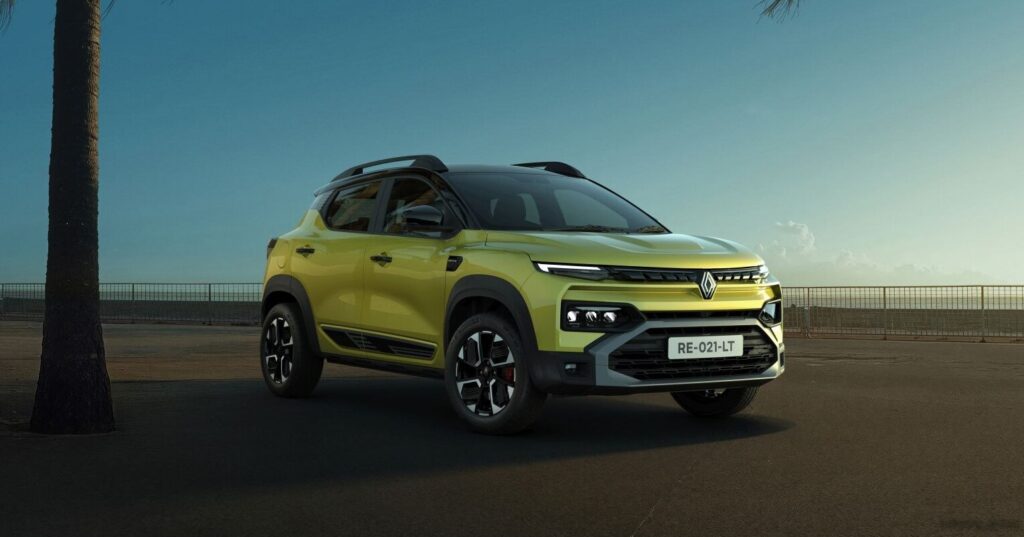
The Renault Kiger 1.0 ENERGY, produced from February 2021 to August 2025, represents the entry point into the Kiger subcompact SUV lineup. Introduced as part of Renault’s aggressive push into the burgeoning Indian market and subsequently offered in other developing nations, the Kiger aimed to provide an affordable and stylish option in a highly competitive segment. This variant, powered by a 1.0-liter three-cylinder engine producing 72 horsepower, was specifically targeted at budget-conscious buyers prioritizing fuel efficiency and practicality over outright performance. It played a crucial role in establishing the Kiger as a popular choice, particularly for first-time car buyers and those seeking a nimble urban vehicle.
Technical Specifications
| Brand | Renault |
| Model | Kiger |
| Generation | Kiger |
| Type (Engine) | 1.0 ENERGY (72 Hp) |
| Start of production | February, 2021 |
| End of production | August, 2025 |
| Powertrain Architecture | Internal Combustion engine |
| Body type | SUV, Crossover |
| Seats | 5 |
| Doors | 5 |
| Fuel consumption (urban) | 6.6 l/100 km (35.6 US mpg, 42.8 UK mpg, 15.2 km/l) |
| Fuel consumption (extra urban) | 4.5 l/100 km (52.3 US mpg, 62.8 UK mpg, 22.2 km/l) |
| Fuel consumption (combined) | 5.3 l/100 km (44.4 US mpg, 53.3 UK mpg, 18.9 km/l) |
| CO2 emissions | 126 g/km |
| Fuel Type | Petrol (Gasoline) |
| Weight-to-power ratio | 14.1 kg/Hp, 71.1 Hp/tonne |
| Weight-to-torque ratio | 10.5 kg/Nm, 94.9 Nm/tonne |
| Power | 72 Hp @ 6250 rpm |
| Power per litre | 72.1 Hp/l |
| Torque | 96 Nm @ 3500 rpm (70.81 lb.-ft. @ 3500 rpm) |
| Engine layout | Front, Transverse |
| Engine Model/Code | B4D |
| Engine displacement | 999 cm3 (60.96 cu. in.) |
| Number of cylinders | 3 |
| Engine configuration | Inline |
| Fuel injection system | Multi-port manifold injection |
| Kerb Weight | 1012 kg (2231.08 lbs.) |
| Trunk (boot) space (minimum) | 405 l (14.3 cu. ft.) |
| Fuel tank capacity | 40 l (10.57 US gal | 8.8 UK gal) |
| Length | 3991 mm (157.13 in.) |
| Width | 1750 mm (68.9 in.) |
| Height | 1605 mm (63.19 in.) |
| Wheelbase | 2500 mm (98.43 in.) |
| Front track | 1536 mm (60.47 in.) |
| Rear track | 1535 mm (60.43 in.) |
| Ride height (ground clearance) | 205 mm (8.07 in.) |
| Drivetrain Architecture | The Internal combustion engine (ICE) drives the front wheels of the vehicle. |
| Drive wheel | Front wheel drive |
| Number of gears and type of gearbox | 5 gears, manual transmission |
| Front suspension | Independent type McPherson |
| Rear suspension | Threaded twist beam, Coil spring |
| Front brakes | Disc |
| Rear brakes | Drum |
| Assisting systems | ABS (Anti-lock braking system) |
| Steering type | Steering rack and pinion |
| Power steering | Electric Steering |
| Tires size | 195/60 R16 |
| Wheel rims size | 16 |
Powertrain & Engine Architecture
The heart of the Kiger 1.0 ENERGY is the B4D engine, a 999cc inline three-cylinder petrol engine. This engine utilizes a multi-point fuel injection system, a relatively simple and cost-effective technology. The engine’s design prioritizes fuel efficiency and low-end torque, rather than peak horsepower. It features a single overhead camshaft (SOHC) valvetrain, contributing to its simplicity and reduced manufacturing costs. Paired with this engine is a five-speed manual transmission, chosen for its affordability and widespread availability. The transmission’s gear ratios are tuned to maximize fuel economy and provide adequate acceleration for urban driving conditions. A Start & Stop system is included as standard, further enhancing fuel efficiency by automatically shutting off the engine when the vehicle is stationary.
Driving Characteristics
The 72 horsepower and 96 Nm (70.81 lb-ft) of torque produced by the 1.0-liter engine translate to modest, but adequate, performance. Acceleration is best described as leisurely, with a 0-60 mph time estimated to be around 14-15 seconds. The engine feels most comfortable in the lower to mid-range of the rev band, providing sufficient power for everyday driving situations. Compared to higher-spec Kiger models equipped with the 1.3-liter turbocharged engine, the 1.0 ENERGY feels significantly less powerful, particularly when fully loaded or tackling inclines. The five-speed manual transmission is light and easy to operate, but the gear ratios are spaced to prioritize economy over sporty driving. The relatively low weight of the Kiger (1012 kg / 2231 lbs) helps to mitigate the engine’s power deficit, making it feel more responsive than its specifications might suggest.
Equipment & Trim Levels
The Kiger 1.0 ENERGY typically served as the base trim level. Standard features generally included air conditioning, power steering, front power windows, and a basic audio system with Bluetooth connectivity. Safety features such as dual airbags and ABS were also standard. Interior upholstery was typically cloth, with a functional but basic dashboard layout. Optional extras, depending on the market, could include rear power windows, a touchscreen infotainment system, and alloy wheels. The interior design focused on practicality and durability, rather than luxury.
Chassis & Braking
The Kiger utilizes a McPherson strut front suspension and a threaded twist beam rear suspension. This setup provides a comfortable ride quality, particularly on smoother roads. The front brakes are disc brakes, while the rear brakes are drum brakes – a cost-saving measure common in this segment. The electric power steering provides light and easy steering, making it ideal for maneuvering in tight urban spaces. The ride height of 205mm (8.07 inches) provides good ground clearance, allowing the Kiger to navigate rough roads and speed bumps with ease.
Market Reception & Comparison
The Renault Kiger 1.0 ENERGY was generally well-received by critics as an affordable and practical subcompact SUV. Its fuel efficiency was a major selling point, and its compact size made it easy to maneuver in crowded city environments. However, its lack of power was often criticized, particularly when compared to competitors offering more powerful engines. Compared to the higher-spec Kiger models with the 1.3-liter turbo engine, the 1.0 ENERGY offered significantly lower performance but at a considerably lower price point. Its fuel economy figures of around 5.3 l/100 km (44.4 US mpg) were competitive within its class, and its reliability proved to be generally good.
Legacy
The Renault Kiger 1.0 ENERGY has established itself as a popular choice in the used car market, particularly for buyers seeking an affordable and fuel-efficient urban runabout. The B4D engine, while not known for its performance, has proven to be relatively reliable with proper maintenance. Common issues reported include occasional sensor failures and the need for regular oil changes. The Kiger’s simple mechanical design makes it relatively easy and inexpensive to repair, further adding to its appeal in the used car market. As a foundational trim level, the 1.0 ENERGY played a vital role in the Kiger’s overall success, attracting a wide range of buyers and establishing Renault as a significant player in the subcompact SUV segment.