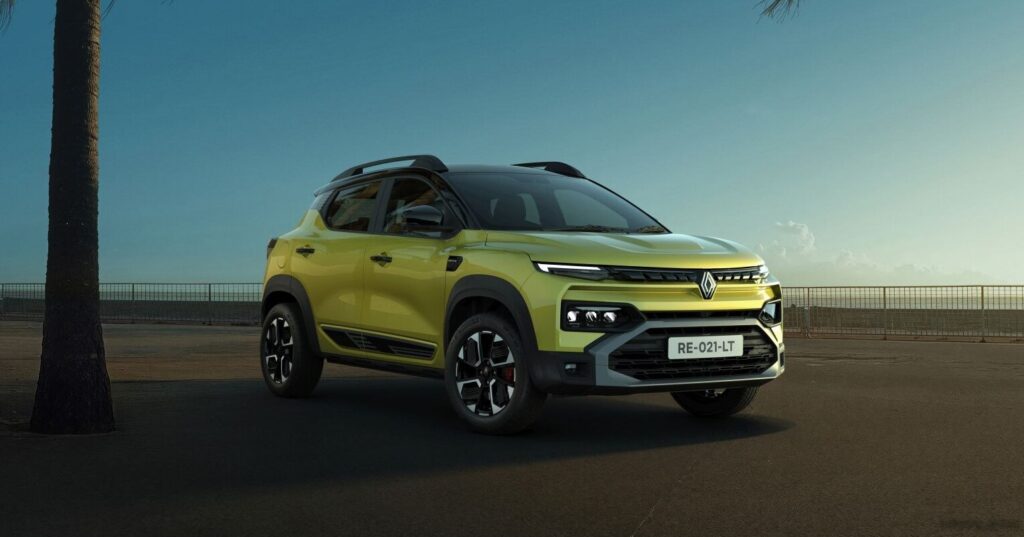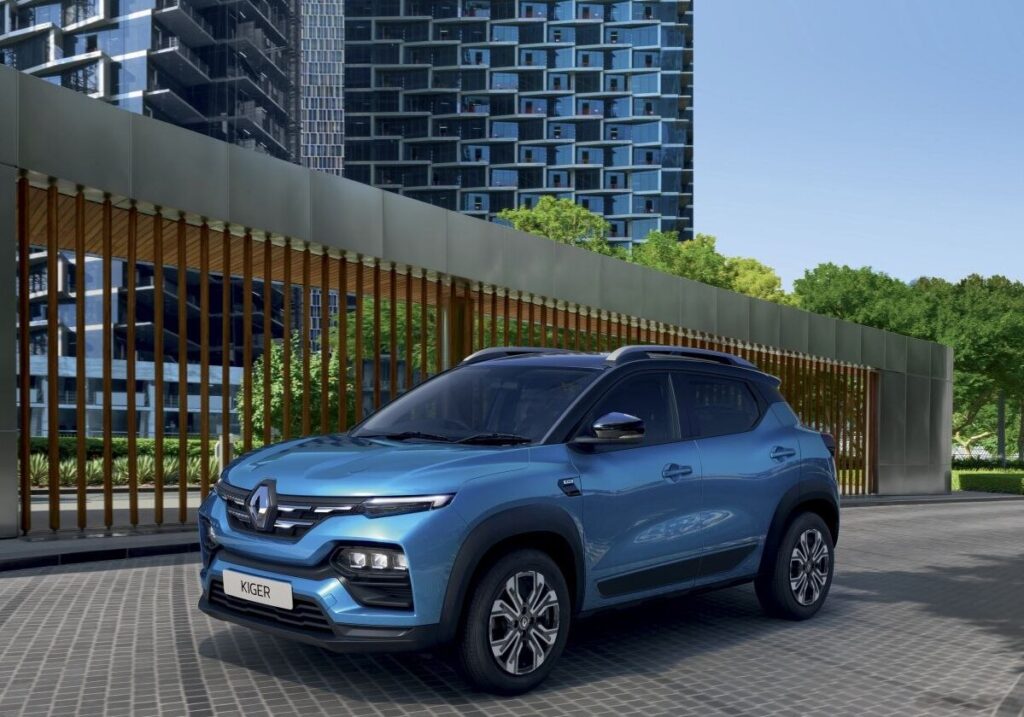
The Renault Kiger 1.0 TURBO, producing 100 horsepower, was a key variant in Renault’s entry into the highly competitive subcompact SUV market. Introduced in February 2021 and continuing through August 2025, the Kiger was primarily aimed at the Indian and South American markets, offering a blend of affordability, fuel efficiency, and modern styling. This particular engine and transmission combination represented a mid-range offering within the Kiger lineup, positioned between the base naturally aspirated engine and potential higher-spec turbocharged options. The Kiger aimed to provide a compelling alternative to established players like the Maruti Suzuki Vitara Brezza and Hyundai Venue.
Technical Specifications
| Brand | Renault |
| Model | Kiger |
| Generation | Kiger |
| Type (Engine) | 1.0 TURBO (100 Hp) |
| Start of production | February, 2021 |
| End of production | August, 2025 |
| Powertrain Architecture | Internal Combustion engine |
| Body type | SUV, Crossover |
| Seats | 5 |
| Doors | 5 |
| Fuel consumption (economy) – urban | 5.8 l/100 km (40.6 US mpg, 48.7 UK mpg, 17.2 km/l) |
| Fuel consumption (economy) – extra urban | 4.6 l/100 km (51.1 US mpg, 61.4 UK mpg, 21.7 km/l) |
| Fuel consumption (economy) – combined | 5 l/100 km (47 US mpg, 56.5 UK mpg, 20 km/l) |
| CO2 emissions | 119 g/km |
| Fuel Type | Petrol (Gasoline) |
| Weight-to-power ratio | 10.1 kg/Hp, 98.8 Hp/tonne |
| Weight-to-torque ratio | 6.3 kg/Nm, 158.1 Nm/tonne |
| Power | 100 Hp @ 5000 rpm |
| Power per litre | 100.1 Hp/l |
| Torque | 160 Nm @ 2800-3600 rpm (118.01 lb.-ft. @ 2800-3600 rpm) |
| Engine layout | Front, Transverse |
| Engine Model/Code | HRA0 |
| Engine displacement | 999 cm3 (60.96 cu. in.) |
| Number of cylinders | 3 |
| Engine configuration | Inline |
| Fuel injection system | Multi-port manifold injection |
| Engine aspiration | Turbocharger, Intercooler |
| Kerb Weight | 1012 kg (2231.08 lbs.) |
| Trunk (boot) space – minimum | 405 l (14.3 cu. ft.) |
| Fuel tank capacity | 40 l (10.57 US gal | 8.8 UK gal) |
| Length | 3991 mm (157.13 in.) |
| Width | 1750 mm (68.9 in.) |
| Height | 1605 mm (63.19 in.) |
| Wheelbase | 2500 mm (98.43 in.) |
| Front track | 1536 mm (60.47 in.) |
| Rear (Back) track | 1535 mm (60.43 in.) |
| Ride height (ground clearance) | 205 mm (8.07 in.) |
| Drivetrain Architecture | The Internal combustion engine (ICE) drives the front wheels of the vehicle. |
| Drive wheel | Front wheel drive |
| Number of gears and type of gearbox | 5 gears, manual transmission |
| Front suspension | Independent type McPherson |
| Rear suspension | Threaded twist beam, Coil spring |
| Front brakes | Disc |
| Rear brakes | Drum |
| Assisting systems | ABS (Anti-lock braking system) |
| Steering type | Steering rack and pinion |
| Power steering | Electric Steering |
| Tires size | 195/60 R16 |
| Wheel rims size | 16 |
Powertrain & Engine Architecture
The heart of the Kiger 1.0 TURBO is the HRA0 engine, a 999cc, inline three-cylinder petrol engine. This engine utilizes a turbocharger and intercooler to boost power output to 100 horsepower at 5000 rpm and 160 Nm (118 lb-ft) of torque between 2800 and 3600 rpm. The engine employs multi-port fuel injection, a relatively conventional system for its class, prioritizing cost-effectiveness and reliability. The three-cylinder configuration, while offering inherent packaging advantages, is known for its slightly rougher operation compared to four-cylinder engines. Renault addressed this through careful engine balancing and the use of a dual-mass flywheel with the manual transmission. The five-speed manual transmission was the standard offering for this variant, providing a direct and engaging driving experience. The engine’s transverse mounting and front-wheel-drive configuration are typical for modern subcompact SUVs.
Driving Characteristics
The Kiger 1.0 TURBO, equipped with the five-speed manual, offered a surprisingly lively driving experience for its size and price point. While not a performance car, the turbocharger provided a noticeable boost in acceleration, making it suitable for navigating city traffic and executing highway overtaking maneuvers. The gear ratios were well-chosen to keep the engine within its optimal torque band. Compared to the base naturally aspirated engine, the turbo variant offered significantly improved responsiveness and overall performance. However, it didn’t quite match the refinement or outright power of potential higher-spec turbocharged options that might have been available in some markets. The relatively lightweight construction of the Kiger contributed to its nimble handling characteristics.
Equipment & Trim Levels
The Kiger 1.0 TURBO typically came equipped with a reasonable level of standard features. These generally included air conditioning, power windows, power steering, and a basic audio system with Bluetooth connectivity. Higher trim levels added features such as alloy wheels, a touchscreen infotainment system with Apple CarPlay and Android Auto compatibility, rear parking sensors, and a rearview camera. Interior upholstery was typically cloth, with options for different color schemes. Safety features included dual airbags and ABS (Anti-lock Braking System). Optional extras could include a sunroof, automatic climate control, and additional safety equipment.
Chassis & Braking
The Kiger utilized a McPherson strut independent suspension setup at the front, providing a comfortable ride and decent handling. The rear suspension employed a threaded twist beam configuration, a cost-effective solution that offered a good balance between ride comfort and stability. The front brakes were disc brakes, providing adequate stopping power, while the rear brakes were drum brakes, a common cost-saving measure in this segment. The electric power steering offered light and easy steering, making it convenient for urban driving. With a ground clearance of 205mm (8.07 inches), the Kiger was well-suited to handle the often-challenging road conditions found in its target markets.
Market Reception & Comparison
The Renault Kiger 1.0 TURBO was generally well-received by automotive critics in its target markets. It was praised for its stylish design, spacious interior, and competitive pricing. The 1.0-liter turbo engine was considered a good compromise between performance and fuel efficiency. Compared to its rivals, the Kiger offered a compelling value proposition, often undercutting competitors on price while offering a similar level of equipment. Fuel economy figures of around 5 liters per 100 kilometers (47 US mpg) were competitive for the segment. Reliability reports were generally positive, although long-term durability data was still emerging during its production run.
Legacy
The Renault Kiger 1.0 TURBO played a significant role in establishing Renault as a serious contender in the subcompact SUV market in India and South America. The HRA0 engine, while not groundbreaking, proved to be a reliable and efficient powerplant. As the Kiger ages, the 1.0 TURBO variant is likely to remain a popular choice in the used car market, offering a blend of affordability, practicality, and modern features. Its relatively simple engine design and readily available parts should contribute to its long-term maintainability. The Kiger’s success demonstrated Renault’s ability to develop and market vehicles specifically tailored to the needs and preferences of emerging market consumers.