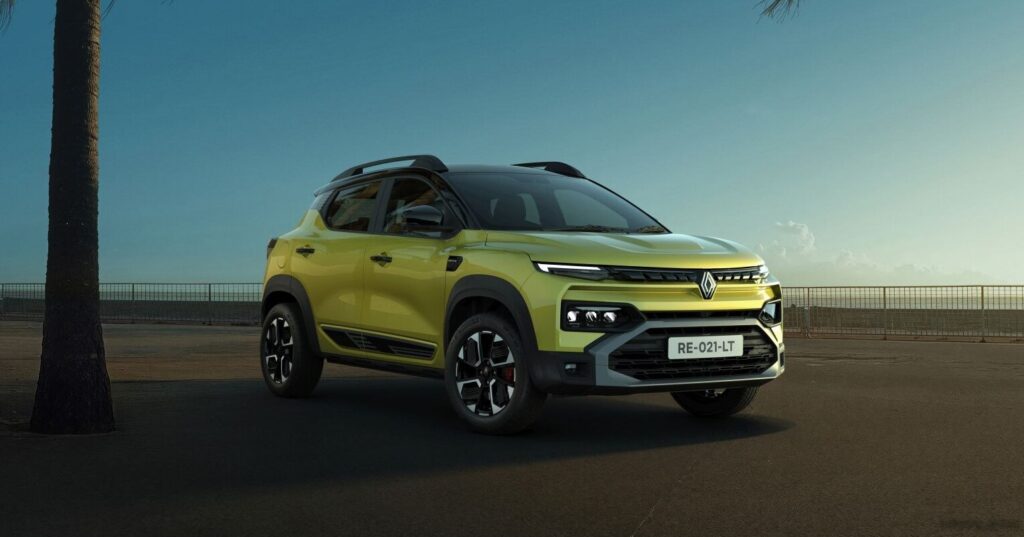
The Renault Kiger (facelift 2025) 1.0 Turbo (100 Hp) X-Tronic CVT represents a significant update to Renault’s popular subcompact SUV, primarily aimed at the Indian and emerging markets. Introduced in August 2025, this variant builds upon the original Kiger, which debuted in 2021, offering a blend of fuel efficiency, modern styling, and accessible technology. Positioned as a mid-range offering within the Kiger lineup, it slots between the base engine variants and potentially higher-spec turbocharged options. The facelift brings revised exterior styling, an upgraded interior, and refinements to the powertrain, all designed to enhance the Kiger’s appeal in a competitive segment.
Technical Specifications
| Brand | Renault |
| Model | Kiger |
| Generation | Kiger (facelift 2025) |
| Type (Engine) | 1.0 Turbo (100 Hp) X-Tronic CVT |
| Start of production | August, 2025 |
| Powertrain Architecture | Internal Combustion engine |
| Body type | SUV, Crossover |
| Seats | 5 |
| Doors | 5 |
| Fuel Type | Petrol (Gasoline) |
| Acceleration 0 – 100 km/h | 11 sec |
| Acceleration 0 – 62 mph | 11 sec |
| Acceleration 0 – 60 mph | 10.5 sec |
| Power | 100 Hp @ 5000 rpm |
| Power per litre | 100.1 Hp/l |
| Torque | 152 Nm @ 2200-4400 rpm / 112.11 lb.-ft. @ 2200-4400 rpm |
| Engine layout | Front, Transverse |
| Engine displacement | 999 cm3 / 60.96 cu. in. |
| Number of cylinders | 3 |
| Engine configuration | Inline |
| Cylinder Bore | 72.2 mm / 2.84 in. |
| Piston Stroke | 81.3 mm / 3.2 in. |
| Number of valves per cylinder | 4 |
| Fuel injection system | Multi-port manifold injection |
| Engine aspiration | Turbocharger, Intercooler |
| Valvetrain | DOHC |
| Trunk (boot) space – minimum | 405 l / 14.3 cu. ft. |
| Fuel tank capacity | 40 l / 10.57 US gal | 8.8 UK gal |
| Max. roof load | 50 kg / 110.23 lbs. |
| Length | 3990 mm / 157.09 in. |
| Width | 1750 mm / 68.9 in. |
| Width including mirrors | 1912 mm / 75.28 in. |
| Height | 1605 mm / 63.19 in. |
| Wheelbase | 2500 mm / 98.43 in. |
| Front track | 1536 mm / 60.47 in. |
| Rear (Back) track | 1535 mm / 60.43 in. |
| Front overhang | 806 mm / 31.73 in. |
| Rear overhang | 684 mm / 26.93 in. |
| Ride height (ground clearance) | 205 mm / 8.07 in. |
| Minimum turning circle | 10.5 m / 34.45 ft. |
| Drivetrain Architecture | The Internal combustion engine (ICE) drives the front wheels of the vehicle. |
| Drive wheel | Front wheel drive |
| Number of gears and type of gearbox | automatic transmission X-Tronic CVT |
| Front suspension | Independent, type McPherson with coil spring and anti-roll bar |
| Rear suspension | Semi-independent, coil spring, Elastic beam |
| Front brakes | Disc |
| Rear brakes | Drum |
| Assisting systems | ABS (Anti-lock braking system) |
| Steering type | Steering rack and pinion |
| Power steering | Electric Steering |
| Tires size | 195/60 R16 |
| Wheel rims size | 16 |
Powertrain & Engine Architecture
The heart of the Kiger 1.0 Turbo X-Tronic CVT is Renault’s HR10 1.0-liter turbocharged three-cylinder engine. This engine, part of the H4D family, utilizes a multi-point fuel injection system and a single scroll turbocharger with an intercooler. The engine produces 100 horsepower at 5000 rpm and 152 Nm (112 lb-ft) of torque between 2200 and 4400 rpm. The engine features a double overhead camshaft (DOHC) valvetrain with four valves per cylinder, contributing to its relatively efficient operation. The X-Tronic CVT (Continuously Variable Transmission) is a key component, offering smooth, stepless gear changes designed to maximize fuel economy and provide a comfortable driving experience. This CVT is specifically tuned for the HR10 engine, with gear ratios optimized for both city driving and highway cruising.
Driving Characteristics
The 1.0 Turbo X-Tronic CVT offers a noticeable step up in performance compared to the naturally aspirated engine options available in the Kiger range. While not a sports car, the turbocharger provides a useful boost in power, making overtaking and merging onto highways more confident. The CVT, while prioritizing smoothness, can sometimes feel less responsive than a traditional automatic transmission, particularly during hard acceleration. The 0-60 mph time of around 10.5 seconds reflects this. The CVT’s programming aims to keep the engine within its optimal torque band, resulting in decent in-gear acceleration. The Kiger’s relatively lightweight construction helps to mitigate the effects of the modest horsepower output. Overall, the driving experience is geared towards comfort and efficiency rather than outright performance.
Equipment & Trim Levels
The 1.0 Turbo X-Tronic CVT trim typically includes a generous amount of standard equipment. This generally encompasses features such as air conditioning, power windows, power-adjustable side mirrors, a touchscreen infotainment system with Apple CarPlay and Android Auto compatibility, and basic safety features like dual airbags and ABS. Higher sub-trims within the 1.0 Turbo CVT range may add features like alloy wheels, a rear parking camera, a digital instrument cluster, automatic climate control, and LED headlights. Interior upholstery is typically cloth, with options for upgraded materials on higher trims. The facelifted 2025 model is expected to feature an updated dashboard design and improved interior materials compared to the original Kiger.
Chassis & Braking
The Kiger utilizes a front-wheel-drive configuration with an independent McPherson strut suspension at the front and a semi-independent elastic beam suspension at the rear. This setup is tuned for a comfortable ride, prioritizing absorbing bumps and imperfections in the road. The front brakes are disc brakes, providing adequate stopping power, while the rear brakes are drum brakes, a cost-saving measure common in this segment. The Kiger’s electric power steering offers light and easy steering, making it maneuverable in urban environments. The ride height of 205mm (8.07 inches) provides good ground clearance, allowing it to handle rough roads and speed bumps with ease.
Market Reception & Comparison
The Renault Kiger has been well-received in its target markets, particularly in India, where it competes with other subcompact SUVs like the Maruti Suzuki Brezza, Hyundai Venue, and Tata Nexon. Critics have praised the Kiger’s stylish design, spacious interior, and competitive pricing. The 1.0 Turbo X-Tronic CVT variant is often seen as a sweet spot in the lineup, offering a good balance of performance, fuel economy, and convenience. Compared to the base engine options, the turbo engine provides a significant performance boost, while the CVT offers a smoother and more relaxed driving experience than a manual transmission. Fuel economy is generally competitive, with figures around 5.5-6.0 liters per 100 kilometers (43-47 mpg) being typical.
Legacy
The Renault Kiger, and specifically the 1.0 Turbo X-Tronic CVT variant, represents Renault’s attempt to establish a strong foothold in the rapidly growing subcompact SUV segment. While long-term reliability data is still emerging, the HR10 engine has proven to be generally robust in other Renault and Nissan applications. The CVT transmission, if properly maintained, is also expected to offer good durability. As the Kiger ages, its affordability and fuel efficiency are likely to make it a popular choice in the used car market. The 2025 facelift is expected to further enhance the Kiger’s appeal and ensure its continued competitiveness in the years to come.