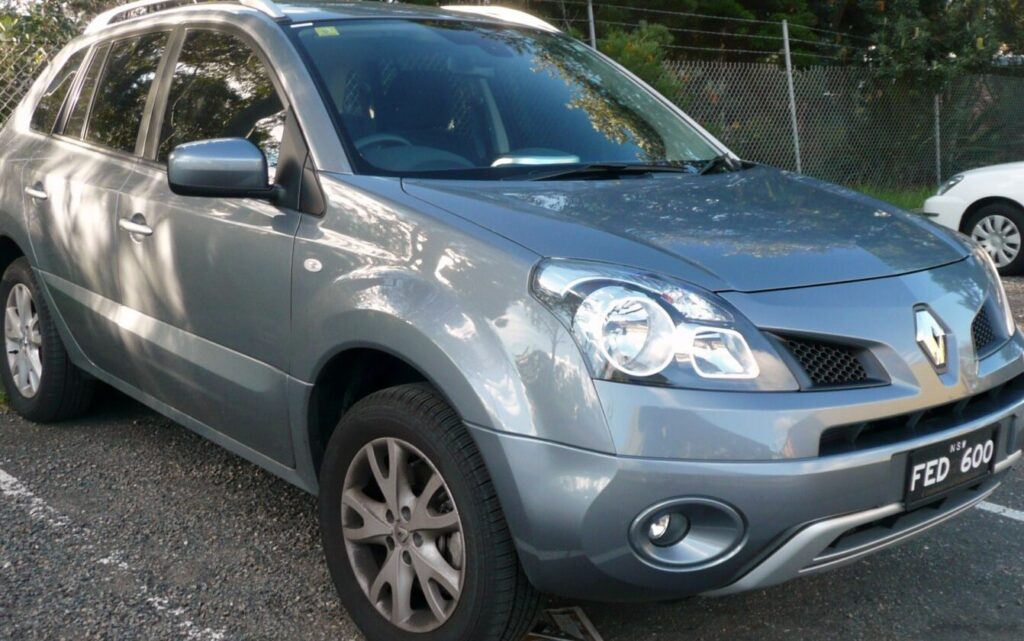
The Renault Koleos 2.0 dCi FAP (150 hp) 4×2 was a front-wheel-drive diesel-powered sport utility vehicle (SUV) produced by the French manufacturer Renault from June 2008 to 2011. Positioned as a mid-range offering within the first generation Koleos lineup (introduced in 2008), it aimed to provide a balance between fuel efficiency, practicality, and affordability. The Koleos itself was a significant model for Renault, representing their entry into the increasingly popular compact SUV segment, often marketed as a more rugged alternative to traditional station wagons and hatchbacks. This particular variant played a key role in attracting buyers seeking a diesel engine for long-distance driving and improved fuel economy.
Technical Specifications
| Brand | Renault |
| Model | Koleos |
| Generation | Koleos |
| Type (Engine) | 2.0 dCi FAP (150 Hp) 4×2 |
| Start of production | June, 2008 |
| End of production | 2011 |
| Powertrain Architecture | Internal Combustion engine |
| Body type | SUV |
| Seats | 5 |
| Doors | 5 |
| Fuel consumption (urban) | 9 l/100 km (26.1 US mpg, 31.4 UK mpg, 11.1 km/l) |
| Fuel consumption (extra urban) | 6.1 l/100 km (38.6 US mpg, 46.3 UK mpg, 16.4 km/l) |
| Fuel consumption (combined) | 7.2 l/100 km (32.7 US mpg, 39.2 UK mpg, 13.9 km/l) |
| Fuel Type | Diesel |
| Acceleration 0 – 100 km/h | 10 sec |
| Acceleration 0 – 62 mph | 10 sec |
| Acceleration 0 – 60 mph | 9.5 sec |
| Maximum speed | 184 km/h (114.33 mph) |
| Emission standard | Euro 4 |
| Weight-to-power ratio | 11.5 kg/Hp, 87 Hp/tonne |
| Weight-to-torque ratio | 5.1 kg/Nm, 197.2 Nm/tonne |
| Power | 150 Hp @ 4000 rpm |
| Power per litre | 75.2 Hp/l |
| Torque | 340 Nm @ 2000 rpm (250.77 lb.-ft. @ 2000 rpm) |
| Engine layout | Front, Transverse |
| Engine Model/Code | M9R |
| Engine displacement | 1995 cm3 (121.74 cu. in.) |
| Number of cylinders | 4 |
| Engine configuration | Inline |
| Fuel injection system | Diesel Commonrail |
| Engine aspiration | Turbocharger, Intercooler |
| Engine oil capacity | 7.4 l (7.82 US qt | 6.51 UK qt) |
| Coolant | 8 l (8.45 US qt | 7.04 UK qt) |
| Kerb Weight | 1724 kg (3800.77 lbs.) |
| Max. weight | 2100 kg (4629.71 lbs.) |
| Max load | 376 kg (828.94 lbs.) |
| Trunk (boot) space – minimum | 450 l (15.89 cu. ft.) |
| Trunk (boot) space – maximum | 1380 l (48.73 cu. ft.) |
| Fuel tank capacity | 65 l (17.17 US gal | 14.3 UK gal) |
| Length | 4520 mm (177.95 in.) |
| Width | 1855 mm (73.03 in.) |
| Height | 1695 mm (66.73 in.) |
| Wheelbase | 2690 mm (105.91 in.) |
| Front track | 1545 mm (60.83 in.) |
| Rear (Back) track | 1550 mm (61.02 in.) |
| Minimum turning circle | 11.6 m (38.06 ft.) |
| Drivetrain Architecture | The Internal combustion engine (ICE) drives the front wheels of the vehicle. |
| Drive wheel | Front wheel drive |
| Number of gears | 6 gears, manual transmission |
| Front suspension | Independent, type McPherson with coil spring and anti-roll bar |
| Rear suspension | Independent multi-link spring suspension with stabilizer |
| Front brakes | Ventilated discs |
| Rear brakes | Disc |
| Assisting systems | ABS (Anti-lock braking system) |
| Steering type | Steering rack and pinion |
| Tires size | 225/60 R17 H |
| Wheel rims size | 6.5J x 17 |
INTRODUCTION
The Renault Koleos 2.0 dCi FAP 4×2, produced between 2008 and 2011, was a key variant within the first generation of Renault’s foray into the compact SUV market. Built on the Nissan/Renault “C” platform (also known as the 1HX0/A3 platform, shared with the Nissan X-Trail and Rogue), the Koleos aimed to offer a more comfortable and refined driving experience than some of its more utilitarian competitors. The 2.0 dCi engine, coupled with a six-speed manual transmission in this specific configuration, represented a popular choice for European buyers prioritizing fuel efficiency and reasonable performance. It sat in the middle of the Koleos range, offering a step up from the base petrol engines but remaining more accessible than the higher-powered dCi variants or those equipped with all-wheel drive.
Powertrain & Engine Architecture
The heart of the Koleos 2.0 dCi FAP 4×2 is the M9R engine, a 2.0-liter inline-four cylinder diesel engine. This engine utilizes a common rail direct injection system, delivering fuel at extremely high pressure for optimized combustion. The M9R engine featured a single overhead camshaft (SOHC) valvetrain with two valves per cylinder. A turbocharger with an intercooler was employed to boost power and torque, providing improved responsiveness and pulling power. The “FAP” designation indicates the presence of a Diesel Particulate Filter (DPF), a crucial component for meeting stringent Euro 4 emissions standards. This filter traps soot particles from the exhaust, periodically undergoing a regeneration process to burn off the accumulated deposits. The six-speed manual transmission offered precise gear changes and contributed to the vehicle’s overall fuel efficiency. Gear ratios were tuned to balance acceleration with cruising comfort, prioritizing torque delivery at lower engine speeds.
Driving Characteristics
The 150 hp and 340 Nm (250 lb-ft) of torque produced by the 2.0 dCi engine provided adequate performance for everyday driving. Acceleration from 0-60 mph took around 9.5 seconds, and a top speed of 114 mph was achievable. While not a particularly sporty SUV, the engine offered sufficient power for overtaking maneuvers and maintaining comfortable cruising speeds on highways. Compared to the higher-output 173 hp version of the 2.0 dCi, this variant felt slightly less responsive, particularly at higher engine speeds. The manual transmission allowed for greater driver control, but the gear ratios were somewhat long, prioritizing fuel economy over outright acceleration. The front-wheel-drive configuration contributed to lower weight and improved fuel efficiency compared to the 4×4 models, but it also meant reduced traction in slippery conditions.
Equipment & Trim Levels
The Koleos 2.0 dCi FAP 4×2 typically came equipped with a reasonable level of standard features. These included air conditioning, electric front and rear windows, a CD player with auxiliary input, and ABS brakes. Higher trim levels, such as the Luxe or Privilege, added features like alloy wheels, automatic climate control, a panoramic sunroof, leather upholstery, and a navigation system. Interior upholstery was typically cloth in the base models, with leather options available on higher trims. The dashboard layout was functional and straightforward, with a focus on ease of use. Optional extras included parking sensors, a rear parking camera, and a premium sound system.
Chassis & Braking
The Koleos featured an independent suspension system on both the front and rear axles. The front suspension utilized a McPherson strut design with a coil spring and anti-roll bar, while the rear suspension employed a multi-link setup with a stabilizer bar. This configuration provided a comfortable ride quality, absorbing bumps and imperfections in the road surface effectively. The Koleos 2.0 dCi FAP 4×2 was equipped with ventilated disc brakes on the front wheels and solid disc brakes on the rear. ABS (Anti-lock Braking System) was standard, enhancing braking performance and stability, particularly in emergency situations. The relatively lightweight front-wheel-drive configuration contributed to balanced handling characteristics.
Market Reception & Comparison
The Renault Koleos 2.0 dCi FAP 4×2 was generally well-received by automotive critics as a practical and comfortable SUV. Its fuel economy was a significant selling point, particularly compared to petrol-powered rivals. However, some reviewers criticized its somewhat bland styling and lack of off-road capability due to its front-wheel-drive configuration. Compared to the 1.6 petrol engine, the 2.0 dCi offered significantly more torque and better fuel economy, making it a more suitable choice for long-distance driving. Against the higher-powered 2.0 dCi variants, it represented a more affordable option, albeit with slightly less performance. Reliability reports suggest that the M9R engine is generally robust, but the DPF system can be prone to issues if the vehicle is primarily used for short trips.
Legacy
The Renault Koleos 2.0 dCi FAP 4×2 remains a relatively common sight on the used car market. The M9R engine, while requiring regular maintenance, has proven to be reasonably durable. The DPF system remains a potential weak point, and prospective buyers should ensure that the vehicle has been properly maintained and that the DPF has been regularly regenerated. Overall, this variant offers a good balance of practicality, fuel efficiency, and affordability, making it a viable option for buyers seeking a used compact SUV. Its position as a mid-range offering within the Koleos lineup ensured a steady stream of sales during its production run, contributing to the model’s overall success in the European market.