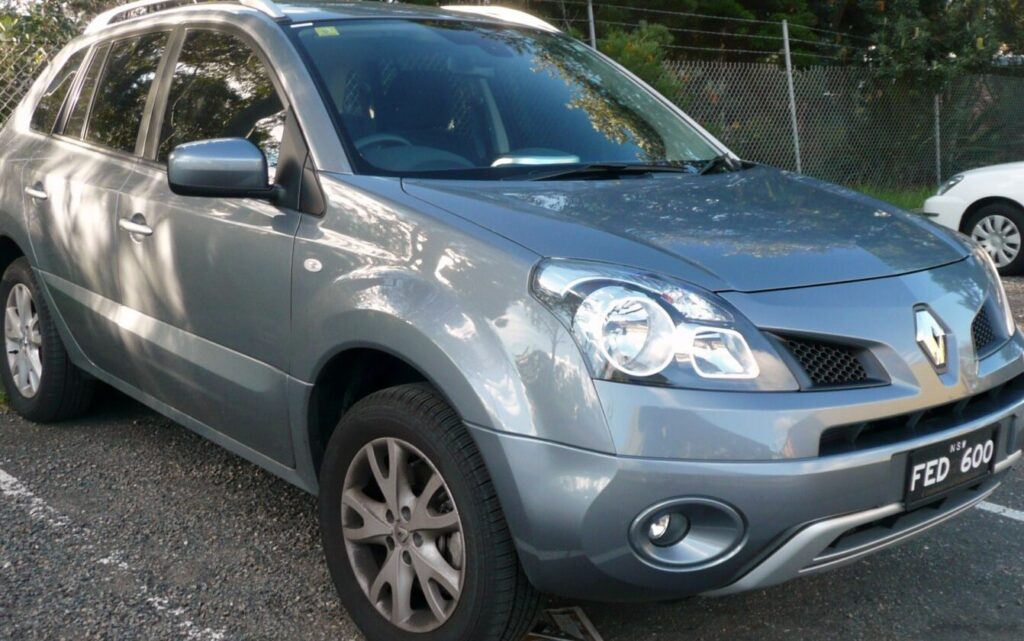
The Renault Koleos 2.0 dCi FAP 4×4, produced between 2008 and 2011, represented Renault’s entry into the burgeoning compact SUV market. Built in collaboration with Nissan, the Koleos shared its platform with the Nissan X-Trail (Rogue in North America) and aimed to provide a more refined and spacious alternative to smaller crossovers. This particular variant, powered by the 2.0-liter dCi diesel engine producing 150 horsepower, was positioned as a mid-range offering within the Koleos lineup, balancing fuel efficiency with respectable performance and all-wheel-drive capability. It was primarily marketed in Europe and other international markets, not being officially sold in the United States.
Technical Specifications
| Brand | Renault |
| Model | Koleos |
| Type (Engine) | 2.0 dCi FAP (150 Hp) 4×4 |
| Start of production | June, 2008 |
| End of production | 2011 |
| Powertrain Architecture | Internal Combustion engine |
| Body type | SUV |
| Seats | 5 |
| Doors | 5 |
| Fuel consumption (urban) | 9.5 l/100 km (24.8 US mpg) |
| Fuel consumption (extra urban) | 6.2 l/100 km (37.9 US mpg) |
| Fuel consumption (combined) | 7.4 l/100 km (31.8 US mpg) |
| Fuel Type | Diesel |
| Acceleration 0 – 100 km/h | 10.4 sec |
| Acceleration 0 – 62 mph | 10.4 sec |
| Acceleration 0 – 60 mph | 9.9 sec |
| Maximum speed | 185 km/h (114.95 mph) |
| Emission standard | Euro 4 |
| Weight-to-power ratio | 11.5 kg/Hp |
| Weight-to-torque ratio | 4.6 kg/Nm |
| Power | 150 Hp @ 3750 rpm |
| Torque | 380 Nm @ 2000 rpm (280.27 lb.-ft. @ 2000 rpm) |
| Engine layout | Front, Transverse |
| Engine Model/Code | M9R |
| Engine displacement | 1995 cm3 (121.74 cu. in.) |
| Number of cylinders | 4 |
| Engine configuration | Inline |
| Fuel injection system | Diesel Commonrail |
| Engine oil capacity | 7.4 l (7.82 US qt | 6.51 UK qt) |
| Coolant capacity | 8 l (8.45 US qt | 7.04 UK qt) |
| Kerb Weight | 1730 kg (3814 lbs.) |
| Max. weight | 2300 kg (5070.63 lbs.) |
| Max load | 570 kg (1256.63 lbs.) |
| Trunk (boot) space – minimum | 450 l (15.89 cu. ft.) |
| Trunk (boot) space – maximum | 1380 l (48.73 cu. ft.) |
| Fuel tank capacity | 65 l (17.17 US gal | 14.3 UK gal) |
| Length | 4520 mm (177.95 in.) |
| Width | 1855 mm (73.03 in.) |
| Height | 1695 mm (66.73 in.) |
| Wheelbase | 2690 mm (105.91 in.) |
| Front track | 1545 mm (60.83 in.) |
| Rear track | 1550 mm (61.02 in.) |
| Minimum turning circle | 11.6 m (38.06 ft.) |
| Drivetrain Architecture | All wheel drive (4×4) |
| Number of gears | 6 |
| Gearbox type | Manual transmission |
| Front suspension | Independent, McPherson with coil spring and anti-roll bar |
| Rear suspension | Independent multi-link with stabilizer |
| Front brakes | Ventilated discs |
| Rear brakes | Disc |
| Tires size | 225/60 R17 H |
| Wheel rims size | 6.5J x 17 |
Powertrain & Engine Architecture
The heart of the Koleos 2.0 dCi FAP 4×4 is the M9R engine, a 2.0-liter inline-four cylinder diesel. This engine utilizes a common rail direct injection system, delivering fuel at extremely high pressure for optimized combustion. A turbocharger with an intercooler further enhances performance by forcing more air into the cylinders. The FAP (Filtre à Particules) is a diesel particulate filter designed to reduce harmful soot emissions, a crucial component for meeting Euro 4 emission standards. The engine produces 150 horsepower at 3750 rpm and a substantial 380 Nm (280 lb-ft) of torque at just 2000 rpm. This torque output is a key characteristic of diesel engines, providing strong pulling power at lower engine speeds. The 6-speed manual transmission was the standard offering for this variant, providing a good balance between fuel economy and driver control.
Driving Characteristics
The 150 hp 2.0 dCi engine, paired with the six-speed manual gearbox, provided adequate, though not exhilarating, performance. Acceleration from 0-60 mph took around 9.9 seconds, making it competitive within its class. The strong low-end torque made everyday driving easy, with ample power for overtaking and climbing hills. Compared to the higher-output 2.0 dCi variants (some producing up to 173 hp), this version felt less responsive, particularly at higher engine speeds. The manual transmission allowed for greater driver engagement than the optional automatic, and the gear ratios were well-suited for both urban and highway driving. The all-wheel-drive system provided enhanced traction in slippery conditions, making it a capable vehicle for inclement weather or light off-road use.
Equipment & Trim Levels
The Koleos 2.0 dCi FAP 4×4 typically came equipped with a reasonable level of standard features. These included air conditioning, power windows and mirrors, a CD stereo system, and alloy wheels. Safety features such as ABS brakes, electronic brakeforce distribution, and front airbags were also standard. Higher trim levels offered options such as leather upholstery, a sunroof, rear parking sensors, and a more advanced audio system with navigation. Interior materials were generally of good quality, offering a comfortable and refined cabin environment. The Koleos prioritized space and practicality, with a generous amount of headroom and legroom for both front and rear passengers.
Chassis & Braking
The Koleos utilized a McPherson strut front suspension and an independent multi-link rear suspension, providing a comfortable ride quality. Stabilizer bars were fitted to both axles to reduce body roll during cornering. The braking system consisted of ventilated discs on the front wheels and solid discs on the rear. ABS (Anti-lock Braking System) was standard, enhancing braking performance and stability. The all-wheel-drive system employed a viscous coupling to distribute torque between the front and rear axles as needed, providing optimal traction in various driving conditions.
Market Reception & Comparison
The Renault Koleos was generally well-received by automotive critics, who praised its spacious interior, comfortable ride, and competitive pricing. However, some reviewers noted that its styling was somewhat conservative and that its driving dynamics were not as engaging as some of its rivals. Compared to other compact SUVs like the Volkswagen Tiguan or the Honda CR-V, the Koleos offered a more affordable alternative, but it lacked the brand recognition and sporty handling of those competitors. The 2.0 dCi FAP engine provided good fuel economy, averaging around 31.8 US mpg in combined driving, making it an attractive option for those seeking a fuel-efficient SUV. Reliability was generally considered average, with some reports of issues with the diesel particulate filter and the electronic parking brake.
Legacy
The Renault Koleos 2.0 dCi FAP 4×4 remains a relatively common sight on European roads today. The M9R engine, while generally reliable, can require maintenance related to the diesel particulate filter and the fuel injection system. The availability of spare parts is generally good, and the vehicle’s relatively simple mechanical design makes it relatively affordable to maintain. In the used car market, the Koleos 2.0 dCi FAP 4×4 represents a practical and affordable option for those seeking a spacious and capable SUV. While it may not offer the same level of performance or refinement as some of its more premium rivals, it provides a good balance of value, practicality, and fuel efficiency.