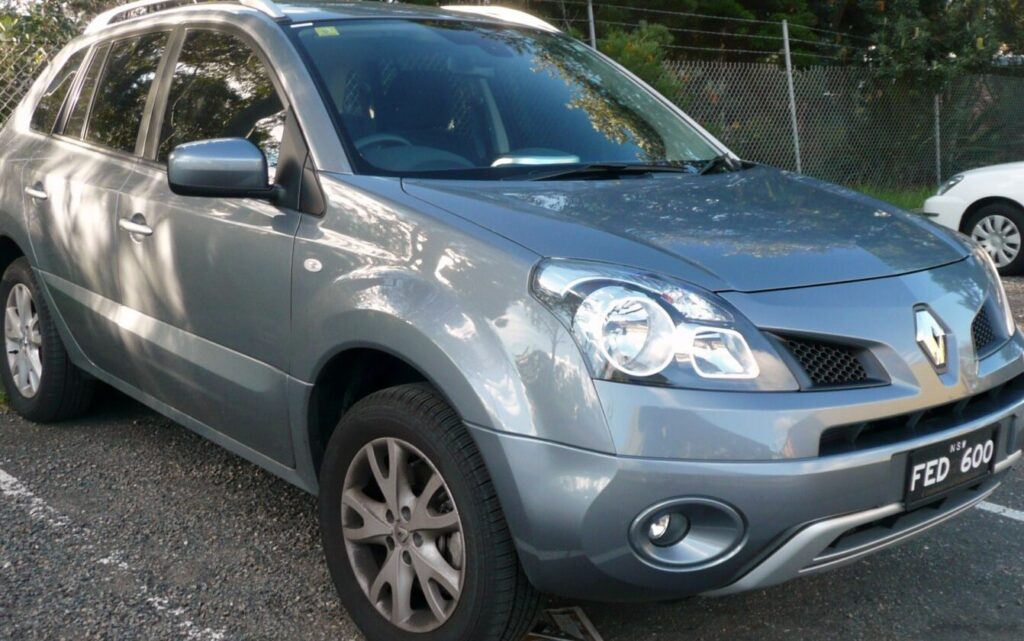
The Renault Koleos 2.5 16V 4WD, produced between June 2008 and July 2010, represented Renault’s entry into the burgeoning compact SUV market. Built in collaboration with Nissan, the Koleos shared its platform – the Nissan/Renault Common Module Family (CMF) – with the Nissan X-Trail and Rogue. This particular variant, powered by a 2.5-liter inline-four engine producing 171 horsepower, was positioned as a mid-range offering within the Koleos lineup, appealing to buyers seeking a balance between performance, practicality, and all-weather capability. It was primarily sold in European, Australian, and select emerging markets, offering a more affordable alternative to premium SUV brands.
Technical Specifications
| Brand | Renault |
| Model | Koleos |
| Generation | Koleos |
| Type (Engine) | 2.5 16V (171 Hp) 4WD |
| Start of production | June, 2008 |
| End of production | July, 2010 |
| Powertrain Architecture | Internal Combustion engine |
| Body type | SUV |
| Seats | 5 |
| Doors | 5 |
| Fuel consumption (urban) | 13 l/100 km (18.1 US mpg, 21.7 UK mpg, 7.7 km/l) |
| Fuel consumption (extra urban) | 7.7 l/100 km (30.5 US mpg, 36.7 UK mpg, 13 km/l) |
| Fuel consumption (combined) | 9.6 l/100 km (24.5 US mpg, 29.4 UK mpg, 10.4 km/l) |
| Fuel Type | Petrol (Gasoline) |
| Acceleration 0 – 100 km/h | 9.3 sec |
| Acceleration 0 – 62 mph | 9.3 sec |
| Acceleration 0 – 60 mph | 8.8 sec |
| Maximum speed | 190 km/h (118.06 mph) |
| Emission standard | Euro 4 |
| Weight-to-power ratio | 9.9 kg/Hp, 100.8 Hp/tonne |
| Weight-to-torque ratio | 7.5 kg/Nm, 133.2 Nm/tonne |
| Power | 171 Hp @ 6000 rpm |
| Power per litre | 68.7 Hp/l |
| Torque | 226 Nm @ 4400 rpm (166.69 lb.-ft. @ 4400 rpm) |
| Engine layout | Front, Transverse |
| Engine Model/Code | 2TR |
| Engine displacement | 2488 cm3 (151.83 cu. in.) |
| Number of cylinders | 4 |
| Engine configuration | Inline |
| Number of valves per cylinder | 4 |
| Fuel injection system | Multi-port manifold injection |
| Engine aspiration | Naturally aspirated engine |
| Valvetrain | DOHC |
| Engine oil capacity | 5.1 l (5.39 US qt | 4.49 UK qt) |
| Coolant capacity | 7.1 l (7.5 US qt | 6.25 UK qt) |
| Kerb Weight | 1697 kg (3741.24 lbs) |
| Max. weight | 2050 kg (4519.48 lbs) |
| Max load | 353 kg (778.23 lbs) |
| Trunk (boot) space – minimum | 450 l (15.89 cu. ft.) |
| Trunk (boot) space – maximum | 1380 l (48.73 cu. ft.) |
| Fuel tank capacity | 65 l (17.17 US gal | 14.3 UK gal) |
| Length | 4520 mm (177.95 in) |
| Width | 1865 mm (73.43 in) |
| Height | 1695 mm (66.73 in) |
| Wheelbase | 2690 mm (105.91 in) |
| Front track | 1545 mm (60.83 in) |
| Rear (Back) track | 1550 mm (61.02 in) |
| Minimum turning circle | 11.6 m (38.06 ft) |
| Drive wheel | All wheel drive (4×4) |
| Number of gears | 6 gears, manual transmission |
| Front suspension | Independent, type McPherson with coil spring and anti-roll bar |
| Rear suspension | Independent multi-link spring suspension with stabilizer |
| Front brakes | Ventilated discs |
| Rear brakes | Disc |
| Assisting systems | ABS (Anti-lock braking system) |
| Steering type | Steering rack and pinion |
| Tires size | 225/60 R17 H |
| Wheel rims size | 6.5J x 17 |
Powertrain & Engine Architecture
The heart of the Koleos 2.5 4WD is the 2TR engine, a 2.5-liter inline-four cylinder gasoline engine. This engine utilizes a multi-point fuel injection system, delivering fuel directly into the intake ports. The engine features a double overhead camshaft (DOHC) valvetrain, optimizing airflow for improved performance. The 2TR engine, while not known for being particularly innovative, was chosen for its reliability and relatively low production cost. Paired with this engine was a six-speed manual transmission, providing drivers with direct control over gear selection. The 4WD system was an on-demand system, automatically engaging all-wheel drive when wheel slip was detected, enhancing traction in adverse conditions.
Driving Characteristics
The 171 horsepower and 167 lb-ft of torque offered by the 2.5-liter engine provided adequate, but not exhilarating, performance. Acceleration from 0-60 mph took around 8.8 seconds, making it competitive with other compact SUVs of the time. The six-speed manual transmission allowed for precise gear changes, but the engine’s relatively narrow powerband meant frequent shifting was necessary to maintain momentum, especially when fully loaded or tackling inclines. Compared to the more powerful engine options available in some markets (like a 2.5L CVT), the manual transmission and lower horsepower offered a more engaging driving experience, but at the expense of outright speed. The 4WD system provided confident handling on slippery surfaces, but the Koleos wasn’t designed for serious off-roading.
Equipment & Trim Levels
The Koleos 2.5 4WD typically came equipped with a reasonable level of standard features. These included air conditioning, power windows and mirrors, a CD player with auxiliary input, and ABS brakes. Higher trim levels added features like alloy wheels, a sunroof, leather upholstery, and a more advanced audio system. Interior upholstery was typically cloth on the base models, with leather options available. The dashboard layout was functional and straightforward, prioritizing ease of use over stylistic flair. Optional extras included rear parking sensors, a navigation system, and automatic climate control.
Chassis & Braking
The Koleos utilized an independent McPherson strut suspension in the front and an independent multi-link suspension in the rear, providing a comfortable ride quality. Stabilizer bars were fitted to both axles to reduce body roll during cornering. Braking duties were handled by ventilated discs at the front and solid discs at the rear. The ABS system helped to maintain steering control during emergency braking situations. The suspension tuning was geared towards comfort rather than sporty handling, making it well-suited for everyday driving and long journeys.
Market Reception & Comparison
The Renault Koleos 2.5 4WD received mixed reviews from automotive critics. While praised for its spacious interior, comfortable ride, and capable 4WD system, it was often criticized for its uninspired styling and somewhat lackluster engine performance. Compared to the more powerful engine options, the 2.5-liter version offered better fuel economy – around 24.5 US mpg combined – but at the cost of acceleration. Reliability was generally considered average, with some reports of minor electrical issues. It competed directly with vehicles like the Honda CR-V, Toyota RAV4, and Nissan X-Trail, often positioned as a more affordable alternative.
Legacy
The Renault Koleos 2.5 16V 4WD, while not a groundbreaking vehicle, served as a solid and practical SUV option for buyers in its target markets. The 2TR engine proved to be reasonably durable, and well-maintained examples continue to be found on the used car market today. However, due to its age, potential buyers should be aware of the possibility of needing to address age-related maintenance issues, such as worn suspension components and potential leaks. The Koleos paved the way for Renault’s continued presence in the SUV segment, and its collaborative development with Nissan highlighted the benefits of platform sharing in the automotive industry.