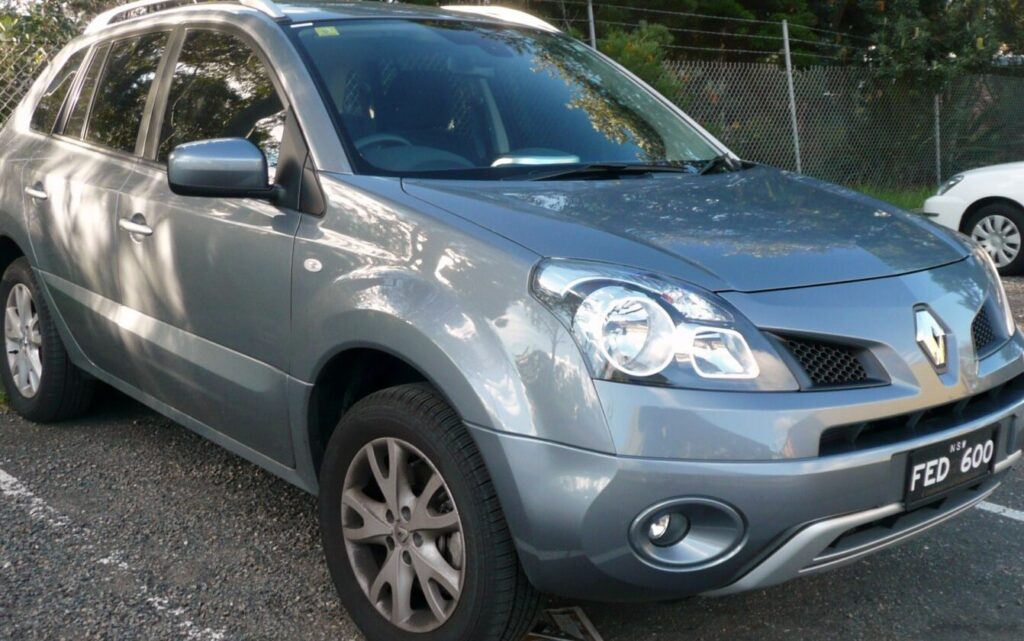
Technical Specifications
| Brand | Renault |
| Model | Koleos |
| Generation | Koleos II |
| Type (Engine) | 1.6 dCi (130 Hp) |
| Start of production | June, 2017 |
| End of production | July, 2018 |
| Powertrain Architecture | Internal Combustion engine |
| Body type | SUV |
| Seats | 5 |
| Doors | 5 |
| Fuel consumption (urban) | 5.1 l/100 km (46.1 US mpg, 55.4 UK mpg, 19.6 km/l) |
| Fuel consumption (extra urban) | 4.2 l/100 km (56 US mpg, 67.3 UK mpg, 23.8 km/l) |
| Fuel consumption (combined) | 4.6 l/100 km (51.1 US mpg, 61.4 UK mpg, 21.7 km/l) |
| CO2 emissions | 120 g/km |
| Fuel Type | Diesel |
| Acceleration 0 – 100 km/h | 11.4 sec |
| Acceleration 0 – 62 mph | 11.4 sec |
| Acceleration 0 – 60 mph | 10.8 sec |
| Maximum speed | 185 km/h (114.95 mph) |
| Emission standard | Euro 6b |
| Weight-to-power ratio | 12.4 kg/Hp, 80.5 Hp/tonne |
| Weight-to-torque ratio | 5 kg/Nm, 198.1 Nm/tonne |
| Power | 130 Hp @ 4000 rpm |
| Power per litre | 81.4 Hp/l |
| Torque | 320 Nm @ 1750 rpm (236.02 lb.-ft. @ 1750 rpm) |
| Engine layout | Front, Transverse |
| Engine Model/Code | R9M |
| Engine displacement | 1598 cm3 (97.52 cu. in.) |
| Number of cylinders | 4 |
| Engine configuration | Inline |
| Number of valves per cylinder | 4 |
| Fuel injection system | Diesel Commonrail |
| Engine aspiration | Turbocharger, Intercooler |
| Engine oil capacity | 6.2 l (6.55 US qt | 5.46 UK qt) |
| Coolant capacity | 7.7 l (8.14 US qt | 6.78 UK qt) |
| Kerb Weight | 1615 kg (3560.47 lbs.) |
| Max. weight | 2153 kg (4746.55 lbs.) |
| Max load | 538 kg (1186.09 lbs.) |
| Trunk (boot) space – minimum | 530 l (18.72 cu. ft.) |
| Trunk (boot) space – maximum | 1677 l (59.22 cu. ft.) |
| Fuel tank capacity | 60 l (15.85 US gal | 13.2 UK gal) |
| Max. roof load | 80 kg (176.37 lbs.) |
| Permitted trailer load with brakes (12%) | 2000 kg (4409.25 lbs.) |
| Permitted trailer load without brakes | 750 kg (1653.47 lbs.) |
| Permitted towbar download | 75 kg (165.35 lbs.) |
| Length | 4673 mm (183.98 in.) |
| Width | 1843 mm (72.56 in.) |
| Width with mirrors folded | 1864 mm (73.39 in.) |
| Width including mirrors | 2063 mm (81.22 in.) |
| Height | 1673 mm (65.87 in.) |
| Wheelbase | 2705 mm (106.5 in.) |
| Front track | 1591 mm (62.64 in.) |
| Rear track | 1586 mm (62.44 in.) |
| Front overhang | 930 mm (36.61 in.) |
| Rear overhang | 1038 mm (40.87 in.) |
| Ride height (ground clearance) | 210 mm (8.27 in.) |
| Minimum turning circle | 11.4 m (37.4 ft.) |
| Drivetrain Architecture | Front wheel drive |
| Number of gears | 6 |
| Gearbox type | Manual transmission |
| Front brakes | Ventilated discs |
| Rear brakes | Ventilated discs |
| Tires size | 225/65 R17 |
| Wheel rims size | 17 |
The Renault Koleos II 1.6 dCi (130 Hp) represented a key offering in Renault’s SUV range, launched as part of the second-generation Koleos (introduced in 2017). This model aimed to broaden the Koleos’ appeal by providing a more economical and accessible entry point into the lineup. The Koleos II, built on the CMF-C/D platform, was designed to compete with vehicles like the Peugeot 3008 and Hyundai Tucson. The 1.6 dCi variant, with its 130 horsepower output, was positioned as a practical choice for drivers prioritizing fuel efficiency and everyday usability over outright performance.
Powertrain & Engine Architecture
At the heart of the Koleos II 1.6 dCi is the Renault R9M engine, a 1.6-liter inline-four cylinder diesel engine. This engine utilizes a common-rail direct fuel injection system, delivering fuel at extremely high pressure for optimized combustion. The R9M engine is turbocharged with an intercooler, enhancing power output and efficiency. The 130 horsepower version of the R9M was specifically tuned for a balance of fuel economy and drivability. The engine features four valves per cylinder and a variable geometry turbocharger (VGT) to improve responsiveness across the rev range. Paired with this engine was a 6-speed manual transmission, chosen for its efficiency and cost-effectiveness. The transmission’s gear ratios were optimized to provide adequate acceleration while maintaining low engine speeds for improved fuel consumption.
Driving Characteristics
The Koleos II 1.6 dCi (130 Hp) offered a comfortable, if not particularly sporty, driving experience. Acceleration from 0-62 mph took approximately 11.4 seconds, which was adequate for everyday driving but noticeably slower than higher-powered Koleos variants. The 320 Nm (236 lb-ft) of torque, available from 1750 rpm, provided sufficient pulling power for overtaking and navigating hills. The manual transmission, while efficient, required more driver involvement than the automatic options available on other Koleos models. The front-wheel-drive configuration contributed to a slightly less engaging driving experience compared to the all-wheel-drive versions, particularly in adverse weather conditions. The suspension was tuned for comfort, absorbing bumps and imperfections in the road well, but this came at the expense of some body roll during cornering.
Equipment & Trim Levels
The 1.6 dCi variant of the Koleos II typically came with a reasonable level of standard equipment. This included air conditioning, a touchscreen infotainment system with Bluetooth connectivity, alloy wheels, and basic safety features like ABS, ESP, and multiple airbags. Higher trim levels offered additional features such as a panoramic sunroof, leather upholstery, heated seats, a reversing camera, and advanced driver-assistance systems (ADAS) like lane departure warning and automatic emergency braking. Interior upholstery was generally cloth on the base models, with leather options available as upgrades. The dashboard layout was functional and modern, with a focus on ease of use.
Chassis & Braking
The Koleos II 1.6 dCi utilized a MacPherson strut front suspension and a multi-link rear suspension, providing a good balance of ride comfort and handling. The front and rear brakes were ventilated discs, offering adequate stopping power for the vehicle’s weight. ABS (Anti-lock Braking System) and ESP (Electronic Stability Program) were standard features, enhancing safety and control. The steering was a rack and pinion system, providing reasonable precision and feedback. The 17-inch alloy wheels were typically fitted with 225/65 R17 tires, offering a good compromise between comfort and grip.
Market Reception & Comparison
The Renault Koleos II 1.6 dCi (130 Hp) was generally well-received by critics as a practical and fuel-efficient SUV. However, some reviewers noted its relatively modest performance compared to competitors and higher-powered Koleos variants. Fuel economy was a strong point, with combined figures around 4.6 l/100 km (51.1 US mpg), making it an attractive option for drivers covering long distances. Compared to the 2.0 dCi models, the 1.6 dCi offered lower running costs but sacrificed some performance. The manual transmission was seen as a positive by some, offering greater driver control, while others preferred the convenience of an automatic gearbox.
Legacy
The Renault Koleos II 1.6 dCi (130 Hp) has established a reputation as a reliable and economical SUV in the used car market. The R9M engine, while not without its occasional issues (such as potential EGR valve problems), is generally considered durable when properly maintained. The relatively simple mechanical design of this variant contributes to lower maintenance costs compared to more complex models. Today, these vehicles represent a good value proposition for buyers seeking a practical and affordable family SUV, though potential buyers should be aware of the typical maintenance requirements for diesel engines and ensure a thorough inspection before purchase.