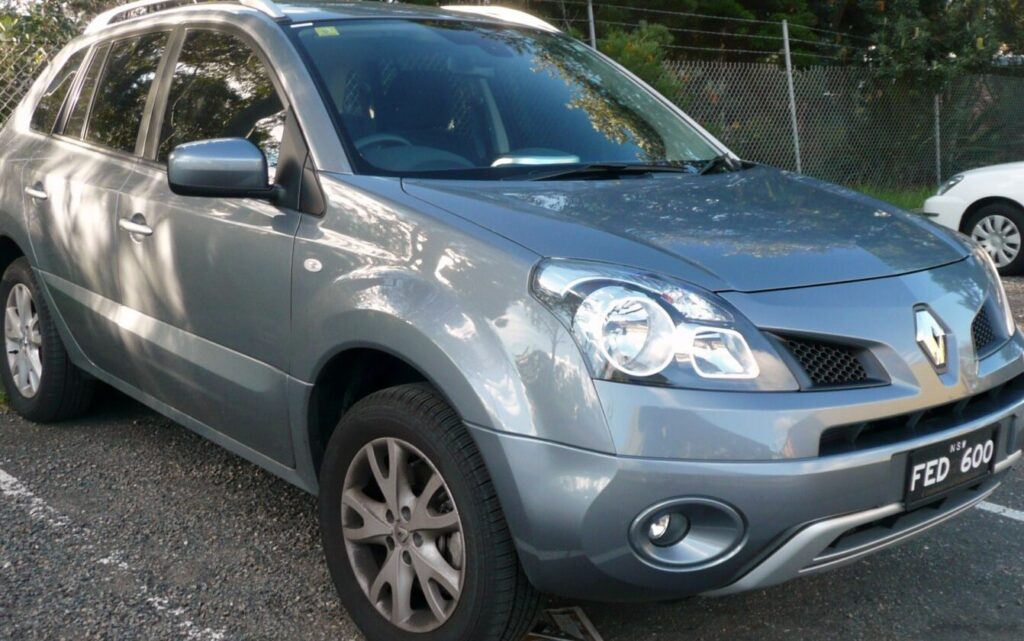
The Renault Koleos II 1.6 dCi (130 hp) CVT, produced from June 2017 to July 2018, represents a key variant within the second generation of Renault’s mid-size SUV. Positioned as a fuel-efficient and accessible entry point into the Koleos range, this model aimed to broaden the vehicle’s appeal, particularly in European markets where diesel engines and continuously variable transmissions (CVTs) were popular choices. It was built on the Renault-Nissan Alliance’s Common Module Family (CMF) platform, specifically the CMF-C/D architecture, shared with models like the Nissan X-Trail. This variant offered a balance between practicality, comfort, and running costs, targeting families and individuals seeking a versatile SUV without the higher price tag of more powerful or better-equipped trims.
Technical Specifications
| Brand | Renault |
| Model | Koleos |
| Generation | Koleos II |
| Type (Engine) | 1.6 dCi (130 Hp) CVT |
| Start of production | June, 2017 |
| End of production | July, 2018 |
| Powertrain Architecture | Internal Combustion engine |
| Body type | SUV |
| Seats | 5 |
| Doors | 5 |
| Fuel consumption (urban) | 5.7 l/100 km (41.3 US mpg, 49.6 UK mpg, 17.5 km/l) |
| Fuel consumption (extra urban) | 5.3 l/100 km (44.4 US mpg, 53.3 UK mpg, 18.9 km/l) |
| Fuel consumption (combined) | 5.5 l/100 km (42.8 US mpg, 51.4 UK mpg, 18.2 km/l) |
| CO2 emissions | 142 g/km |
| Fuel Type | Diesel |
| Acceleration 0 – 100 km/h | 13.3 sec |
| Acceleration 0 – 62 mph | 13.3 sec |
| Acceleration 0 – 60 mph | 12.6 sec |
| Maximum speed | 165 km/h (102.53 mph) |
| Emission standard | Euro 6b |
| Weight-to-power ratio | 12.3 kg/Hp, 81.3 Hp/tonne |
| Weight-to-torque ratio | 5 kg/Nm, 200.1 Nm/tonne |
| Power | 130 Hp @ 4000 rpm |
| Power per litre | 81.4 Hp/l |
| Torque | 320 Nm @ 1750 rpm (236.02 lb.-ft. @ 1750 rpm) |
| Engine layout | Front, Transverse |
| Engine Model/Code | R9M |
| Engine displacement | 1598 cm3 (97.52 cu. in.) |
| Number of cylinders | 4 |
| Engine configuration | Inline |
| Cylinder Bore | 80 mm (3.15 in.) |
| Piston Stroke | 79.5 mm (3.13 in.) |
| Compression ratio | 15.4:1 |
| Number of valves per cylinder | 4 |
| Fuel injection system | Diesel Commonrail |
| Engine aspiration | Turbocharger, Intercooler |
| Engine oil capacity | 6.2 l (6.55 US qt | 5.46 UK qt) |
| Coolant | 7.7 l (8.14 US qt | 6.78 UK qt) |
| Kerb Weight | 1599 kg (3525.19 lbs.) |
| Max. weight | 2168 kg (4779.62 lbs.) |
| Max load | 569 kg (1254.43 lbs.) |
| Trunk (boot) space – minimum | 530 l (18.72 cu. ft.) |
| Trunk (boot) space – maximum | 1677 l (59.22 cu. ft.) |
| Fuel tank capacity | 60 l (15.85 US gal | 13.2 UK gal) |
| Length | 4673 mm (183.98 in.) |
| Width | 1843 mm (72.56 in.) |
| Width with mirrors folded | 1864 mm (73.39 in.) |
| Width including mirrors | 2063 mm (81.22 in.) |
| Height | 1673 mm (65.87 in.) |
| Wheelbase | 2705 mm (106.5 in.) |
| Front track | 1591 mm (62.64 in.) |
| Rear (Back) track | 1586 mm (62.44 in.) |
| Front overhang | 930 mm (36.61 in.) |
| Rear overhang | 1038 mm (40.87 in.) |
| Ride height (ground clearance) | 210 mm (8.27 in.) |
| Minimum turning circle | 11.4 m (37.4 ft.) |
| Drivetrain Architecture | The Internal combustion engine (ICE) drives the front wheels of the vehicle. |
| Drive wheel | Front wheel drive |
| Number of gears and type of gearbox | automatic transmission CVT |
| Front suspension | Independent type McPherson |
| Rear suspension | Independent multi-link suspension |
| Front brakes | Ventilated discs |
| Rear brakes | Disc |
| Assisting systems | ABS (Anti-lock braking system) |
| Steering type | Steering rack and pinion |
| Power steering | Electric Steering |
| Tires size | 225/65 R17 |
| Wheel rims size | 17 |
INTRODUCTION
The Renault Koleos II 1.6 dCi CVT, launched in mid-2017, was a significant addition to the Koleos lineup. The second-generation Koleos (introduced in 2016) represented a substantial upgrade over its predecessor, moving towards a more sophisticated and globally-appealing SUV. This particular variant, powered by the 1.6-liter diesel engine paired with a continuously variable transmission, was designed to offer a compelling blend of fuel efficiency and ease of driving. It occupied the lower-mid range of the Koleos offerings, slotting below the more powerful 2.0 dCi models and serving as an attractive alternative for buyers prioritizing economy and comfort over outright performance.
Powertrain & Engine Architecture
At the heart of the Koleos 1.6 dCi CVT lies the Renault R9M engine, a 1.6-liter inline-four cylinder diesel. This engine utilizes a common-rail direct injection system, delivering fuel at extremely high pressure for optimized combustion. A turbocharger with an intercooler further enhances performance by forcing more air into the cylinders. The R9M engine is known for its relatively quiet operation and decent low-end torque. The engine produces 130 horsepower at 4000 rpm and 320 Nm (236 lb-ft) of torque at 1750 rpm. The CVT (Continuously Variable Transmission) is a key component of this variant. Unlike traditional automatic transmissions with fixed gear ratios, a CVT uses a belt and pulley system to provide a seamless and theoretically infinite number of gear ratios within its operating range. This contributes to smoother acceleration and improved fuel economy. However, CVTs can sometimes exhibit a “rubber band” feel, where engine revs rise independently of vehicle speed, a characteristic some drivers find undesirable.
Driving Characteristics
The Koleos 1.6 dCi CVT delivers a comfortable and relaxed driving experience. Acceleration is adequate for everyday driving, with the 0-62 mph (0-100 km/h) sprint taking around 13.3 seconds. The CVT transmission prioritizes fuel efficiency, keeping engine speeds low during cruising. While not particularly sporty, the engine provides sufficient torque for overtaking maneuvers. Compared to the 2.0 dCi variants, the 1.6 dCi feels noticeably less powerful, especially when fully loaded or tackling steep inclines. The CVT, while smooth, lacks the responsiveness of a traditional automatic or manual gearbox. The gear ratios are optimized for fuel economy rather than performance, resulting in a less engaging driving experience. The focus is on providing a comfortable and effortless ride, making it well-suited for long journeys.
Equipment & Trim Levels
The Koleos 1.6 dCi CVT typically came with a reasonable level of standard equipment. This included features such as air conditioning, a touchscreen infotainment system with Bluetooth connectivity, alloy wheels, and a suite of safety systems including ABS, ESP (Electronic Stability Program), and multiple airbags. Interior upholstery was generally cloth, with options for leather upgrades available. Higher trim levels added features like a panoramic sunroof, heated seats, and a more advanced infotainment system with navigation. Optional extras included parking sensors, a reversing camera, and a premium sound system.
Chassis & Braking
The Koleos II utilizes an independent suspension setup on both the front and rear axles. The front suspension employs a McPherson strut design, while the rear features a multi-link system. This configuration provides a good balance between ride comfort and handling. Braking duties are handled by ventilated discs on the front wheels and solid discs on the rear. ABS (Anti-lock Braking System) is standard, enhancing braking performance and stability. The Koleos 1.6 dCi, being one of the lighter variants, generally felt more agile than its heavier counterparts. However, it wasn’t designed for aggressive cornering, prioritizing comfort and stability over sporty handling.
Market Reception & Comparison
The Renault Koleos 1.6 dCi CVT received mixed reviews. Critics praised its fuel efficiency and comfortable ride, but some found the engine underpowered and the CVT transmission lacking in responsiveness. Compared to the 2.0 dCi models, the 1.6 dCi offered significantly better fuel economy but at the expense of performance. It was often seen as a more sensible and economical choice for buyers who didn’t require the extra power of the larger engine. Reliability reports suggest that the R9M engine is generally robust, but the CVT transmission can be prone to issues if not properly maintained. Regular fluid changes are crucial for ensuring the longevity of the CVT.
Legacy
The Renault Koleos II 1.6 dCi CVT represents a practical and fuel-efficient option within the Koleos range. While not the most exciting SUV to drive, it offered a comfortable and reliable experience for everyday use. On the used car market, these models are generally well-priced and represent good value for money, provided the CVT transmission has been well-maintained. The R9M engine’s reputation for durability adds to its appeal. However, potential buyers should carefully inspect the CVT for any signs of wear or malfunction before making a purchase. The Koleos II, in general, helped Renault establish a stronger presence in the competitive mid-size SUV segment, and the 1.6 dCi CVT variant played a role in attracting a wider range of customers.