
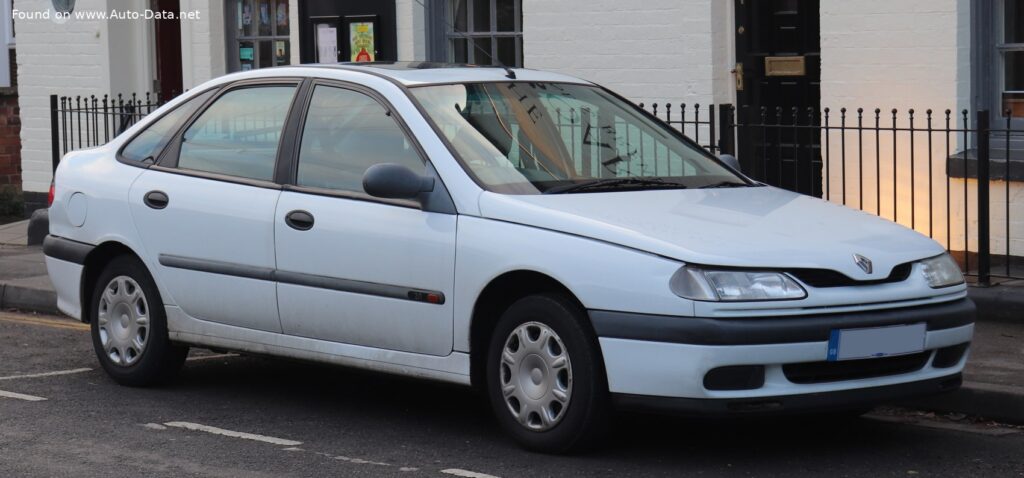
The Renault Laguna 1.8, produced between 1993 and 2000, represents Renault’s entry into the mid-size family car segment. Designed as a competitor to vehicles like the Ford Mondeo and Opel/Vauxhall Vectra, the Laguna was Renault’s first genuinely international model, intended to replace the aging Renault 18 and 20. While not initially sold in the United States due to market preferences and Renault’s limited presence there, the Laguna was a significant vehicle in Europe, offering a blend of practicality, comfort, and a relatively modern design for its time. This article details the specifications and characteristics of the 1.8-liter version, producing 90 horsepower.
Renault Laguna 1.8: Overview and Market Position
The first-generation Laguna (often referred to as the XA2 platform) marked a departure for Renault, emphasizing a more cohesive and modern design language. It was available as a five-door hatchback and, later, as a station wagon (Estate). The 1.8-liter engine was a popular choice within the Laguna range, offering a balance between fuel economy and acceptable performance for everyday driving. The Laguna aimed to provide a more sophisticated alternative to its predecessors, with a focus on interior space and comfort. It was a key model in establishing Renault as a major player in the European mid-size car market.
Engine & Performance
The Renault Laguna 1.8 is powered by a 1.8-liter (1794 cm3 or 109.48 cu. in.) inline four-cylinder gasoline engine, designated the F3P. This engine produces 90 horsepower (Hp) at 5750 rpm and 144 Newton-meters (106.21 lb.-ft.) of torque at 2750 rpm. The engine utilizes a single-point fuel injection system and an overhead camshaft (OHC) valvetrain with two valves per cylinder. While not a particularly powerful engine by modern standards, it provided adequate performance for the Laguna’s intended purpose. Acceleration from 0 to 100 km/h (0-62 mph) takes 13.9 seconds, and 0 to 60 mph is achieved in approximately 13.2 seconds. The top speed is rated at 180 km/h (111.85 mph). The engine’s power-to-weight ratio is 72.6 Hp per tonne, and the torque-to-weight ratio is 116.1 Nm per tonne. Fuel consumption is rated at 8.5 liters per 100 kilometers (27.7 US mpg or 33.2 UK mpg).
Design & Features
The Laguna 1.8 is a five-door hatchback, offering a practical and versatile body style. The design, penned under the direction of Patrick Le Quément, was characterized by smooth lines and a relatively understated aesthetic. Interior space was a key selling point, with ample room for five passengers and a generous trunk capacity ranging from 452 liters (15.96 cu. ft.) with the rear seats up to 884 liters (31.22 cu. ft.) with them folded down.
Safety features for the time included an Anti-lock Braking System (ABS) as standard equipment, a notable inclusion for a vehicle in this class during the early 1990s. The Laguna also featured hydraulic power steering and ventilated disc brakes on the front wheels, with disc brakes on the rear. The suspension system comprised a spring strut setup at the front and a torsion beam at the rear, providing a comfortable ride quality. The vehicle rides on 14-inch wheel rims with tire size 185/65 R14.
Technical Specifications
| Brand | Renault |
| Model | Laguna |
| Generation | Laguna |
| Type (Engine) | 1.8 (90 Hp) |
| Start of production | 1993 |
| End of production | 2000 |
| Powertrain Architecture | Internal Combustion engine |
| Body type | Hatchback |
| Seats | 5 |
| Doors | 5 |
| Fuel consumption (combined) | 8.5 l/100 km |
| Fuel consumption (US mpg) | 27.7 US mpg |
| Fuel consumption (UK mpg) | 33.2 UK mpg |
| Fuel Type | Petrol (Gasoline) |
| Acceleration 0 – 100 km/h | 13.9 sec |
| Acceleration 0 – 62 mph | 13.9 sec |
| Acceleration 0 – 60 mph | 13.2 sec |
| Maximum speed | 180 km/h (111.85 mph) |
| Weight-to-power ratio | 13.8 kg/Hp |
| Weight-to-torque ratio | 8.6 kg/Nm |
| Power | 90 Hp @ 5750 rpm |
| Torque | 144 Nm @ 2750 rpm (106.21 lb.-ft. @ 2750 rpm) |
| Engine layout | Front, Transverse |
| Engine Model/Code | F3P |
| Engine displacement | 1794 cm3 (109.48 cu. in.) |
| Number of cylinders | 4 |
| Engine configuration | Inline |
| Cylinder Bore | 82.7 mm (3.26 in.) |
| Piston Stroke | 83.5 mm (3.29 in.) |
| Compression ratio | 9.7:1 |
| Number of valves per cylinder | 2 |
| Fuel injection system | Single-point injection |
| Engine aspiration | Naturally aspirated |
| Valvetrain | OHC |
| Engine oil capacity | 5.3 l (5.6 US qt | 4.66 UK qt) |
| Coolant capacity | 8.5 l (8.98 US qt | 7.48 UK qt) |
| Kerb Weight | 1240 kg (2733.73 lbs.) |
| Max. weight | 1765 kg (3891.16 lbs.) |
| Max load | 525 kg (1157.43 lbs.) |
| Trunk (boot) space – minimum | 452 l (15.96 cu. ft.) |
| Trunk (boot) space – maximum | 884 l (31.22 cu. ft.) |
| Fuel tank capacity | 66 l (17.44 US gal | 14.52 UK gal) |
| Length | 4508 mm (177.48 in.) |
| Width | 1752 mm (68.98 in.) |
| Height | 1432 mm (56.38 in.) |
| Wheelbase | 2670 mm (105.12 in.) |
| Front track | 1480 mm (58.27 in.) |
| Rear track | 1472 mm (57.95 in.) |
| Drivetrain | Front wheel drive |
| Number of gears | 5 gears, manual transmission |
| Front suspension | Spring Strut |
| Rear suspension | Torsion |
| Front brakes | Ventilated discs |
| Rear brakes | Disc |
| Assisting systems | ABS (Anti-lock braking system) |
| Steering type | Steering rack and pinion |
| Power steering | Hydraulic Steering |
| Tires size | 185/65 R14 |
| Wheel rims size | 14 |
The Renault Laguna 1.8, while not a performance car, offered a compelling package of practicality, comfort, and safety for its time. It played a crucial role in Renault’s expansion in the European market and laid the groundwork for future generations of the Laguna.
