
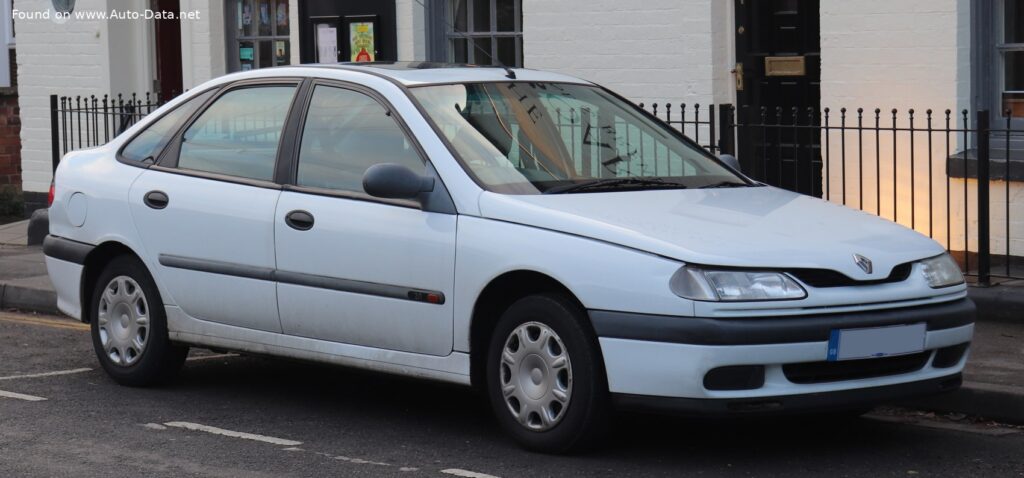
The Renault Laguna, specifically the 2.0 16V (139 Hp) variant produced between 1995 and 2000, represented a pivotal model in the European mid-size (D-segment) car market. Launched by the French automaker Renault, the first-generation Laguna succeeded the long-running Renault 21 (and the larger 25, which it partially replaced) and quickly established itself as a formidable competitor against rivals such as the Ford Mondeo, Volkswagen Passat, and Opel Vectra. While never officially sold in the United States, the Laguna was a cornerstone of Renault’s offerings in its home market and across Europe, catering to both family buyers and a significant fleet market. This particular iteration, known for its balanced performance and practical hatchback body style, embodied Renault’s commitment to comfort, safety, and efficiency for the discerning European consumer of the late 20th century.
The First Generation Renault Laguna: Engineering and Market Position
The first-generation Renault Laguna, with its production run from 1995 to 2000, was designed to be a highly versatile and appealing vehicle for the European market. Its powertrain architecture centered around an internal combustion engine, driving the front wheels, a common and efficient setup for its class. The 2.0 16V (139 Hp) model, a popular choice within the range, offered a compelling blend of everyday usability and adequate performance. The vehicle’s design emphasized aerodynamic efficiency and a contemporary aesthetic, positioning it as a modern family car that could also serve effectively as a company vehicle. Its role in the market was to provide a comfortable, safe, and reliable mode of transport, equipped with features that were considered advanced for its time.
Engine and Performance Characteristics of the Renault Laguna 2.0 16V
At the heart of the 1995-2000 Renault Laguna 2.0 16V was a robust N7Q inline-four engine, a naturally aspirated gasoline unit designed for smooth power delivery and reasonable fuel economy. With an engine displacement of 1948 cubic centimeters (approximately 118.87 cubic inches), this 16-valve powerplant generated a respectable 139 horsepower at 6000 revolutions per minute. This power output, combined with a compression ratio of 9.8:1, yielded a power-per-liter figure of 71.4 horsepower per liter, which was competitive for a mainstream naturally aspirated engine of its era. Torque peaked at 134.24 lb.-ft. (182 Nm) at 4500 rpm, providing ample pulling power for daily driving and highway cruising. The engine featured a multi-port manifold injection system and an OHC (Overhead Camshaft) valvetrain, contributing to its efficiency and responsiveness.
The Laguna 2.0 16V was paired with a 5-speed manual transmission, directing power to the front wheels. This drivetrain configuration was standard for the segment, offering drivers direct control and a balanced driving experience. Performance figures for this model were quite respectable: acceleration from 0 to 60 miles per hour was achieved in an estimated 9.3 seconds, and the vehicle could reach a maximum speed of 127.38 mph (205 km/h). These numbers placed the Laguna firmly in contention with its European rivals, offering sufficient performance for both urban environments and extended highway journeys. The weight-to-power ratio stood at 9.2 kg per horsepower, or 108.2 horsepower per tonne, indicating a well-matched engine for the vehicle’s curb weight of 2832.94 lbs (1285 kg).
Fuel efficiency, a critical consideration for European buyers, was also a strong point for the Laguna 2.0 16V. It achieved an urban fuel economy of 19.4 US mpg (12.1 l/100 km) and an extra-urban (highway) economy of 33.1 US mpg (7.1 l/100 km). These figures were commendable for a mid-size gasoline-powered vehicle of the mid-to-late 1990s, offering a practical balance between performance and running costs. The vehicle’s fuel tank capacity of 17.44 US gallons (66 liters) provided a substantial cruising range, further enhancing its suitability for long-distance travel across the continent.
Design and Features: Practicality and Safety
The Renault Laguna 2.0 16V was offered exclusively as a 5-door hatchback in this specification, a body style highly favored in Europe for its versatility and practicality. Measuring 177.56 inches (4510 mm) in length, 68.9 inches (1750 mm) in width, and 56.3 inches (1430 mm) in height, the Laguna presented a sleek yet substantial profile. Its wheelbase of 105.12 inches (2670 mm) contributed to a stable ride and a spacious cabin capable of comfortably seating five occupants. The design prioritized interior volume, offering a minimum trunk space of 15.89 cubic feet (450 liters), which could expand significantly to 47.15 cubic feet (1335 liters) with the rear seats folded down. This generous cargo capacity made the Laguna an ideal choice for families and those requiring flexible luggage solutions.
In terms of chassis and dynamics, the Laguna featured an independent front suspension utilizing spring struts, a common design for front-wheel-drive vehicles that provides a good balance of ride comfort and handling precision. The rear suspension employed a torsion beam setup, a cost-effective and space-saving solution that also contributed to the car’s practical load-carrying abilities. Braking performance was handled by disc brakes on both the front and rear axles, augmented by an Anti-lock Braking System (ABS), which was a significant safety enhancement for mainstream vehicles in the mid-1990s. The steering system was a hydraulic rack and pinion setup, providing direct and communicative feedback to the driver, typical of European cars of the period. The vehicle rode on 195/60 R15 tires mounted on 15-inch wheel rims, offering a comfortable ride and predictable grip.
Beyond its mechanical specifications, the Laguna represented Renault’s growing emphasis on passive and active safety. While specific airbag counts are not detailed, the inclusion of ABS as a standard assisting system underscored a commitment to driver and passenger protection. The overall design language also focused on occupant comfort, with thoughtful interior ergonomics and materials designed to withstand the rigors of daily family use. The Laguna’s appeal lay not just in its performance, but in its holistic package of safety, practicality, and comfort, making it a highly competitive and respected vehicle in its market segment throughout its production run.
Technical Specifications: Renault Laguna 2.0 16V (139 Hp)
| Brand | Renault |
| Model | Laguna |
| Generation | Laguna (First Generation) |
| Type (Engine) | 2.0 16V (139 Hp) |
| Start of production | 1995 year |
| End of production | 2000 year |
| Powertrain Architecture | Internal Combustion Engine |
| Body type | Hatchback |
| Seats | 5 |
| Doors | 5 |
| Fuel consumption (economy) – urban | 19.4 US mpg (12.1 l/100 km) |
| Fuel consumption (economy) – extra urban | 33.1 US mpg (7.1 l/100 km) |
| Fuel Type | Petrol (Gasoline) |
| Acceleration 0 – 60 mph | 9.3 sec |
| Maximum speed | 127.38 mph (205 km/h) |
| Power | 139 Hp @ 6000 rpm |
| Power per liter | 71.4 Hp/l |
| Torque | 134.24 lb.-ft. @ 4500 rpm (182 Nm) |
| Engine layout | Front, Transverse |
| Engine Model/Code | N7Q |
| Engine displacement | 118.87 cu. in. (1948 cm3) |
| Number of cylinders | 4 |
| Engine configuration | Inline |
| Cylinder Bore | 3.27 in. (83 mm) |
| Piston Stroke | 3.54 in. (90 mm) |
| Compression ratio | 9.8:1 |
| Number of valves per cylinder | 4 |
| Fuel injection system | Multi-port manifold injection |
| Engine aspiration | Naturally aspirated engine |
| Valvetrain | OHC |
| Engine oil capacity | 6.23 US qt (5.9 l) |
| Engine oil specification | Not specified in data provided |
| Coolant | 8.45 US qt (8 l) |
| Kerb Weight | 2832.94 lbs (1285 kg) |
| Max. weight | 4166.74 lbs (1890 kg) |
| Max load | 1333.8 lbs (605 kg) |
| Trunk (boot) space – minimum | 15.89 cu. ft. (450 l) |
| Trunk (boot) space – maximum | 47.15 cu. ft. (1335 l) |
| Fuel tank capacity | 17.44 US gal (66 l) |
| Length | 177.56 in. (4510 mm) |
| Width | 68.9 in. (1750 mm) |
| Height | 56.3 in. (1430 mm) |
| Wheelbase | 105.12 in. (2670 mm) |
| Front track | 58.27 in. (1480 mm) |
| Rear (Back) track | 57.48 in. (1460 mm) |
| Drivetrain Architecture | The Internal Combustion Engine (ICE) drives the front wheels of the vehicle. |
| Drive wheel | Front wheel drive |
| Number of gears and type of gearbox | 5 gears, manual transmission |
| Front suspension | Spring Strut |
| Rear suspension | Torsion |
| Front brakes | Disc |
| Rear brakes | Disc |
| Assisting systems | ABS (Anti-lock braking system) |
| Steering type | Steering rack and pinion |
| Power steering | Hydraulic Steering |
| Tires size | 195/60 R15 |
| Wheel rims size | 15 |
