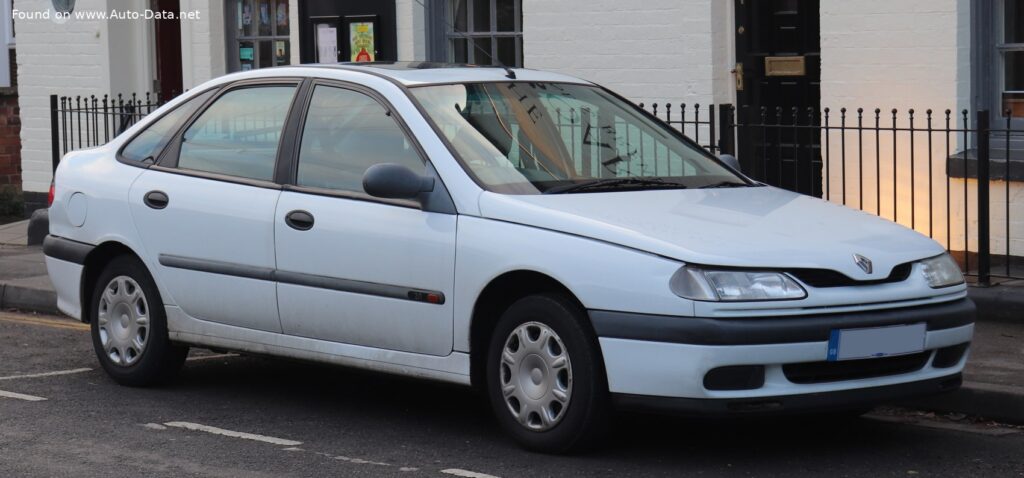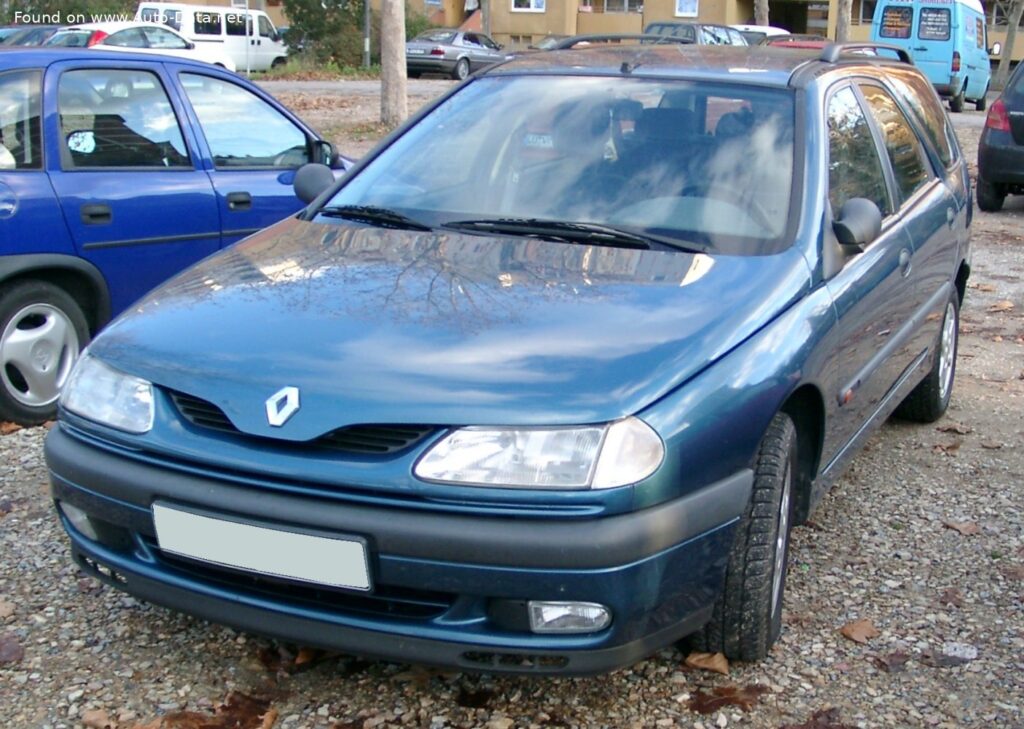
The Renault Laguna Grandtour 1.6 i 16V (107 Hp) emerged as a compelling contender in the highly competitive European mid-size family car segment during its production run from 1997 to 2000. Representing a key variant within the first-generation Laguna Grandtour lineup, this model was specifically tailored to meet the demands of European consumers seeking a blend of practicality, comfort, and modest performance in a station wagon format. While never officially sold in the United States, its design and engineering philosophy provide valuable insights into the automotive trends and consumer priorities prevalent in Europe at the turn of the millennium. The Laguna Grandtour, with its expansive cargo capacity and family-oriented features, epitomized the versatile estate car, a body style that held significant cultural and functional importance across the continent. This particular iteration, powered by its 1.6-liter 16-valve engine, offered a balanced proposition of fuel efficiency and adequate power for daily driving, establishing itself as a sensible choice for families and professionals alike.
Engineering and Performance of the Laguna Grandtour
At the heart of the Renault Laguna Grandtour 1.6 i 16V (107 Hp) lay the K4M engine, a robust and widely utilized 1.6-liter (1598 cm3 or 97.52 cu. in.) inline four-cylinder powerplant. This naturally aspirated unit featured a DOHC (Double Overhead Camshaft) valvetrain with four valves per cylinder, a configuration that was becoming standard for optimizing both power output and fuel efficiency in the late 1990s. With a compression ratio of 10:1 and a multi-port manifold injection system, the engine was designed for smooth power delivery and reliable operation using regular gasoline. It produced a respectable 107 horsepower at 5750 rpm, providing a lively character for its displacement. Torque figures stood at 148 Nm, or approximately 109.16 lb.-ft., peaking at 3750 rpm, ensuring sufficient pulling power for daily commutes and light loads.
Power was delivered to the front wheels via a five-speed manual transmission, a common and efficient setup for vehicles in this class. This drivetrain architecture, with the engine mounted transversely at the front, was a proven method for maximizing interior space and manufacturing cost-effectiveness. The performance metrics for the Laguna Grandtour 1.6 i 16V (107 Hp) were well-suited for its intended purpose. It could accelerate from 0 to 60 mph in a calculated 11.3 seconds, reaching a maximum speed of 116.2 mph (187 km/h). While not a performance-oriented vehicle, these figures demonstrated its capability to handle highway speeds and provide confident overtaking maneuvers. The vehicle’s weight-to-power ratio of 12 kg/Hp (approximately 83.6 Hp per tonne) further underscored its practical rather than sporty nature.
Fuel Economy and Drivability
Fuel efficiency was a significant consideration for European buyers, and the Laguna Grandtour 1.6 i 16V (107 Hp) delivered competitive figures for its era. The combined fuel economy was rated at 7 liters per 100 kilometers, translating to an impressive 33.6 US mpg. In urban driving conditions, it achieved 10.3 l/100 km (22.8 US mpg), while extra-urban cruising saw figures as low as 6.2 l/100 km (37.9 US mpg). These numbers, combined with a 17.44 US gallon (66-liter) fuel tank capacity, ensured a practical driving range, making it suitable for long family trips across Europe. The vehicle’s front suspension utilized a wishbone design, paired with a torsion beam rear suspension, a setup that balanced ride comfort with predictable handling. Braking was handled by ventilated discs at the front and traditional drum brakes at the rear, augmented by an Anti-lock Braking System (ABS) for enhanced safety during emergency stops. The hydraulic power steering, employing a rack and pinion system, offered a comfortable and responsive driving experience, typical of European family cars.
Design and Features of the Renault Laguna Grandtour
The Renault Laguna Grandtour’s design prioritized functionality and spaciousness, hallmarks of a successful European station wagon. Its five-door, five-seat configuration made it an ideal family vehicle, offering easy access for passengers and versatile cargo solutions. With an overall length of 181.89 inches (4620 mm), a width of 68.9 inches (1750 mm), and a height of 57.09 inches (1450 mm), the Laguna Grandtour presented a substantial yet manageable footprint for both city driving and highway travel. The generous 105.12-inch (2670 mm) wheelbase contributed significantly to interior volume and ride stability, providing ample legroom for rear passengers, a crucial aspect for long journeys.
A defining characteristic of the Grandtour variant was its exceptional cargo capacity. The minimum trunk space of 890 liters (31.43 cu. ft.) was already impressive, easily accommodating luggage for a family vacation or a substantial grocery run. When the rear seats were folded down, this expanded to a cavernous 1850 liters (65.33 cu. ft.), transforming the vehicle into a highly capable utility hauler. This versatility was key to its appeal in markets where station wagons were often seen as a practical alternative to SUVs. The design of the Laguna Grandtour, while not overtly flashy, was clean and aerodynamic, reflecting Renault’s contemporary styling cues of the late 1990s. The 185/65 R14 tires on 14-inch wheel rims provided a comfortable ride and contributed to the vehicle’s stable demeanor.
Safety and Practicality
Safety features for the Laguna Grandtour 1.6 i 16V (107 Hp) included the aforementioned ABS, a critical active safety system for preventing wheel lock-up during hard braking. While specific passive safety features like airbags are not detailed in the provided data, a vehicle of this segment and era would typically include front airbags as standard or optional equipment in European markets. The robust body structure and thoughtful engineering were aimed at protecting occupants in the event of a collision. The maximum load capacity of 1366.87 lbs (620 kg) and a gross vehicle weight of 4188.78 lbs (1900 kg) highlighted its ability to carry passengers and cargo without compromising structural integrity or driving dynamics. Overall, the Renault Laguna Grandtour 1.6 i 16V (107 Hp) stood as a testament to practical European automotive design, offering a sensible, spacious, and efficient solution for family transportation, even if its presence was primarily confined to markets outside of North America.
Technical Specifications
| Brand | Renault |
| Model | Laguna |
| Generation | Laguna Grandtour |
| Type (Engine) | 1.6 i 16V (107 Hp) |
| Start of production | 1997 year |
| End of production | 2000 year |
| Powertrain Architecture | Internal Combustion engine |
| Body type | Station wagon (estate) |
| Seats | 5 |
| Doors | 5 |
| Fuel consumption (economy) – urban | 10.3 l/100 km (22.8 US mpg) |
| Fuel consumption (economy) – extra urban | 6.2 l/100 km (37.9 US mpg) |
| Fuel consumption (economy) – combined | 7 l/100 km (33.6 US mpg) |
| Fuel Type | Petrol (Gasoline) |
| Acceleration 0 – 60 mph | 11.3 sec |
| Acceleration 0 – 100 km/h | 11.9 sec |
| Maximum speed | 187 km/h (116.2 mph) |
| Weight-to-power ratio | 12 kg/Hp (83.6 Hp/tonne) |
| Weight-to-torque ratio | 8.6 kg/Nm (115.6 Nm/tonne) |
| Power | 107 Hp @ 5750 rpm |
| Power per litre | 67 Hp/l |
| Torque | 148 Nm @ 3750 rpm (109.16 lb.-ft. @ 3750 rpm) |
| Engine layout | Front, Transverse |
| Engine Model/Code | K4M |
| Engine displacement | 1598 cm3 (97.52 cu. in.) |
| Number of cylinders | 4 |
| Engine configuration | Inline |
| Cylinder Bore | 79.5 mm (3.13 in.) |
| Piston Stroke | 80.5 mm (3.17 in.) |
| Compression ratio | 10:1 |
| Number of valves per cylinder | 4 |
| Fuel injection system | Multi-port manifold injection |
| Engine aspiration | Naturally aspirated engine |
| Valvetrain | DOHC |
| Engine oil capacity | 4.8 l (5.07 US qt) |
| Coolant | 6.2 l (6.55 US qt) |
| Kerb Weight | 1280 kg (2821.92 lbs.) |
| Max. weight | 1900 kg (4188.78 lbs.) |
| Max load | 620 kg (1366.87 lbs.) |
| Trunk (boot) space – minimum | 890 l (31.43 cu. ft.) |
| Trunk (boot) space – maximum | 1850 l (65.33 cu. ft.) |
| Fuel tank capacity | 66 l (17.44 US gal) |
| Length | 4620 mm (181.89 in.) |
| Width | 1750 mm (68.9 in.) |
| Height | 1450 mm (57.09 in.) |
| Wheelbase | 2670 mm (105.12 in.) |
| Front track | 1480 mm (58.27 in.) |
| Rear (Back) track | 1460 mm (57.48 in.) |
| Drivetrain Architecture | The Internal combustion engine (ICE) drives the front wheels of the vehicle. |
| Drive wheel | Front wheel drive |
| Number of gears and type of gearbox | 5 gears, manual transmission |
| Front suspension | Wishbone |
| Rear suspension | Torsion |
| Front brakes | Ventilated discs |
| Rear brakes | Drum |
| Assisting systems | ABS (Anti-lock braking system) |
| Steering type | Steering rack and pinion |
| Power steering | Hydraulic Steering |
| Tires size | 185/65 R14 |
| Wheel rims size | 14 |