
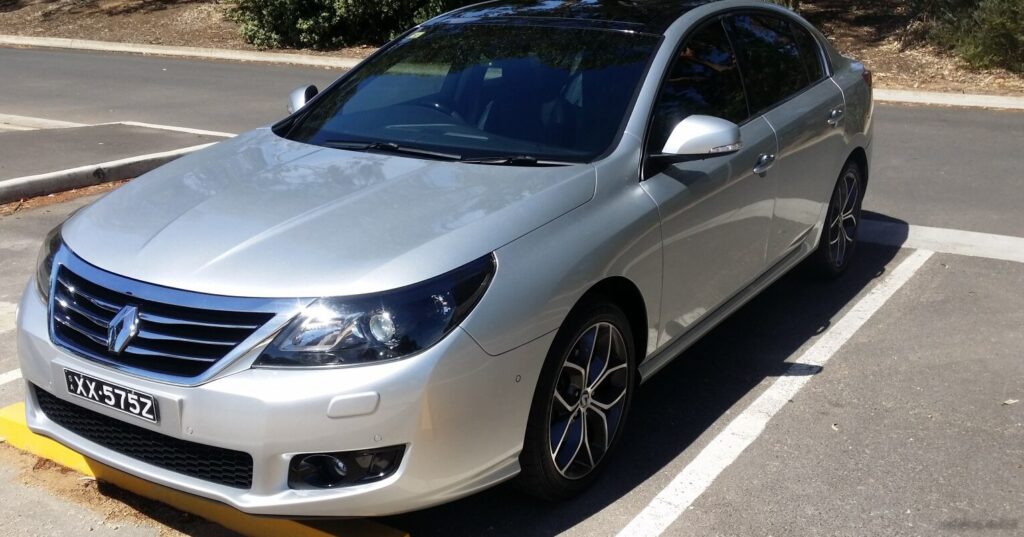
The Renault Latitude 2.0 16V, produced between 2010 and 2013, was Renault’s entry into the mid-size sedan segment, primarily aimed at the European market. Positioned as a more upscale offering than the Megane Sedan, the Latitude sought to compete with established players like the Ford Mondeo and Volkswagen Passat. This particular variant, powered by the 2.0-liter 16-valve engine producing 140 horsepower, represented a balance between performance and fuel efficiency within the Latitude lineup. It served as a core model, offering a more accessible price point compared to the higher-trim diesel options.
Technical Specifications
| Brand | Renault |
| Model | Latitude |
| Generation | Latitude |
| Type (Engine) | 2.0 16V (140 Hp) |
| Start of production | 2010 |
| End of production | 2013 |
| Powertrain Architecture | Internal Combustion engine |
| Body type | Sedan |
| Seats | 5 |
| Doors | 4 |
| Fuel consumption (urban) | 10.9 l/100 km (21.6 US mpg) |
| Fuel consumption (extra urban) | 6.3 l/100 km (37.3 US mpg) |
| Fuel consumption (combined) | 7.9 l/100 km (29.8 US mpg) |
| Fuel Type | Petrol (Gasoline) |
| Acceleration 0 – 100 km/h | 9.3 sec |
| Acceleration 0 – 62 mph | 9.3 sec |
| Acceleration 0 – 60 mph | 8.8 sec |
| Maximum speed | 205 km/h (127.38 mph) |
| Emission standard | Euro 5 |
| Weight-to-power ratio | 10.2 kg/Hp |
| Weight-to-torque ratio | 7.3 kg/Nm |
| Power | 140 Hp @ 6000 rpm |
| Torque | 195 Nm @ 3750 rpm (143.82 lb.-ft. @ 3750 rpm) |
| Engine layout | Front, Transverse |
| Engine Model/Code | M4R |
| Engine displacement | 1998 cm3 (121.93 cu. in.) |
| Number of cylinders | 4 |
| Engine configuration | Inline |
| Cylinder Bore | 84 mm (3.31 in.) |
| Piston Stroke | 90.1 mm (3.55 in.) |
| Number of valves per cylinder | 4 |
| Fuel injection system | Multi-port manifold injection |
| Engine aspiration | Naturally aspirated engine |
| Engine oil capacity | 4.8 l (5.07 US qt | 4.22 UK qt) |
| Coolant capacity | 7.2 l (7.61 US qt | 6.34 UK qt) |
| Kerb Weight | 1425 kg (3141.59 lbs.) |
| Max. weight | 2020 kg (4453.34 lbs.) |
| Max load | 595 kg (1311.75 lbs.) |
| Trunk (boot) space – minimum | 477 l (16.85 cu. ft.) |
| Fuel tank capacity | 70 l (18.49 US gal | 15.4 UK gal) |
| Length | 4897 mm (192.8 in.) |
| Width | 1832 mm (72.13 in.) |
| Height | 1483 mm (58.39 in.) |
| Wheelbase | 2762 mm (108.74 in.) |
| Front track | 1565 mm (61.61 in.) |
| Rear track | 1565 mm (61.61 in.) |
| Drivetrain Architecture | Front wheel drive |
| Number of gears | 6 gears, manual transmission |
| Front suspension | Independent type McPherson |
| Rear suspension | Independent multi-link suspension |
| Front brakes | Ventilated discs |
| Rear brakes | Disc |
| Assisting systems | ABS (Anti-lock braking system) |
| Steering type | Steering rack and pinion |
| Power steering | Electric Steering |
| Tires size | 225/50 R17 |
| Wheel rims size | 17 |
Powertrain & Engine Architecture
The Renault Latitude 2.0 16V utilizes the M4R engine, a 1.998-liter inline-four cylinder gasoline engine. This engine, a product of Renault’s engineering, features a double overhead camshaft (DOHC) design with four valves per cylinder. The engine employs multi-point fuel injection, delivering fuel directly into the intake ports. The 140 horsepower output is achieved at 6000 rpm, while peak torque of 195 Nm (143.82 lb-ft) is available at 3750 rpm. The engine is transversely mounted in the front of the vehicle. The six-speed manual transmission was standard for this variant, providing a relatively direct connection between the engine and the front wheels. The transmission’s gear ratios were tuned for a balance of acceleration and fuel economy, though it wasn’t particularly sporty in its delivery.
Driving Characteristics
The Latitude 2.0 16V offered a comfortable, rather than exhilarating, driving experience. Acceleration from 0-100 km/h (0-62 mph) took approximately 9.3 seconds. The engine provided adequate power for everyday driving situations, but it lacked the punch of the available diesel engines or the more powerful gasoline options. The manual transmission, while precise, didn’t offer particularly short throws. The gear ratios were spaced to prioritize fuel efficiency, meaning the engine often needed to be revved to access its full potential. Compared to the diesel variants, the 2.0L felt less responsive at lower speeds, requiring more downshifting for overtaking maneuvers. The suspension, tuned for comfort, absorbed bumps well but didn’t provide a particularly engaging handling experience.
Equipment & Trim Levels
The 2.0 16V Latitude typically came equipped with a respectable level of standard features. These included air conditioning, power windows, power mirrors, a CD player with auxiliary input, and ABS brakes. Higher trim levels, often denoted by additions like “Expression” or “Dynamique”, added features such as alloy wheels, automatic climate control, a more advanced audio system, and parking sensors. Interior upholstery was typically cloth, with options for leather available on higher trims. Optional extras included a navigation system, sunroof, and upgraded sound systems.
Chassis & Braking
The Latitude utilized a McPherson strut front suspension and a multi-link rear suspension, providing a comfortable ride quality. The front brakes were ventilated discs, offering good stopping power, while the rear brakes were solid discs. ABS (Anti-lock Braking System) was standard. The Latitude’s chassis was designed to prioritize comfort and refinement over sporty handling. Stabilizer bars were fitted to both the front and rear axles to reduce body roll, but the overall setup was geared towards a smooth and predictable driving experience.
Market Reception & Comparison
The Renault Latitude 2.0 16V received mixed reviews. Critics generally praised its comfortable ride, spacious interior, and good level of standard equipment. However, the 2.0-liter engine was often criticized for being underpowered compared to its competitors, particularly the diesel options. Fuel economy was respectable, but not class-leading. Compared to the diesel variants, the 2.0L offered lower running costs in terms of fuel, but potentially higher maintenance costs due to the complexities of the gasoline engine. The manual transmission was seen as a positive by some, but others preferred the convenience of an automatic.
Legacy
The Renault Latitude, while not a massive sales success, offered a comfortable and well-equipped option in the mid-size sedan segment. The M4R engine, while not known for exceptional reliability, proved to be generally durable with proper maintenance. On the used car market, the 2.0 16V variant represents an affordable entry point into Latitude ownership. Potential buyers should be aware of the typical maintenance requirements for a gasoline engine of this era, including regular oil changes and timing belt replacements. The Latitude’s comfortable ride and spacious interior continue to appeal to buyers seeking a practical and refined sedan.
