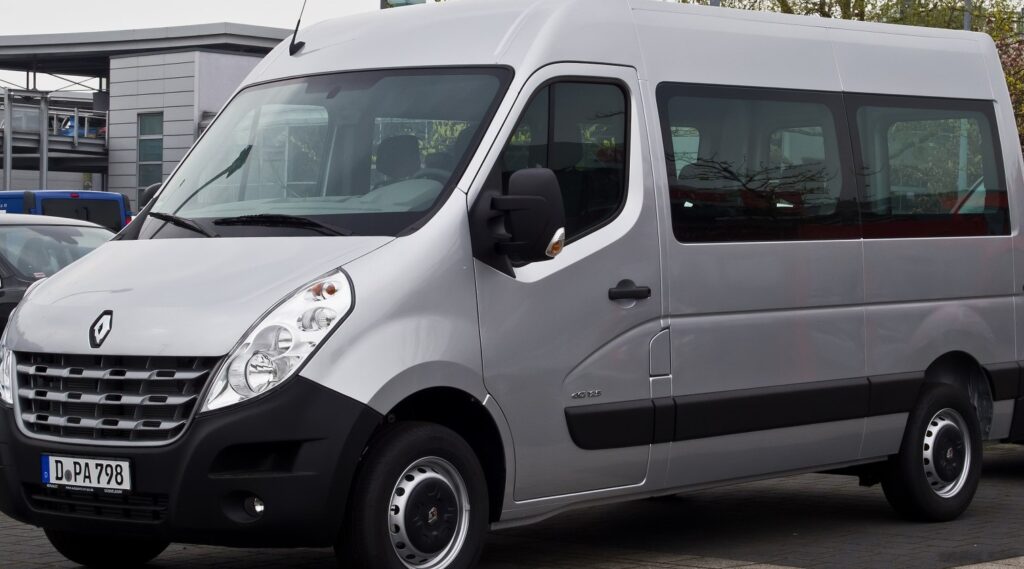
Technical Specifications
| Brand | Renault |
| Model | Master |
| Generation | Master III (Phase II, 2014) Bus |
| Type (Engine) | 2.3 dCi (125 Hp) |
| Start of production | 2014 |
| End of production | 2017 |
| Powertrain Architecture | Internal Combustion engine |
| Body type | MPV |
| Seats | 17 |
| Doors | 4 |
| Fuel consumption (urban) | 9.9 l/100 km (23.8 US mpg, 28.5 UK mpg, 10.1 km/l) |
| Fuel consumption (extra urban) | 7 l/100 km (33.6 US mpg, 40.4 UK mpg, 14.3 km/l) |
| Fuel consumption (combined) | 8.1 l/100 km (29 US mpg, 34.9 UK mpg, 12.3 km/l) |
| CO2 emissions | 212 g/km |
| Fuel Type | Diesel |
| Maximum speed | 100 km/h (62.14 mph) |
| Emission standard | Euro 5 |
| Power | 125 Hp @ 3500 rpm |
| Power per litre | 54.4 Hp/l |
| Torque | 310 Nm @ 1500 rpm (228.64 lb.-ft. @ 1500 rpm) |
| Engine Model/Code | M9T |
| Engine displacement | 2298 cm3 (140.23 cu. in.) |
| Number of cylinders | 4 |
| Engine configuration | Inline |
| Number of valves per cylinder | 4 |
| Fuel injection system | Diesel Commonrail |
| Engine aspiration | Turbocharger, Intercooler |
| Engine oil capacity | 8 l (8.45 US qt | 7.04 UK qt) |
| Coolant | 11 l (11.62 US qt | 9.68 UK qt) |
| Max. weight | 3870 kg (8531.89 lbs.) |
| Fuel tank capacity | 80 l (21.13 US gal | 17.6 UK gal) |
| Length | 6198 mm (244.02 in.) |
| Width | 2070 mm (81.5 in.) |
| Width including mirrors | 2470 mm (97.24 in.) |
| Height | 2488 mm (97.95 in.) |
| Wheelbase | 4332 mm (170.55 in.) |
| Front track | 1750 mm (68.9 in.) |
| Rear track | 1730 mm (68.11 in.) |
| Front overhang | 842 mm (33.15 in.) |
| Rear overhang | 1024 mm (40.31 in.) |
| Ride height (ground clearance) | 173 mm (6.81 in.) |
| Minimum turning circle | 15.7 m (51.51 ft.) |
| Drivetrain | Front wheel drive |
| Number of gears | 6 gears, manual transmission |
| Front brakes | Ventilated discs, 302 mm |
| Rear brakes | Disc, 305 mm |
| Tires size | 225/65 R16 |
| Wheel rims size | 16 |
The Renault Master III (Phase II), specifically the 2.3 dCi 125 horsepower bus variant produced between 2014 and 2017, represents a significant iteration of Renault’s large van and bus platform. Positioned as a workhorse vehicle for commercial and passenger transport, this version of the Master catered to operators needing a balance of capacity, fuel efficiency, and moderate performance. It falls within the third generation of the Master (X72), which was originally launched in 2010 and received a facelift in 2014, designated as Phase II. This particular configuration, with its 2.3-liter diesel engine and 125 hp output, was a popular choice for shuttle services, school transport, and general-purpose bus applications across Europe and other international markets.
Powertrain & Engine Architecture
The heart of this Master variant is the Renault M9T 2.3-liter inline-four cylinder diesel engine. This engine is a member of Renault’s dCi (Diesel Common Injection) family, utilizing a common rail direct injection system for optimized fuel delivery and combustion. The M9T benefits from a turbocharger with an intercooler, which enhances power output and efficiency by increasing air density entering the engine. The engine produces 125 horsepower at 3500 rpm and a respectable 310 Nm (228.64 lb.-ft.) of torque at just 1500 rpm, providing ample low-end grunt for hauling passengers and cargo. The engine features four valves per cylinder, contributing to improved breathing and overall performance. The transmission is a six-speed manual gearbox, chosen for its durability and cost-effectiveness in commercial applications. While an automated manual transmission (AMT) was available on some Master models, the six-speed manual was the most common pairing for the 125 hp engine.
Driving Characteristics
The 125 hp 2.3 dCi engine, coupled with the six-speed manual transmission, delivers a driving experience geared towards practicality rather than outright performance. Acceleration is adequate for most situations, but the van’s substantial weight and size limit its responsiveness. The engine’s strong low-end torque makes it well-suited for navigating urban environments and tackling inclines, even when fully loaded. The gear ratios are spaced to prioritize fuel economy and drivability, with a relatively tall sixth gear for comfortable highway cruising. Compared to higher-output versions of the 2.3 dCi (such as the 150 hp variant), this configuration offers less power but improved fuel efficiency. It also feels less strained during prolonged periods of heavy use. Compared to the 2.5 dCi engine available in earlier Master generations, the M9T offers improved refinement and reduced emissions.
Equipment & Trim Levels
The Master III Phase II bus, in its 125 hp configuration, typically came with a functional, rather than luxurious, equipment list. Standard features generally included power steering, a driver’s airbag, ABS brakes, and basic instrumentation. The interior was typically finished with durable, easy-to-clean materials. Seating arrangements varied depending on the specific application, with configurations ranging from school bus-style bench seats to more comfortable passenger seats with individual headrests. Optional extras included air conditioning, a radio/CD player, electric windows, and a passenger-side airbag. Higher trim levels might have offered features like cruise control and a trip computer, but these were less common on the base 125 hp model.
Chassis & Braking
The Master III utilizes a front-wheel-drive layout with a reinforced chassis designed to handle the stresses of commercial use. The suspension consists of independent coil springs at the front and leaf springs at the rear. The rear leaf springs are chosen for their load-carrying capacity. Braking is handled by ventilated discs on the front wheels and solid discs on the rear. ABS (Anti-lock Braking System) is standard. The steering is hydraulic power-assisted, providing reasonable maneuverability despite the van’s size. Stabilizer bars are fitted to both the front and rear axles to reduce body roll during cornering.
Market Reception & Comparison
The Renault Master III 2.3 dCi 125 hp bus was generally well-received in the commercial vehicle market. Critics praised its fuel efficiency, reliability, and practicality. However, some noted that the engine could feel underpowered when fully loaded or when tackling steep hills. Compared to competitors like the Fiat Ducato and Mercedes-Benz Sprinter, the Master offered a competitive price point and a good balance of features. The 125 hp version was often seen as a cost-effective option for operators who didn’t require the extra power of the higher-output engines. Fuel economy figures of around 8.1 l/100 km (29 US mpg) were considered respectable for a vehicle of this size and weight.
Legacy
The Renault Master III, including the 2.3 dCi 125 hp variant, has proven to be a durable and reliable workhorse. The M9T engine, while not without its quirks, is generally considered to be a robust unit capable of high mileage with proper maintenance. On the used car market, these vans remain popular due to their affordability and practicality. Common issues include wear and tear on suspension components, turbocharger failures (particularly if not properly maintained), and occasional problems with the fuel injection system. However, spare parts are readily available, and the van’s relatively simple construction makes it relatively easy to repair. The Master III continues to be a common sight on roads across Europe and beyond, a testament to its enduring appeal as a versatile and dependable commercial vehicle.