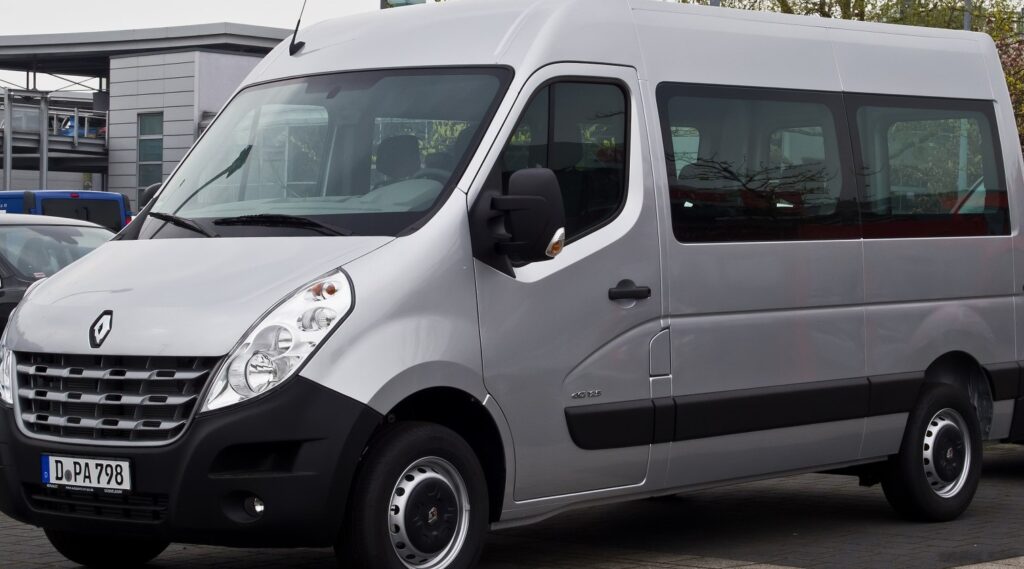
The Renault Master III (Phase II), specifically the 2.3 dCi 150 horsepower bus variant produced from 2014 to 2015, represents a significant iteration of Renault’s large van and bus platform. Positioned as a versatile option within the Master III range, this model catered to businesses and organizations requiring substantial passenger or cargo capacity. It was a key player in the European commercial vehicle market, offering a balance between performance, economy, and practicality. This version sat in the mid-range of the Master III lineup, offering a step up in power and refinement compared to lower-powered engines, while remaining more affordable than the highest-output options.
Technical Specifications
| Brand | Renault |
| Model | Master |
| Generation | Master III (Phase II, 2014) Bus |
| Type (Engine) | 2.3 dCi (150 Hp) |
| Start of production | 2014 |
| End of production | 2015 |
| Powertrain Architecture | Internal Combustion engine |
| Body type | MPV |
| Seats | 17 |
| Doors | 4 |
| Fuel consumption (urban) | 9.9 l/100 km (23.8 US mpg, 28.5 UK mpg, 10.1 km/l) |
| Fuel consumption (extra urban) | 7 l/100 km (33.6 US mpg, 40.4 UK mpg, 14.3 km/l) |
| Fuel consumption (combined) | 8.1 l/100 km (29 US mpg, 34.9 UK mpg, 12.3 km/l) |
| CO2 emissions | 212 g/km |
| Fuel Type | Diesel |
| Maximum speed | 100 km/h (62.14 mph) |
| Emission standard | Euro 5 |
| Weight-to-power ratio | 18.1 kg/Hp, 55.2 Hp/tonne |
| Weight-to-torque ratio | 7.8 kg/Nm, 128.8 Nm/tonne |
| Power | 150 Hp @ 3500 rpm |
| Power per litre | 65.3 Hp/l |
| Torque | 350 Nm @ 1500-2750 rpm (258.15 lb.-ft. @ 1500-2750 rpm) |
| Engine Model/Code | M9T |
| Engine displacement | 2298 cm3 (140.23 cu. in.) |
| Number of cylinders | 4 |
| Engine configuration | Inline |
| Number of valves per cylinder | 4 |
| Fuel injection system | Diesel Commonrail |
| Engine aspiration | Turbocharger, Intercooler |
| Engine oil capacity | 8 l (8.45 US qt | 7.04 UK qt) |
| Coolant capacity | 11 l (11.62 US qt | 9.68 UK qt) |
| Kerb Weight | 2718 kg (5992.16 lbs.) |
| Max. weight | 3870 kg (8531.89 lbs.) |
| Max load | 1152 kg (2539.73 lbs.) |
| Fuel tank capacity | 80 l (21.13 US gal | 17.6 UK gal) |
| Length | 6198 mm (244.02 in.) |
| Width | 2070 mm (81.5 in.) |
| Width including mirrors | 2470 mm (97.24 in.) |
| Height | 2488 mm (97.95 in.) |
| Wheelbase | 4332 mm (170.55 in.) |
| Front track | 1750 mm (68.9 in.) |
| Rear track | 1730 mm (68.11 in.) |
| Front overhang | 842 mm (33.15 in.) |
| Rear overhang | 1024 mm (40.31 in.) |
| Ride height (ground clearance) | 173 mm (6.81 in.) |
| Minimum turning circle | 15.7 m (51.51 ft.) |
| Drivetrain | Front wheel drive |
| Number of gears | 6 |
| Gearbox type | Manual transmission |
| Front brakes | Ventilated discs, 302 mm |
| Rear brakes | Disc, 305 mm |
| Tires size | 225/65 R16 |
| Wheel rims size | 16 |
Powertrain & Engine Architecture
The heart of this Master III variant is the Renault M9T 2.3 dCi engine. This is a four-cylinder, inline diesel engine utilizing common rail direct injection and a turbocharger with intercooling. The M9T engine family was a workhorse for Renault, known for its durability and relatively good fuel efficiency. The 2.3-liter displacement provides a good balance between power and economy for a vehicle of this size. The engine produces 150 horsepower at 3500 rpm and a substantial 350 Nm (258 lb-ft) of torque between 1500 and 2750 rpm. This broad torque band is particularly beneficial for a van designed to carry heavy loads. The engine meets Euro 5 emission standards, incorporating a diesel particulate filter (DPF) to reduce particulate matter emissions. The 6-speed manual transmission was the standard offering, providing a good spread of gears for both urban driving and highway cruising.
Driving Characteristics
The 150 hp 2.3 dCi engine, paired with the 6-speed manual gearbox, delivers adequate performance for most commercial applications. While not a sports van, it provides sufficient power for fully loaded operation. Acceleration is modest, but the strong low-end torque makes it easy to manage in city traffic and when climbing hills. The gear ratios are well-chosen, allowing the engine to operate efficiently at cruising speeds. Compared to the lower-powered 125 hp version, the 150 hp model offers a noticeable improvement in responsiveness and overall drivability, especially when carrying a full load. Compared to higher-output versions, it lacks the outright punch for rapid acceleration, but it offers a better balance of performance and fuel economy.
Equipment & Trim Levels
The Master III Phase II Bus 2.3 dCi (150 Hp) typically came with a functional, rather than luxurious, interior. Standard equipment included a driver’s airbag, ABS brakes, power steering, and a basic audio system. The interior trim was typically durable and practical, with hard-wearing plastics and cloth upholstery. Optional extras included air conditioning, a passenger airbag, cruise control, and upgraded audio systems. The bus configuration featured seating for up to 17 passengers, depending on the specific layout. The dashboard layout was straightforward and functional, prioritizing ease of use for the driver.
Chassis & Braking
The Master III utilizes a front-wheel-drive layout with independent suspension at the front and a leaf spring suspension at the rear. The front suspension consists of MacPherson struts, while the rear utilizes a robust leaf spring setup designed to handle heavy loads. Braking is provided by ventilated discs at the front and solid discs at the rear. ABS (Anti-lock Braking System) is standard. The suspension is tuned for comfort and stability, providing a reasonably smooth ride even when the vehicle is fully loaded. The front track is 1750mm and the rear track is 1730mm.
Market Reception & Comparison
The Renault Master III 2.3 dCi (150 Hp) was generally well-received by critics and operators. It was praised for its practicality, reliability, and relatively low running costs. Fuel economy was considered competitive for a vehicle of its size and weight, averaging around 29 US mpg in combined driving. Compared to other vans in its class, such as the Mercedes-Benz Sprinter and the Volkswagen Crafter, the Master offered a good value proposition, providing a similar level of functionality at a lower price point. The 150 hp engine was seen as a sweet spot in the range, offering a good balance between performance and economy.
Legacy
The Renault Master III, including the 2.3 dCi 150 hp variant, has proven to be a durable and reliable workhorse. The M9T engine, while not without its quirks, is generally considered to be a robust unit. In the used car market, these vans remain popular due to their affordability and practicality. Common issues include wear and tear on the turbocharger and potential problems with the DPF, particularly if the vehicle has been primarily used for short journeys. However, with regular maintenance, these vans can provide many years of reliable service. The Master III laid the groundwork for the current generation Master, continuing Renault’s legacy in the large van and bus segment.