
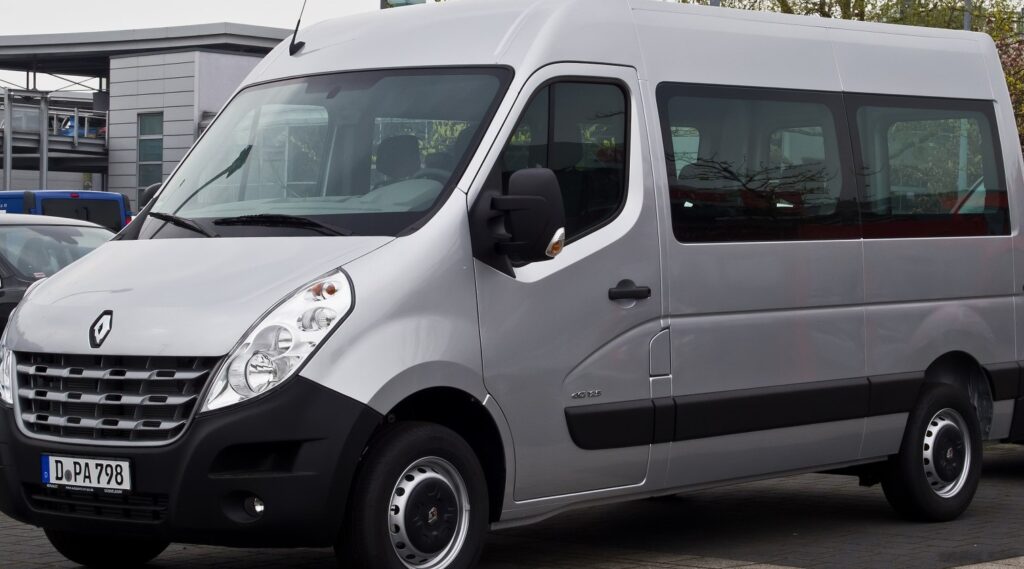
The Renault Master III (Phase II), specifically the Combi 2.3 dCi variant with 125 horsepower, was a popular choice in the European commercial vehicle market from 2014 to 2017. Positioned as a versatile passenger and cargo carrier, this version of the Master catered to businesses and families requiring substantial space and seating capacity. The “L2H2” designation refers to the vehicle’s length and roof height, indicating a medium-length wheelbase and a high roof, maximizing interior volume. This particular configuration, equipped with a 2.3-liter diesel engine and a six-speed manual transmission, offered a balance between fuel efficiency, practicality, and affordability within the broader Master III lineup.
Technical Specifications
| Brand | Renault |
| Model | Master |
| Generation | Master III (Phase II, 2014) Combi |
| Type (Engine) | 2.3 dCi (125 Hp) L2H2 9 Seat |
| Start of production | 2014 |
| End of production | 2017 |
| Powertrain Architecture | Internal Combustion engine |
| Body type | Minivan, MPV |
| Seats | 9 |
| Doors | 4 |
| Fuel consumption (combined) | 7.4 l/100 km (31.8 US mpg, 38.2 UK mpg, 13.5 km/l) |
| CO2 emissions | 195 g/km |
| Fuel Type | Diesel |
| Maximum speed | 143 km/h (88.86 mph) |
| Emission standard | Euro 5 |
| Weight-to-power ratio | 17.8 kg/Hp, 56.3 Hp/tonne |
| Weight-to-torque ratio | 7.2 kg/Nm, 139.6 Nm/tonne |
| Power | 125 Hp @ 3500 rpm |
| Power per litre | 54.4 Hp/l |
| Torque | 310 Nm @ 1250-2000 rpm (228.64 lb.-ft. @ 1250-2000 rpm) |
| Engine Model/Code | M9T |
| Engine displacement | 2298 cm3 (140.23 cu. in.) |
| Number of cylinders | 4 |
| Engine configuration | Inline |
| Cylinder Bore | 85 mm (3.35 in.) |
| Piston Stroke | 101.3 mm (3.99 in.) |
| Number of valves per cylinder | 4 |
| Fuel injection system | Diesel Commonrail |
| Engine aspiration | Turbocharger, Intercooler |
| Engine oil capacity | 8 l (8.45 US qt | 7.04 UK qt) |
| Coolant | 11 l (11.62 US qt | 9.68 UK qt) |
| Kerb Weight | 2220 kg (4894.26 lbs.) |
| Max. weight | 3300 kg (7275.25 lbs.) |
| Max load | 1080 kg (2380.99 lbs.) |
| Trunk (boot) space – maximum | 4800 l (169.51 cu. ft.) |
| Fuel tank capacity | 80 l (21.13 US gal | 17.6 UK gal) |
| AdBlue tank | 20 l (5.28 US gal | 4.4 UK gal) |
| Permitted trailer load with brakes (12%) | 2500 kg (5511.56 lbs.) |
| Permitted trailer load without brakes | 750 kg (1653.47 lbs.) |
| Permitted towbar download | 100 kg (220.46 lbs.) |
| Length | 5548 mm (218.43 in.) |
| Width | 2070 mm (81.5 in.) |
| Width including mirrors | 2470 mm (97.24 in.) |
| Height | 2495 mm (98.23 in.) |
| Wheelbase | 3682 mm (144.96 in.) |
| Front track | 1750 mm (68.9 in.) |
| Rear (Back) track | 1730 mm (68.11 in.) |
| Front overhang | 842 mm (33.15 in.) |
| Rear overhang | 1024 mm (40.31 in.) |
| Minimum turning circle (turning diameter) | 13.6 m (44.62 ft.) |
| Drivetrain Architecture | Front wheel drive |
| Number of gears and type of gearbox | 6 gears, manual transmission |
| Front suspension | Independent, type McPherson with coil spring and anti-roll bar |
| Rear suspension | Leaf spring |
| Front brakes | Ventilated discs, 302×28 mm |
| Rear brakes | Disc, 305×12 mm |
| Tires size | 215/65 R16 |
| Wheel rims size | 16 |
Powertrain & Engine Architecture
The heart of the Master Combi 2.3 dCi (125 Hp) is the M9T engine, a 2.3-liter inline-four cylinder diesel. This engine utilizes a common rail direct injection system, delivering fuel at high pressure for improved combustion efficiency and reduced emissions. A turbocharger with an intercooler further enhances performance by forcing more air into the cylinders. The engine produces 125 horsepower at 3500 rpm and 310 Nm (228.64 lb-ft) of torque between 1250 and 2000 rpm. This broad torque band is particularly useful for a vehicle of this size and weight, providing ample pulling power for carrying passengers and cargo. The engine is paired with a six-speed manual transmission, offering precise gear selection and contributing to fuel economy.
Driving Characteristics
The 125 hp 2.3 dCi engine, coupled with the six-speed manual transmission, provided adequate, though not exhilarating, performance for the Master Combi. Acceleration was modest, prioritizing fuel efficiency and load-carrying capability over outright speed. The gear ratios were well-suited for maintaining momentum on inclines and during highway cruising. Compared to higher-output versions of the Master, such as those with 150 or 170 horsepower, this variant felt less strained when fully loaded. However, it also required more deliberate planning when overtaking or merging onto highways. The manual transmission allowed for greater driver control and engagement compared to the optional automated manual transmission available on some models.
Equipment & Trim Levels
The Master Combi 2.3 dCi (125 Hp) L2H2 9 Seat typically came equipped with a range of practical features. Standard equipment included power steering, central locking, an adjustable steering column, and a basic audio system. The interior was designed for durability and ease of cleaning, with hard-wearing plastics and fabric upholstery. The nine-seat configuration featured a flexible layout, with individual seats that could be folded or removed to maximize cargo space. Optional extras included air conditioning, cruise control, a more advanced audio system with Bluetooth connectivity, and parking sensors. Higher trim levels offered additional comfort and convenience features, such as upgraded upholstery and alloy wheels.
Chassis & Braking
The Master Combi’s chassis was designed to handle substantial loads while providing a reasonable level of ride comfort. The front suspension utilized an independent McPherson strut setup with coil springs and an anti-roll bar, while the rear suspension employed a more traditional leaf spring arrangement. This combination offered a good balance between load-carrying capacity and ride quality. The braking system consisted of ventilated discs on the front wheels and solid discs on the rear. While adequate for normal driving conditions, the brakes could feel somewhat overwhelmed when the vehicle was heavily loaded.
Market Reception & Comparison
The Renault Master III Combi 2.3 dCi (125 Hp) was generally well-received in the European market as a practical and versatile commercial vehicle. Critics praised its spacious interior, fuel efficiency, and robust construction. However, some reviewers noted that the 125 hp engine could feel underpowered when fully loaded, particularly on hilly terrain. Compared to other vans in its class, such as the Fiat Ducato and the Volkswagen Crafter, the Master offered a competitive combination of price, features, and reliability. The 1.8L engine was often seen as a good entry-level option for businesses or families who didn’t require the extra power of the higher-output engines.
Legacy
The Renault Master III, including the 2.3 dCi (125 Hp) variant, has proven to be a relatively reliable workhorse in the used car market. The M9T engine, while not without its quirks, is generally considered durable and capable of high mileage with proper maintenance. Common issues include turbocharger wear and potential problems with the fuel injection system. However, these issues are typically addressable with routine servicing and preventative maintenance. Today, the Master III remains a popular choice for businesses and individuals seeking an affordable and spacious van for commercial or personal use. Its practicality and versatility continue to make it a relevant contender in the used vehicle market.

