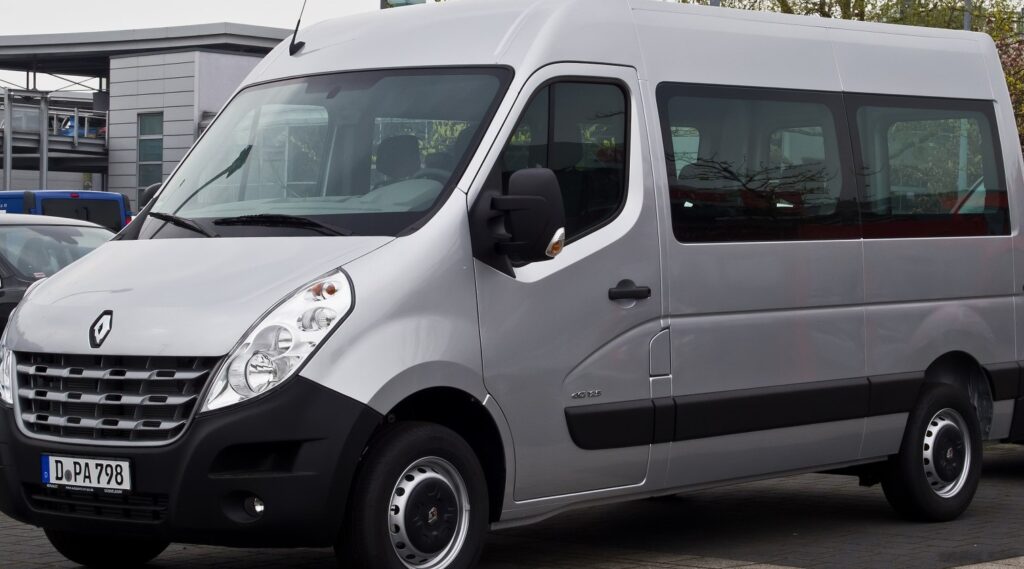
The Renault Master III (Phase II), specifically the 2.3 dCi 150 horsepower automatic variant introduced in 2014, represents a significant iteration of Renault’s large van offering. Positioned as a versatile crew van – offering seating for up to seven passengers – this version of the Master targeted businesses and tradespeople requiring both cargo space and passenger capacity. Produced from 2014 to 2017, it falls within the third generation of the Master (launched in 2010), benefitting from the Phase II facelift which included updated styling and improved efficiency. The L3H2 designation indicates a long wheelbase and high roof, maximizing interior volume. This particular configuration was primarily sold in European and international markets, offering a practical and robust solution for commercial transport needs.
Technical Specifications
| Brand | Renault |
| Model | Master |
| Generation | Master III (Phase II, 2014) Crew Van |
| Type (Engine) | 2.3 dCi (150 Hp) L3H2 Automatic |
| Start of production | 2014 |
| End of production | 2017 |
| Powertrain Architecture | Internal Combustion engine |
| Body type | Minivan, MPV |
| Seats | 7 |
| Doors | 4 |
| Fuel consumption (urban) | 8.5-8.8 l/100 km (27.7 – 26.7 US mpg) |
| Fuel consumption (extra urban) | 7.7-8.0 l/100 km (30.5 – 29.4 US mpg) |
| Fuel consumption (combined) | 8.0-8.3 l/100 km (29.4 – 28.3 US mpg) |
| CO2 emissions | 209-217 g/km |
| Fuel Type | Diesel |
| Emission standard | Euro 5 |
| Power | 150 Hp @ 3500 rpm |
| Torque | 350 Nm @ 1500 rpm (258.15 lb.-ft. @ 1500 rpm) |
| Engine Model/Code | M9T |
| Engine displacement | 2298 cm3 (140.23 cu. in.) |
| Number of cylinders | 4 |
| Engine configuration | Inline |
| Number of valves per cylinder | 4 |
| Fuel injection system | Diesel Commonrail |
| Engine aspiration | Turbocharger, Intercooler |
| Engine oil capacity | 8 l (8.45 US qt | 7.04 UK qt) |
| Coolant capacity | 11 l (11.62 US qt | 9.68 UK qt) |
| Max. weight | 3500 kg (7716.18 lbs.) |
| Trunk (boot) space – maximum | 9000 l (317.83 cu. ft.) |
| Fuel tank capacity | 105 l (27.74 US gal | 23.1 UK gal) |
| Length | 6198 mm (244.02 in.) |
| Width | 2070 mm (81.5 in.) |
| Width including mirrors | 2470 mm (97.24 in.) |
| Height | 2496 mm (98.27 in.) |
| Wheelbase | 4332 mm (170.55 in.) |
| Front track | 1750 mm (68.9 in.) |
| Rear track | 1730 mm (68.11 in.) |
| Front overhang | 842 mm (33.15 in.) |
| Rear overhang | 1024 mm (40.31 in.) |
| Ride height (ground clearance) | 174 mm (6.85 in.) |
| Drivetrain Architecture | Front wheel drive |
| Number of gears and type of gearbox | 6 gears, automatic transmission |
| Front suspension | Independent, type McPherson with coil spring and anti-roll bar |
| Rear suspension | Leaf spring |
| Front brakes | Ventilated discs, 302 mm |
| Rear brakes | Disc, 305 mm |
| Tires size | 225/65 R16 |
| Wheel rims size | 16 |
Powertrain & Engine Architecture
The heart of the Master III 2.3 dCi 150 is the M9T engine, a 2.3-liter inline four-cylinder diesel. This engine utilizes a common rail direct injection system, delivering fuel at extremely high pressure for optimized combustion. A turbocharger with an intercooler further enhances performance by forcing more air into the cylinders. The engine produces 150 horsepower at 3500 rpm and a substantial 350 Nm (258 lb-ft) of torque at a low 1500 rpm, making it well-suited for hauling and towing. The automatic transmission is a six-speed unit, designed to provide smooth shifts and efficient power delivery. While not known for being the sportiest transmission, it prioritizes usability and reduces driver fatigue, particularly in stop-and-go traffic. The M9T engine is known for its relatively robust construction, though it does incorporate a diesel particulate filter (DPF) to meet Euro 5 emissions standards, which can require periodic maintenance.
Driving Characteristics
The 150 hp automatic configuration of the Master III offers a balance between performance and economy. While not as quick as the higher-powered variants, it provides sufficient power for most commercial applications. The automatic transmission, while smooth, does slightly diminish the overall responsiveness compared to a manual gearbox. The gear ratios are tuned for maximizing fuel efficiency and providing adequate pulling power, rather than outright acceleration. In real-world conditions, the van feels capable when loaded, but drivers may notice the engine working harder on steep inclines. The front-wheel-drive layout provides predictable handling, but traction can be limited in slippery conditions when heavily loaded.
Equipment & Trim Levels
The Crew Van trim level of the Master III typically included features geared towards both practicality and driver comfort. Standard equipment generally included air conditioning, a driver’s airbag, electric windows, and a basic audio system. The seven-seat configuration featured a second row of seats, often with a folding arrangement to maximize cargo space when needed. Optional extras included features like a navigation system, rear parking sensors, cruise control, and upgraded upholstery. The dashboard layout is functional and straightforward, prioritizing ease of use over aesthetic flair. Interior materials are durable and designed to withstand the rigors of commercial use.
Chassis & Braking
The Master III utilizes a robust chassis designed to handle heavy loads. The front suspension employs an independent McPherson strut setup with coil springs and an anti-roll bar, providing a reasonable level of ride comfort. The rear suspension utilizes a leaf spring design, which is known for its durability and load-carrying capacity, though it can result in a firmer ride when unladen. Braking is handled by ventilated discs at the front and solid discs at the rear. The braking system is adequate for the vehicle’s weight, but drivers should allow for a longer stopping distance when fully loaded. The van rides on 16-inch steel wheels, typically fitted with 225/65 R16 tires.
Market Reception & Comparison
The Renault Master III 2.3 dCi 150 Automatic was generally well-received in the commercial vehicle market. Critics praised its spacious interior, practical features, and relatively fuel-efficient engine. Compared to the higher-powered 170 hp version, the 150 hp model offered a lower purchase price and slightly better fuel economy, making it an attractive option for businesses prioritizing cost-effectiveness. However, some reviewers noted that the automatic transmission could feel sluggish at times, and the ride quality was not as refined as some of its competitors. Compared to the 2.3 dCi manual versions, the automatic offered greater convenience, especially in urban environments.
Legacy
The Renault Master III, including the 2.3 dCi 150 Automatic variant, has proven to be a reliable and durable workhorse. The M9T engine, while not without its potential issues (particularly related to the DPF), is generally considered to be a robust unit when properly maintained. On the used car market, these vans remain relatively popular due to their practicality and affordability. Common maintenance concerns include DPF regeneration, turbocharger health, and wear and tear on suspension components. Overall, the Master III 2.3 dCi 150 Automatic represents a solid choice for businesses and individuals seeking a versatile and dependable large van.