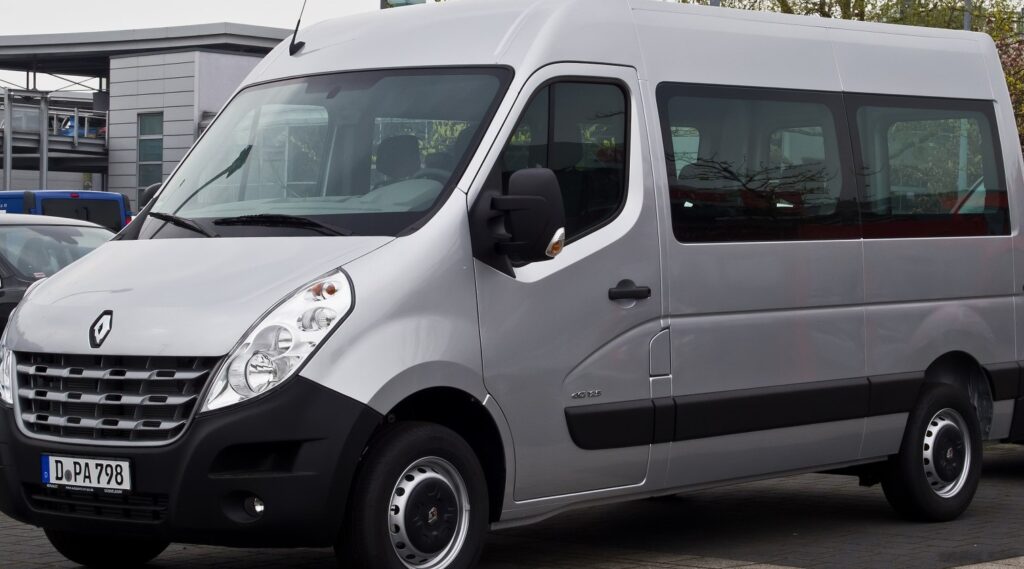
The Renault Master III (Phase II), specifically the 2.3 Energy dCi (170 hp) L3H2 Crew Van produced from 2017 to 2018, represents a significant iteration of Renault’s large van offering. Positioned as a versatile workhorse, this variant catered to businesses and tradespeople requiring substantial cargo space combined with passenger capacity. The “L3H2” designation indicates a long wheelbase and high roof, maximizing interior volume. This generation of the Master, built upon the X62 platform, aimed to balance practicality, efficiency, and driver comfort within the competitive European commercial vehicle market. It served as a direct competitor to vans like the Fiat Ducato, Mercedes-Benz Sprinter, and Ford Transit.
Technical Specifications
| Brand | Renault |
| Model | Master |
| Generation | Master III (Phase II, 2014) Crew Van |
| Type (Engine) | 2.3 Energy dCi (170 Hp) L3H2 |
| Start of production | 2017 |
| End of production | 2018 |
| Powertrain Architecture | Internal Combustion engine |
| Body type | Minivan, MPV |
| Seats | 7 |
| Doors | 4 |
| Fuel consumption (urban) | 7.6-7.7 l/100 km (30.9 – 30.5 US mpg) |
| Fuel consumption (extra urban) | 6.9-7.0 l/100 km (34.1 – 33.6 US mpg) |
| Fuel consumption (combined) | 7.2-7.3 l/100 km (32.7 – 32.2 US mpg) |
| CO2 emissions | 186 – 189 g/km |
| Fuel Type | Diesel |
| Emission standard | Euro 6 |
| Weight-to-power ratio | 13 kg/Hp, 76.9 Hp/tonne |
| Weight-to-torque ratio | 5.8 kg/Nm, 171.9 Nm/tonne |
| Power | 170 Hp @ 3500 rpm |
| Power per litre | 74 Hp/l |
| Torque | 380 Nm @ 1500 rpm (280.27 lb.-ft. @ 1500 rpm) |
| Engine Model/Code | M9T |
| Engine displacement | 2298 cm3 (140.23 cu. in.) |
| Number of cylinders | 4 |
| Engine configuration | Inline |
| Cylinder Bore | 85 mm (3.35 in.) |
| Piston Stroke | 101.3 mm (3.99 in.) |
| Number of valves per cylinder | 4 |
| Fuel injection system | Diesel Commonrail |
| Engine aspiration | Twin-Turbo, Intercooler |
| Engine oil capacity | 8 l (8.45 US qt | 7.04 UK qt) |
| Coolant | 11 l (11.62 US qt | 9.68 UK qt) |
| Kerb Weight | 2211 kg (4874.42 lbs.) |
| Max. weight | 3500 kg (7716.18 lbs.) |
| Max load | 1289 kg (2841.76 lbs.) |
| Trunk (boot) space – maximum | 9000 l (317.83 cu. ft.) |
| Fuel tank capacity | 105 l (27.74 US gal | 23.1 UK gal) |
| Length | 6198 mm (244.02 in.) |
| Width | 2070 mm (81.5 in.) |
| Width including mirrors | 2470 mm (97.24 in.) |
| Height | 2549 mm (100.35 in.) |
| Wheelbase | 4332 mm (170.55 in.) |
| Front track | 1750 mm (68.9 in.) |
| Rear (Back) track | 1730 mm (68.11 in.) |
| Front overhang | 842 mm (33.15 in.) |
| Rear overhang | 1024 mm (40.31 in.) |
| Ride height (ground clearance) | 172 mm (6.77 in.) |
| Minimum turning circle | 16.2 m (53.15 ft.) |
| Drivetrain Architecture | Front wheel drive |
| Number of gears | 6 |
| Gearbox type | Manual transmission |
| Front suspension | Independent, type McPherson with coil spring and anti-roll bar |
| Rear suspension | Leaf spring |
| Front brakes | Ventilated discs, 302×28 mm |
| Rear brakes | Disc, 305×12 mm |
| Tires size | 235/65 R16 |
| Wheel rims size | 16 |
Powertrain & Engine Architecture
The heart of the Master III 2.3 dCi (170 hp) is the M9T engine, a 2.3-liter inline four-cylinder diesel. This engine utilizes a sophisticated twin-turbocharger setup with an intercooler, designed to deliver a broad torque curve and improved responsiveness. The engine employs a Diesel Commonrail direct fuel injection system, ensuring precise fuel delivery and contributing to both performance and fuel efficiency. The 170 horsepower peak is achieved at 3500 rpm, while the substantial 380 Nm (280 lb-ft) of torque is available from just 1500 rpm, making it well-suited for hauling and towing. The six-speed manual transmission was the standard offering for this variant, providing a good balance between fuel economy and drivability. The engine also incorporated a Start & Stop system and a particulate filter to meet stringent Euro 6 emission standards.
Driving Characteristics
The 170 hp 2.3 dCi engine, paired with the six-speed manual transmission, provided a competent, if not exhilarating, driving experience. The emphasis was on usability and load-carrying capability rather than outright speed. The readily available torque meant that the van could comfortably handle fully loaded conditions without excessive gear changes. The gear ratios were optimized for both urban driving and highway cruising. Compared to lower-powered versions of the Master, this variant offered noticeably improved acceleration and hill-climbing ability. However, it didn’t possess the refinement or performance of some of its competitors with more powerful engines. The leaf spring rear suspension, while robust, could result in a somewhat firm ride when unladen.
Equipment & Trim Levels
The Crew Van configuration of the Master III L3H2 typically included seating for up to seven occupants, making it ideal for transporting work crews and their tools. Standard equipment included features like air conditioning, a radio with USB connectivity, electric windows, and central locking. Safety features such as ABS, ESP (Electronic Stability Program), and driver and passenger airbags were also standard. Optional extras included a navigation system, rear parking sensors, cruise control, and upgraded interior trim. The interior was generally functional and durable, prioritizing practicality over luxury. The dashboard layout was straightforward and easy to use, with clearly labeled controls.
Chassis & Braking
The Master III utilized a front-wheel-drive layout, contributing to a lower load floor and improved space utilization. The front suspension employed an independent McPherson strut design with coil springs and an anti-roll bar, providing a reasonable level of comfort and handling. The rear suspension featured a robust leaf spring setup, designed to handle heavy loads. The braking system consisted of ventilated discs on the front wheels (302x28mm) and solid discs on the rear wheels (305x12mm). The van rode on 16-inch steel wheels with 235/65 R16 tires.
Market Reception & Comparison
The Renault Master III 2.3 dCi (170 hp) L3H2 Crew Van was generally well-received by critics and operators alike. It was praised for its spacious interior, strong engine, and competitive pricing. Fuel economy was considered respectable for a vehicle of its size and weight, averaging around 32.7 mpg in combined driving. Compared to the lower-powered versions of the Master, the 170 hp variant offered a significant improvement in performance, making it a more suitable choice for those who frequently carry heavy loads or travel long distances. However, some reviewers noted that the ride quality could be improved, particularly when the van was unladen. Reliability was generally good, although some owners reported minor issues with the electronic systems.
Legacy
The Renault Master III, including the 2.3 Energy dCi (170 hp) variant, has proven to be a durable and reliable workhorse. On the used market, these vans continue to be popular choices for businesses and tradespeople seeking a cost-effective and practical solution for their transportation needs. The M9T engine, while not without its complexities, has generally proven to be robust when properly maintained. Regular servicing, including oil changes and filter replacements, is crucial for ensuring the long-term reliability of this powertrain. The availability of spare parts remains good, making maintenance relatively straightforward and affordable. The Master III remains a common sight on roads throughout Europe, a testament to its enduring appeal and practicality.